Weekend Write-Off

Scars as Beauty


“On the girl’s brown legs there were many small white scars. I was thinking, Do those cover the whole of you, like the stars and the moons on your dress? I thought that would be pretty too, and I ask you right here please to agree with me that a scar is never ugly. That is what the scar makers want us to think. But you and I, we must make an agreement to defy them. We must see all scars as beauty. Okay? This will be our secret. Because take it from me, a scar does not form on the dying. A scar means, I survived.

In a few breaths’ time I will speak some sad words to you. But you must hear them the same way we have agreed to see scars now. Sad words are just another beauty. A sad story means, this storyteller is alive. The next thing you know, something fine will happen to her, something marvelous, and then she will turn around and smile.”

– from Little Bee by Chris Cleave


Standard
Maternal Health Month, Maternal Health Month 2014, may is maternal mental health month, Weekend Write-Off

Sometimes My Mommy Gets Angry


The book begins like any other for children. A breakfast scene, a mother making pancakes for her daughter in a sun-filled kitchen. She helps her dress and tells her how “beautastic” she looks before sending her off to school with “a kiss and big smile.” But here, the mood shifts. Annie, the daughter, hopes that Mommy “is still smiling when [she] comes home” because “sometimes my mommy doesn’t smile at all.”

angryAnd it is no mistake that the tone and plot of the book changes with a shift in mood. Sometimes My Mommy Gets Angry by Bebe Moore Campbell is the story of a child living with a mother suffering from bipolar disorder.

Indeed, when Annie returns home from school that afternoon, it is not smiling Mommy that greets her. Her mother yells at her to stop making noise, to get in the house, to ignore the neighbor’s inquires about her school day. Then she turns on the neighbor, accusing him of always spying on her.

And apparently this isn’t the first time, for once Annie gets inside, she follows a well-scripted plan. She calls her grandmother. “Mommy is yelling again,” she says. After her grandmother assures her she’s done nothing wrong, she tells her to go to the neighbor’s house until she comes to get her if she feels scared. When Annie tells her she’s not scared talking to her, she is to get her “secret snack without bothering Mommy.” But most importantly, to “think happy thoughts.”

The next day dawns much differently than the first. The rain pours down rather than sun through the windows. Annie is left to fend for herself, eating cold cereal rather than hot pancakes. But her friends help her brush out the knots she missed in her hair. They joke and laugh on their walk to school despite the raindrops.

True to her grandmother’s directive, Annie does manage to think happy thoughts. She says, “Sometimes my mommy has dark clouds inside her. I can’t stop the rain from falling, but I can find sunshine in my mind.”

How do we, as parents, ensure our child finds the sunshine in her mind – even when we simply cannot? Whether it’s from bipolar or another mental illness, how do we shield our children from the worst of the disease without also blocking out our love for them? Annie’s grandmother emphasizes that her “mother loves you even when she’s yelling.” She even goes so far as to say, “It’s okay for you to be angry. I know you love her too.” How do we teach this give and take and encourage our child’s healthy feelings in response to our unhealthy ones?

An author’s note before the story, which also provides important information on bipolar disorder and other mental illnesses, states that “the ‘village’ that supports the children of the mentally ill – the grandparents, aunts, uncles, teachers and neighbors – can help foster within these fragile children a sense of security and hope that life can get better, and encourage self-esteem in the face of extremely trying situations.”

Is that how we parents support our children? By farming it out to the surrounding village when we can’t do it?

This book is directed toward the children of parents with mental illness. I’m looking at it through the lens of guilt and worry that comes from being a parent with mental illness. Perhaps I should take Grandma’s advice: have a healthy snack, look to the support of neighbors, and think happy thoughts. I feel terrible that my conditions keep me from being ‘the end all and be all’ for my children. But maybe I never was supposed to be anyway. Maybe it really does take a village.

At the very least, Sometimes My Mommy Gets Angry takes on the task of telling the story of one special little girl’s resilience in the face of great difficulty. And that’s a story a lot of kids out there really need to hear.


Standard
Maternal Health Month, Maternal Health Month 2014, may is maternal mental health month, Weekend Write-Off

Stranger than Fiction


You just can’t make this stuff up.


We’ve all heard people say this. We may have even heard some pretty good instances of the phenomenon. Read Kelly Kittel’s Breathe: A Memoir of Motherhood, Grief, and Family Conflict, however, and you’ll find perhaps the best exemplar of it ever.

Kittel’s story starts much like many other love stories: with the birth of a precious baby boy. We learn to know and love Noah, Kittel’s fourth child, right along with her. Amidst the love and adoration, though, there is an undercurrent of tension. Relations with extended family increasingly interfere with the Kittels’ close knit circle of immediate family, creating conditions ripe for catastrophe.

A tragic accident involving Noah is unfortunately and unbelievably only the first tragedy to befall Kelly and her family. In her quest for “an oversized house and a plastic car overflowing with round-headed pink and blue babies while [she] navigated [her] way through the Game of Life,” Kittel experienced miscarriages and an unnecessary stillbirth, unsupportive and argumentative family members.

Through personal anguish and legal battles, spiritual searches and encounters with nature, Kittel somehow arrives victorious on the other end, relishing each and every moment with her family of five living children and the spirit of those in heaven. Even with all its loss, Breathe is always – on every page, in every word – a life-affirming story.

I was fortunate enough to have read Breathe in its entirety before publication. Shortly after Kelly joined our writers’ group, she began sharing excerpts of her story, until we’d read, critiqued, and discussed the whole thing. We stroked the cover of her first proof when she passed it around the circle one night (it really is velvety soft!). We cheered her on upon its release on May 14, the birthday of her dear son, Jonah, his one and only day upon the earth.

Kelly Kittel wrote this story for those precious sons robbed of the oft-neglected privilege of breathing. But she also offers a poignant story of survival – her own. And in doing so, she most certainly will help countless mothers and women do the same.

Breathe-Cover


Standard
Spirituality, Weekend Write-Off

The Red Tree: A Child’s Story, A Depressive Tale, and an Allegory All in One

Imagine not wanting to get out of bed in the morning. Not because you stayed up too late or the air is too cold – but because “the day begins with nothing to look forward to.” Forcing yourself out of bed only makes “things go from bad to worse.” You maneuver through a world that “is a deaf machine”; where “darkness overcomes you” and “nobody understands”. Ironically, you are on the inside – locked there by regret – looking out at the “wonderful things [] passing you by.”

Now, imagine you are a child.

In Shaun Tan’s The Red Tree, a young girl is the one going through all these machinations, these miserable feelings. The book jacket summary lists them as “inexplicable feelings”, which though they are, will be immediately recognizable to anyone who has had them. The swirling, at times, surreal illustrations Tan has created to accompany his text add an otherworldly depth that show their meaning perhaps more than the words can. Upon repeated inspection, you find more and more layers of detail and meaning.

This could be a story of a child trying to find her place in the world, which certainly can be daunting itself. I, however, saw deeper evidence of despair. Perhaps my dark lens of depression is translating the clues to match my view, but Tan’s story seems very much to match the trajectory of depression. This book is an amazingly evocative, yet straightforward treatment of a condition that words often fail. It would be perfect for children who may be suffering – either themselves or through someone close to them – to understand what’s happening and that they are not alone. My depressed self sees utter value in that. My paranoid mother hen heart breaks at the thought of a child suffering this way, scared that my own brood may be subjected it. I would call this required reading for struggling adults and extremely-valuable-but-hope-you-never-have-use-it with children.

Still, there is a thread of hope at the end of the story, that doesn’t always come with depression. Just as “the day seems to end the way it began, [] suddenly there it is right in front of you bright and vivid quietly waiting just as you imagined it would be.” In the book, it is a red tree growing from the center of her room that makes the girl smile. I wanted to shake the book and say, “But what is it? Why can’t I find the solution so easily? Just make it appear?” That’s when I thought maybe I was approaching this as a downward motion rather than from the bottom up.

I leafed through the pages once more, searching for the flashes of red I’d only slightly registered the first time. As the girl awakens on the first page, a red leaf is mounted on the wall above her bed. While black leaves swirl around her, the red leaf follows her through every scene. At times, it lies forlornly on the ground or is buffeted by the wind, but it is always there. When she returns to the quiet reflection of her room at the end of the day, there is a small red sprout, which quickly grows in the beam of light shining through the door she opens.

Though I didn’t realize it until I had reached rock bottom, that red leaf of the Holy Spirit followed me around the whole time. It waited patiently for me to open the door so I could flourish in God’s light and love. So instead of some magic trick I hoped to perform, healing myself, I just had to open myself to the guidance and care that was there all along.

How perfect that this epiphany came in time for this Good Friday. Even when Christ was at his lowest, He called out to the Father. He suffered so that we may have peace. And just as importantly, God never abandoned Him through all his trials.

Now I just need to be open to God’s uplifting power rather than the downward pull of depression.

* All quotes from Tan, Shaun.  The Red Tree.  Vancouver: Simply Read Books, 2008.


Standard
Weekend Write-Off

Extra Yarn

“On a cold afternoon, in a cold little town, where everywhere you looked was either the white of snow or the black soot from chimneys, Annabelle found a box filled with yarn of every color.”

It was a seemingly endless box of yarn; no matter the number of sweaters or hats or cozies knit, there was always extra yarn.

Annabelle converted town bullies with her rainbow thread. She led her dog, Mars, around on a rainbow leash. She clothed her naysayers in a prism of perseverance and accomplishment.

image from School Library Journal

The very nature of the town began to change.

And she still had extra yarn.

News spread of Annabelle’s wondrous deeds and visitors came from far and wide. An archduke wanted, at any cost, to acquire “that miraculous box of yarn.” No matter the price, Annabelle declined. The archduke arranged to have it stolen, but once he returned home and opened the box, he saw that it was empty. Hurling the box into the sea, he shouted, “Little girl, I curse you with my family’s curse! You will never be happy again!”

The current carries the box back to the shore where Annabelle and Mars sit. And once Annabelle retrieves it, its magic power is once more ignited.

A box of extra yarn is available to all who want it. We need not seek it out in a secret nook of a far-flung fiber shop. We need not win a life lottery. We need not spend all our riches in acquiring it.

It is there for the taking – if we have the right combination of thoughts and attitudes to unlock it. It opens easily enough; it is how we view the contents that determines the wealth and abundance of them.

We need the wide-eyed optimism of a girl that, despite dreary surroundings, can still see wonder in the world. And doesn’t question the where and why for of happiness, but wraps herself in it like a cozy, hand-knit sweater.

Standard
Art, Identity, Writing

Six Degrees of Memoir

Six words.

Choose them carefully because that’s all you have to tell your life story.

Should be easy, right? Anyone can complete a story that’s only six words long.

But can it encapsulate an entire life? Can it fully relate the defining moment in someone’s life? With only six words, you have to precisely concise.

Or is it even possible to pin down a life in six words, several characters?

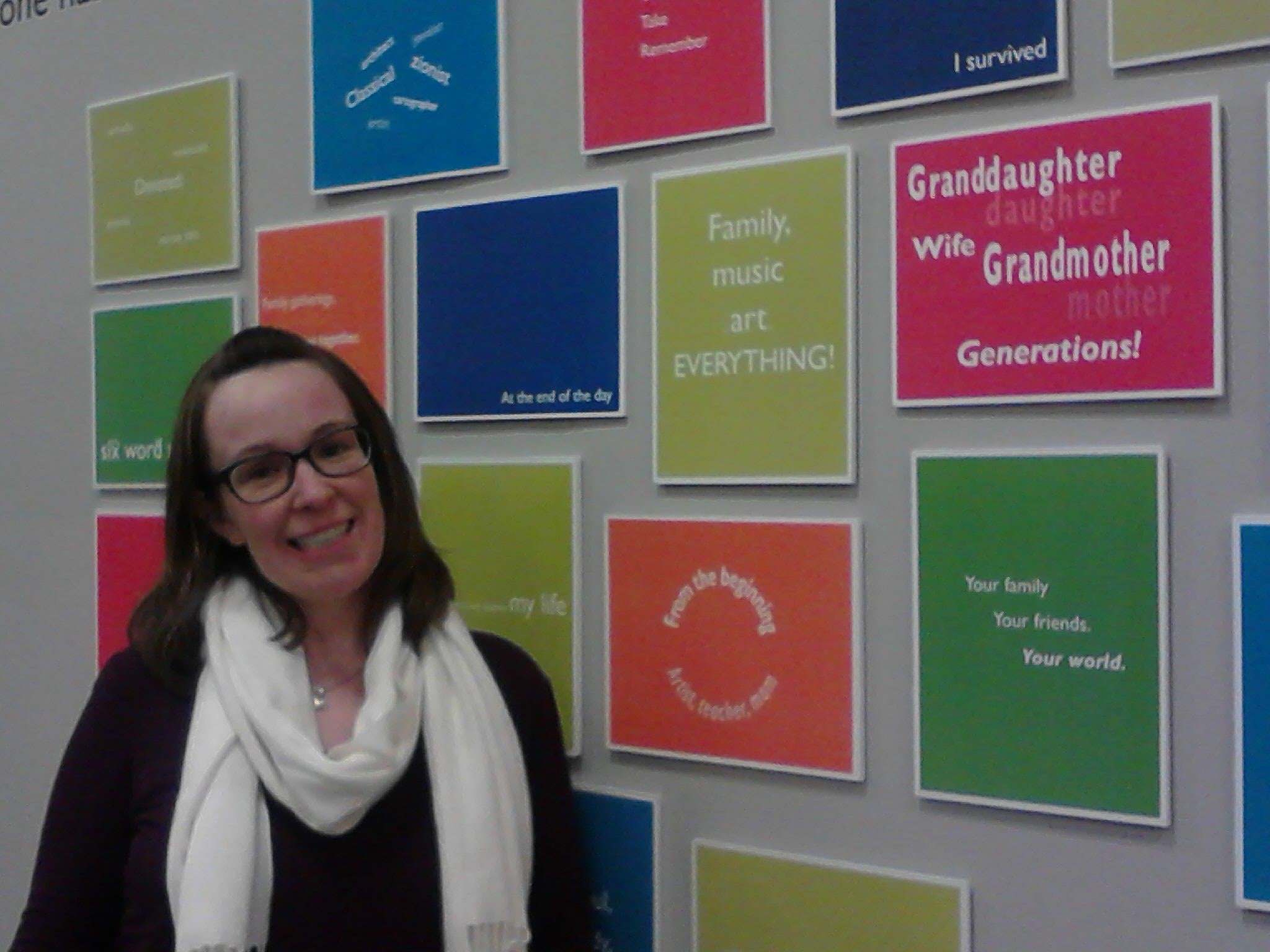
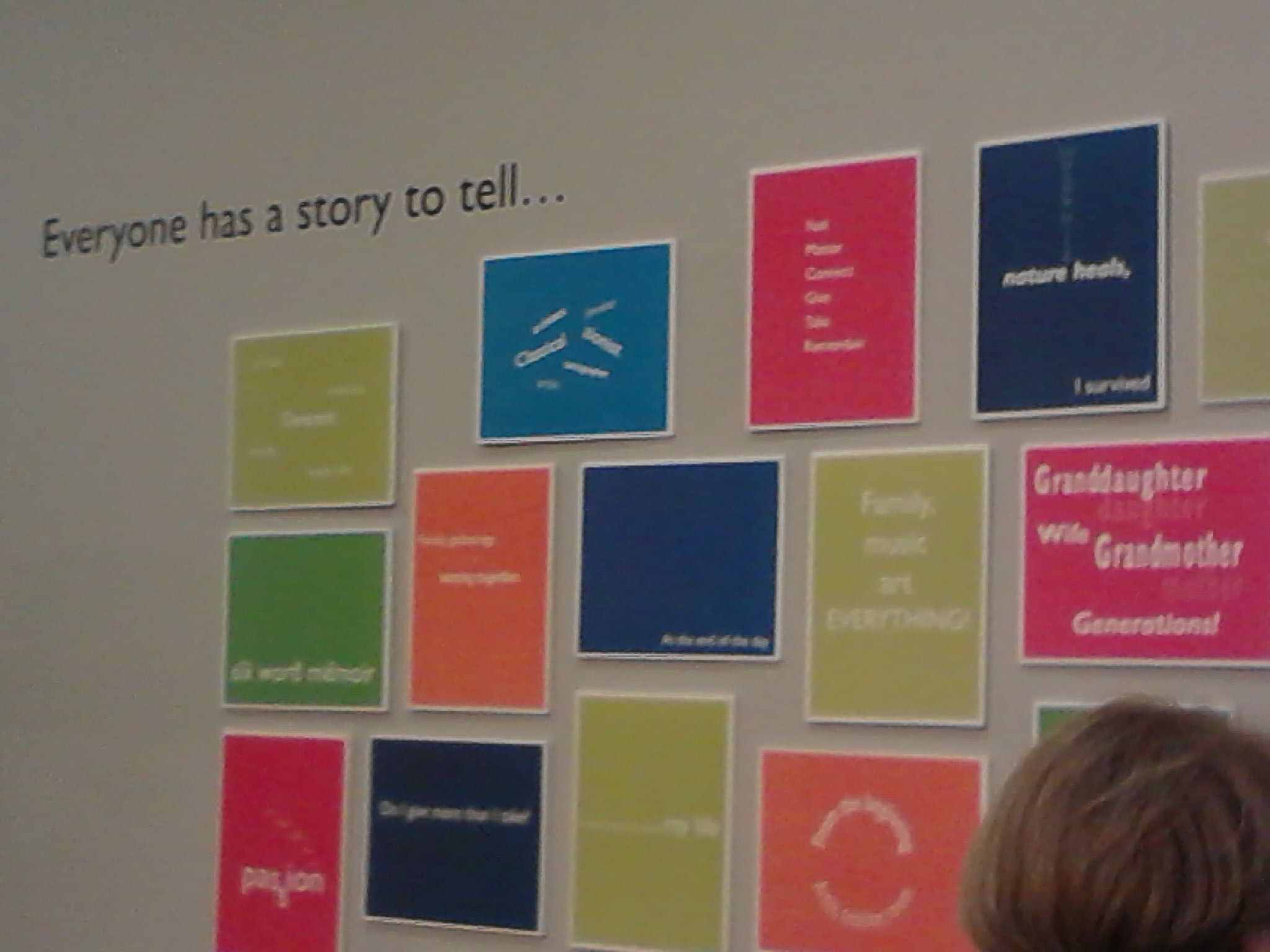
That was the conundrum I faced with ‘My Six Word Memoir’, a calling for and exhibition of this unique artistic narrative at the Jewish Alliance of Greater Rhode Island.

D by wall

A dear friend connected with the organization encouraged me to participate in the project, an offshoot of Larry Smith’s Six-Word Memoir challenge. The Jewish Alliance challenged the “community to rethink the notion of writer and memoir and offer a simple platform to share the short, sharp story of your life.”

everyone has The opening night of the exhibit, my friend and I circulated amongst  on-lookers and other writers. Some writers gave themselves away  with the click of a camera by their memoir. Others pointed theirs out  sheepishly when I commented on them. One of the organizers  admitted “[her] six words are always changing,” which segued nicely  into a conversation with another participant about the difficulty of choosing just one story. We discussed the distinction between a story and the story. Would bits and pieces of our lives represent it as fully or richly as an agoniziplace to tellngly selected six-word summary? Or more so? Someone had asked her whether her memoir was too simple. She’d countered with, ‘But is it?

Perspective is everything.

What seemed like a simple exercise in writing opened up many philosophical  and existential conversations – personally, as I sat at my keyboard, and  collectively, once I joined the audience at the art gallery. I realized that what  I put on my ‘canvas’ was not what others brought to it from their own  experiences. And what I read in theirs wasn’t necessarily what they  intended. Another case of artist vs. art critic. Writer vs. reader response.  Intent vs. interpretation.

Who can say that any one of the versions is wrong? Who can say that any one of us is finished writing the story of his or her life? It is the meditation and conversation that comes with that truly defines us.

mine

* A special thank you to the Jewish Alliance of Greater Rhode Island for offering this project and showcasing it in such a palatable way in Gallery (401).gallery 401

Standard
Art, Writing

Process of Procrastination

This is how I spent the better part of my afternoon yesterday.

Photo by Jennifer Butler Basile

Actually, it’s how I spent the better part of the last few years. Or should have.

If you are the one person who happens to notice the bottom corner of my blog, where I post which book is currently on my bedside table, you might have been wondering what the hell was taking me so long to read The Process of Sculpture by Anthony Padovano. I’ve actually been reading it longer than I’ve been advertising it.

This highly informative tome of the processes of sculpture was loaned to me by an artist generous of her time and talent – and trust. My aunt took me to meet her friend, Sarah Blair, years ago, at the origin point of the trajectory I’m still on to write the young adult novel of Dmitri, the seventeen year old who desires to eschew the family tradition of plastering for sculpture. This sculptor was the subject of my very first interview as an author. I felt so official, doing research, for my novel. She happily answered all my questions, showed me her work, and sent me out the door with a text she’d studied in art school.

I wonder if she knew how long it would be before her book came home?

The book sat, pregnant with possibility and inspiration, in my rolling writing office at my old house, and on the writing desk I’d graduated to after we moved. It held the scratching and scribblings of my interview notes and beginnings of detailed notes on its contents. It waited when I’d lost forward motion on the project. It taunted when I picked the project back up and had no excuse not to crack its cover. It inspired me with its epiphanies that could be applied to sculpture and life. It lulled me to sleep at night. It awoke new insights into Dmitri and his story.

After mining its surfeit of information, I blessedly, rejoicedly finished it!

And yet, I couldn’t take it off my bedside table. I had yet to transcribe the nuggets marked by myriad sticky tags, rippling their rainbow tongues at me from the edges of the pages. I should be moved on to the next book. I should be typing a new title into the little corner of my blog. Alas, I had unfinished business.

After days of putting off the seemingly tedious task of transcribing quotes and notes about the practical and procedural side of sculpture, I sat down and realized Anthony Padovano spoke about a lot more than just sculpture. He spoke of artistic process. He spoke of life philosophy. Of beauty. Of meaning. Of right and wrong. Of finding one’s voice and when and when not one should use it. Of how to use it.

Yes, he and Sarah Blair taught me what Dmitri needs to know as a sculptor, what I might find him doing on any day in his studio, but also about the artistic process all around me. Of the importance of art and the valuing of it, in our world. How it shapes and defines our lives.

The book’s rainbow tongues had transformed into technicolor teeth on my computer, as I filled the edges of the screen with each completed point. Light from the windows behind transfused even the opaque white parts of the tags with a brilliance. Soft, gentle, but brilliant. The sense of accomplishment I felt upon closing that book with a solid thunk was brilliant. A job well-done. Finally.

Now I can write my book, armed to the technicolor teeth with sculpturing knowledge and a better understanding of what makes Dmitri tick. I could, in theory, build an armature with materials from the hardware store and mix my own plaster with which to mold it into life. I definitely can return Sarah’s book to her in good conscience and thank her wholeheartedly for sharing the process and molding the shape of my book.

Standard
Weekend Write-Off, Writing

Polka Dot Penguin Pottery

It’s usually a good sign when the cover of a book on creativity is oriented so that it opens bottom to top rather than right to left. Once I opened the cover of Polka Dot Penguin Pottery by Lenore Look/illustrated by Yumi Heo, I kept waiting for the page where the text would shift to traditional format, but the entire book continues in this way. And what a testament to the creative process it is. And how refreshing that is addressed in a picture book for children.

Though it’s been floating around our house for awhile, I read it for the first time to my six year-old last week – a day or so after reigniting my love affair with writing my young adult novel. How fitting that I should find this story at that moment in time. The “author”, an eight-ten year old girl, introduces herself by her nom de plume, Aspen Colorado Kim Chee Lee, stating that she writes stories “about monkeys and elephants, aliens and robots, and sometimes, about me.” She goes on to elucidate the writer’s process in the way only a child can. I sniggered to myself that I could’ve used this book a few days previous; if only I’d had the secret to finishing a story!


Illustration by Yumi Heo; image from George Shannon 

Alas, even with this fail-proof plan, Aspen Colorado Kim Chee Lee falls prey to the dreaded writer’s block. Her grandparents suggest some ‘chill-out’ time and take her and her baby sister on an outing. On the way to Polka Dot Penguin Pottery, Aspen continues to make lyrical observations despite her writer’s block. “The wind lick[s her] nose and whistle[s] in [her] ears.” Once she enters the shop, [her] words are swirling around . . . and [she] cannot catch them.” A potent reminder of the fact that we are always writing – even when we walk, stare, converse, dead-head blooms in the garden – not just when we sit at the keyboard.

Unfortunately, the crippling malaise of writer’s block transfers to Aspen’s pottery painting project. Luther and Ivy, who sit nearby, tell her “you have to stay super-still and wait for something to happen.” The shop owner suggests she relax and have fun. When she makes a blotch on her ceramic egg by accident and thinks the project is ruined, her creativity soon blossoms because she realizes she has nothing to lose. “You can only make a masterpiece if you’re willing to make a mess,” says Ivy.

Taking risks and keeping at it are the true key to the creative process. Following your monkey mind even if – perhaps especially if – you don’t know where it’s leading.

“And this is the story that began with just hanging out,” Aspen finishes her narrative with.

All too often, I think writers, at least me, are crippled by the blank page or screen. I may have ideas zipping around my head like crazy, but once the word processor loads that blank screen, I feel a constricting band around my throat. Unless I can ‘not think’ like Aspen in this story. When she wasn’t looking for it, the story found her.


Some additional notes about this book:

  • While the format is landscape, find the spreads that have different views depending on which way you turn the book. For instance, the page where Aspen and her family walk the street; her family in relation to the words and the shops and other people on the street.
  • Search for whimsical details like the squirrel 🙂
  • Consider sharing this with other writers in your life – especially those who have trouble living the simple truth it conveys!
  • Expect to enjoy it perhaps more than your children. I don’t know if I love its value to children or the fact that it’s a kids’ book that introduces the concept of the creative process. I sometimes wonder if authors create some picture books with the adult who will be reading it aloud in mind. (Thank you!)
  • Another picture book I’ve come across addressing the creative process is Begin at the Beginning: A Little Artist Learns about Life by Amy Schwartz
  • It is not a coincidence if you find parallels between the creative process and life.  We could all adapt such useful lessons to our benefit.


Standard
Writing

I’m in Love – Again

You fall in love and you can’t get enough of your heart’s desire.  Every waking moment is spent thinking of, studying, obsessing over, and drinking in all that he or she is.  He or she loves every bit of you in return and all is right with the world where birds chirp and the sun shines everyday.

And then the shine wears off.

Suddenly, endearing quirks become irritating.  Spending so much time together becomes smothering.  Familiarity may eventually breed contempt, but at the very least it keeps you from recognizing what it was that made him or her special in the first place.  You can’t really even see the person at all.

Now before you think I’ve lost sight of our relationship, this is not about my husband and me.

This is about the cast of characters, particularly a young man named Dmitri, in my young adult novel.

I had sensed the growing frustration between us.  I tried doing things differently to liven up the doldrums into which we’d wandered.  I gave him space.  None of this worked.  In fact, the extra space felt surprisingly refreshing.  Too freeing.  I didn’t know if I’d ever want to return to the constraints of our relationship.  Though I didn’t know how to fix it, I always felt guilty when he came to mind because of our unresolved issues.

Then one day, I opened a book.  The voice on the page, the way the girl told her story reminded me of my Dmitri.  I thought, if only Dmitri could be freed like that to tell his story.  I opened my laptop and Dmitri spoke to me in ways he never had.

I’ve spent the last four days cavorting with him.  In a blissful sort of oblivion, we’ve reunited, he reaffirming all I ever loved about him.  I can’t catch my breath.  I’m positively vibrating with excitement.  When I’m forced to perform one of my daily obligations, I can’t wait until I can return to him.

So sorry I haven’t posted lately – I’ve been falling head over heels in love – again.

Standard
Awards, Writing

Go Sister, Soul Sister

You know that book they turned into a movie with the amazing America Ferrera?  The one with the group of girls who shared the magical pair of pants?  That would be really cool if that happened in real life, right?  A bond of friendship so strong it magically transforms your life and the size of those jeans.

Well, the magic of the interweb has gifted me with the blogging bond of Sherri Matthew‘s friendship and support.  And as if that were not enough, she’s nominated me for the Sisterhood of the World Bloggers Award.  Sadly, it does not come with a pair of magical blue jeans, but there are other perks.

Will these take me to Greece?

~ ~The Rules ~ ~

  1. Provide a link to and thank the blogger who nominated you for this award.
  2. Answer ten questions.
  3. Nominate 10-12 blogs that you find a joy to read.
  4. Provide links to these nominated blogs and kindly let the recipients know they have been nominated.
  5. Include the award logo within your blog post.

~ ~Ten questions to be answered ~ ~

  1. Your favorite color …. Purple (though I tend to wear a lot of blue)
  2. Your favorite animal … Black lab (though I’ve never owned one)
  3. Your favorite non-alcoholic drink … Cafe Mocha (I’m attempting to perfect it in house)
  4. Facebook or Twitter … Facebook (lots of kakking, but no tweeting)
  5. Your favorite pattern … Chevron, baby (for now)
  6. Do you prefer getting or giving presents?  Giving (though I wouldn’t mind a Frye boot donation 😉 )
  7. Your favorite number … Three (grew up in a family of three – Mom, Dad, me – and now have three.  How did that happen!?)
  8. Your favorite day of the week …One that I can stay in my pjs and read/write and no one rings the bell
  9. Your favorite flower … Hydrangea
  10. What is your passion? … Writing – and ice cream

~ ~ The Nominees ~ ~

There are quite a few blogs I love reading.   The ladies behind the ones I’ve listed below write pieces that make me feel as if they knew what I needed at that moment; that make me feel like I’m not the only one who’s having this, that, or another horrible feeling; that bring hope from isolation.  And quite frequently make me laugh my pants off. Through their reading and comments, they make me feel that my own words are not in vain.  So for those sisters I never knew I had and may have never even met, this one’s for you.

Kathy at Chasing Clever

Marlyn at Kintal 

Charlotte at momaste

Miss Fanny P at The Adventures of Fanny P

Ruby Tuesday at I Was Just Thinking 

Rachel at The Red Tent

Casi at Mama Cravings

Off Duty Mom

Natalie at Happy Cat 13

Megan at The War in My Brain

I invoke the song in the title because it’s got a funky beat you can dance to, but in no way am endorsing Lady Marmalade’s career choices 😉

Standard