Diana Pexels
Living, Poetry

Meditaciones Molestas

In the quiet left

by the whir of the dishwasher as it clicked off

The wind rose

to drown out the ticking of the clock

My limbs felt the weight

of the end of the luteal phase

My soul felt the sadness

of dreams deferred

My mind said

I need you to come here

and sit

and be still

I did not want to listen.

Standard
Ivan Negru
Weekend Write-Off, Writing

The Watermelon Seed

When I was pregnant with my second child and teaching English/Language Arts to twelve and thirteen year-olds, my belly grew in line with the progression of the kids’ knowledge and the school year. If they hadn’t figured it out at the start of the year, it soon became apparent.

One morning, a co-teacher came to me with a story about a shared student, very intelligent and matter-of-fact. She said that Paul had asked her in homeroom whether I was pregnant.

“I hope so, Paul. Either that or she swallowed a watermelon.”

With no hesitation whatsoever, he responded, “Well, I vote for the watermelon. Babies make a lot of noise.”

She turned what seemed to be an obvious question into a playful response; he turned it into a truthful commentary on raising kids.

Each summer when my young children would happily devour sweet cool watermelon, inevitably a black shiny seed would be ingested. Usually, they’d complain if they even spied one in their slice, but one always seemed to slip through. After repeated ignored attempts to explain their harmless nature, how they’ll only provide some fiber … I finally just responded with, “Uh oh, looks like a watermelon is going to grow in your belly.” After the shocked look of disbelief, I’d follow up with, “Yup, it’s going to sprout right out of your belly button.”

And that’s just what happens to the crocodile in Greg Pizzoli’s picture book, The Watermelon Seed!

On the first several pages, he pontificates on his love for the fruit:

I like it for breakfast.

I like it for lunch.

I like a big salty slab for dinner . . .

and I LOVE it for dessert!

But then the unthinkable happens – with a page as dark as the seed itself.

Crocodile is worried the vines will come out his ears rather than his belly button, but the look on his face is the same as my girls’ always was.

It ends up being only a close call for Crocodile and he is not scared straight from his obsession with watermelon. Neither have seeds kept my girls away from watermelon in the long run.

The Watermelon Seed is a funny, playful, relatable book for kids. Emergent and early readers will be able to access the language on their own, but toddlers, preschoolers, and early elementary will love the hilarity of it in a read-aloud. Even older children and students will be able to appreciate Crocodile’s conundrum and it can offer a bridge to childhood memories for discussion or narrative writing. Pizzoli’s illustration adds to the comedy with some pretty epic facial expressions from Crocodile. The graphic shapes and block letters as well as use of color give the entire story an accessible and universal feel.

Just as it did for me, The Watermelon Seed may conjure funny and happy stories – at the very least, sweet summer memories of chomping watermelon.

Standard
Weekend Write-Off

Lost in NYC

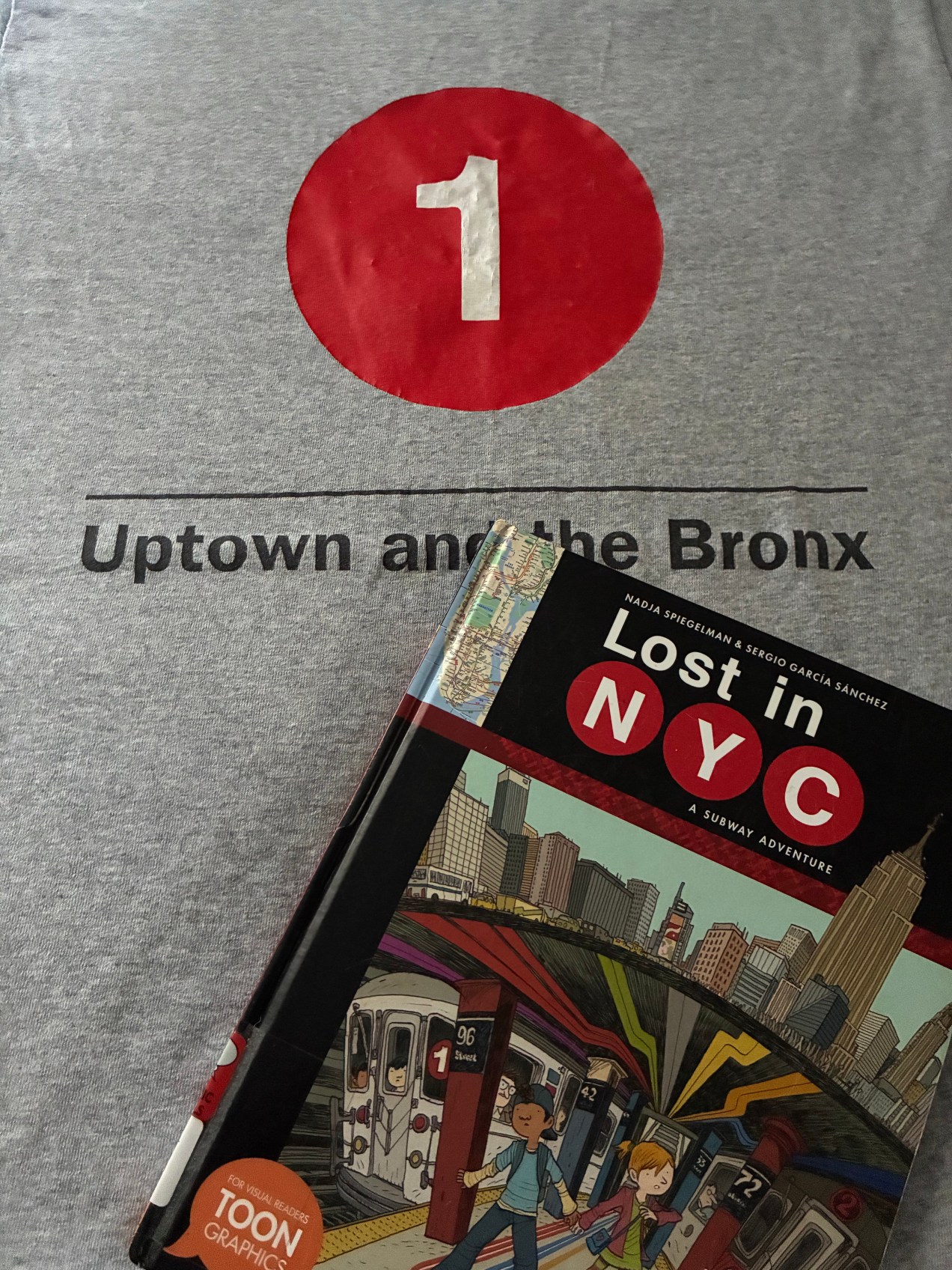
I have a shirt with a bright red circle surrounding a big number one on the front.

Whenever I wear it, people (very often my dad) ask what I’m number one in.

I joke that I got it that summer I lived in New York so I would remember which subway line to take home.

But the truth is that I loved the MTA system so much. It, like the grid New York’s streets are laid out on, was so logistical and straightforward. It didn’t hurt that my lines, the 1 and the 9, were a straight shot up to the Bronx where I was staying.

I also fell for its graphic design. Bold primary colors, crisp black lines, and solid shapes.

Not only did I buy the shirt, but when I discovered that the transit authority holds a surplus sale each year, I signed up for the newsletter to be apprised of all events. I have yet to acquire a slab of subway station or signage, but there is the dream.

So when I accompanied my ten year-old to the graphic novel section of our library, Lost in NYC: A Subway Adventure leapt right off the shelf.

With story by Nadja Spiegelman and art by Sergio Garcia Sanchez (colored by Lola Moral), Lost in NYC details a beginner’s day on the MTA through the eyes of a child. Pablo, and his new friend Alicia, do some quick thinking on their feet when they are separated from their class field trip. Soon, they are even separated from each other, leaving Alicia, while a native New Yorker, to navigate independently for the first time.

Before the class leaves the school, their teacher gives a brief history of the city’s subway system, using the bedrock the Empire State Building (and their destination) is anchored in as a segue to its underground workings. The readers learn about express and local trains when Alicia and Pablo mistakenly hop the one opposite the class. We learn about different routes and exchanges as they separately make their way back to rendesvous with the class.

The subway adventure, while exciting on its own, is also a frame for another story within. While Pablo learns the transportation system of his new city, with Alicia’s help, he is learning how to trust and accept friendship and belonging in a new place. A seemingly small interaction with his parents on the sidewalk in front of the school in the morning, where he brushes off their hugs and help, sets the stage for his own acclimation to his new home, even if he was brought there by his parents. He relies on himself, bringing in help from Alicia and an adult he asks for assistance.

This graphic novel would be a fabulous read for someone visiting the city for the first time or readers who love big cities, transportation, trains, and/or maps. I would make it required reading before taking my own kids into the city – even the big ones. Several pages at the back of the book offer historical photos and facts about the creation of the subway system and the inner workings of the Empire State Building. I learned things after already visiting both. Setting and cities aside, this graphic novel is also a good read for children facing or acclimating to a move and making new friends.

A quintessential part of any New York experience, the New York City MTA is the perfect setting to paint a picture of life there. Given that it is presented in a graphic format is all the more fitting.


Standard
RTsocial Pixabay
grief

One Year Gone

Two weeks ago was a week. But then, the days leading up to it and these weeks since have also been something.

That something is grief.

I’ve learned a thing or two about it over the last year or so. But apparently its knowledge base is as wide as its pit of despair is.

The day before the one-year anniversary of my father’s death, as my mother and I stood facing the stove top waiting for our two cups of tea to steep, I admitted that as much as it was on my mind and I wanted to mark his life, I’d been dreading the one-year mark. Because as much as I’ve been taught to dread ‘a year of firsts without your person’, I was also able to look back at this time a year ago when he was with us. And now that seal has been broken, his existence wiped off this calendar page.

As if that isn’t bad enough, after a year, that dreaded ‘year of firsts’, I feared that people wouldn’t think about it anymore or my person or my grief. Not like I do anyway. And as much as I hated the checking in and the questioning, its anticipated absence makes his all the more real.

Like a true stupid human, I’m trying to attach a timeline to something that stretches through all of space and time.

And apparently my body knows that.

After my mother and I drank our tea and went to a lovely remembrance mass in my father’s honor, I got upset over the stupidest things, completely unrelated to my father’s passing. I guess I’d reached the limits of my emotional bandwidth. Then I got exhausted. Like fall asleep on the couch at random times and go to bed early exhausted. I had no choice but to go to bed one evening when I couldn’t hold my head up the pain in my neck was so bad.

I thought I was done with it by the end of that week and attempted to resume normal functioning.

By the end of the next, one of the kids shared kisses and a cold, which at times left me shivering and twitchy, which I thought was weird since I didn’t have a fever. A few days later, the same stop-everything-and-close-your-eyes neck pain came back. Lying in bed with my pillow over my legs so my spine could lay flat, I felt that same twitching as I stared at the ceiling and prayed for sleep.

The next day I tried one of the stretches my daughter had DM’d to me the last time my next was hurting. Then I moved to the foam roller. And I sobbed on the living room floor.

Not enough to let it all out. Not even a full release for that day. But for a few hours, my head felt lighter, I didn’t twitch at every movement.

As the afternoon went on and the soreness set in, I tried to guzzle water as instructed after a deep massage.

I still haven’t read van der Kolk’s The Body Keeps the Score though it’s been on my list for awhile. I’ve already learned part of its lesson with tension and holding and release in my own yoga practice. But this tightness in my neck has driven home the point more than anything ever has.

The only good thing about it (said ruefully with an ironic smirk) is that its presence stretching beyond the one-year mark seems to make my previous comments moot.

But then, I knew missing my father was for the long haul.

Standard
jplenio Pixabay
Depression

Steeling Myself

Somewhere in the season before COVID

Days cold and damp, earth air and sky the color of faded cement

I drove that road endlessly.

Parallel to the train tracks, steely cars the same color as all else but with a glossy sheen.

Ironically not what made me take a shine to them.

It was their forward motion

the promise of speeding me away

to some other day

destination

away from the depression I couldn’t outrun.

I felt like I was forever on that road.

Sad when the train didn’t rush past; sadder still when it did.

Now in this change of seasons, the red-winged blackbirds replaced by pops of red leaves,

the gray clouds are descending

but the swoosh of the train surprised me yesterday.

I noted its passing and didn’t feel the urge to run.

Standard
17th century ship Vasa Stockholm Sweden
grief

Photos and a Good Layer of Guilt

I posted exactly one photo from a once-in-a-lifetime trip I took last September.

My dear friend whisked me away to Sweden, Stockholm specifically, and we had a fabulous time.

So much about our trip was aesthetic and Scandi and Instagram-worthy.

But the only photo I shared was one on the last full day of our trip, which happened to be my father’s last day on earth.

And while I subjected my husband and girls to a screen-cast slideshow squeezed on our couch when I was back stateside, the photos sat largely untouched for the last year.

Now I’ve been known to live in an entirely different timeline in scrap-landia. According to our family scrapbook, it is circa 2012.

But this was somehow different.

Somehow, and largely subconsciously, I’d covered those photos in a layer of guilt.

Guilt at not being by his bedside, guilt at not being there for my mother, guilt at not being there when he breathed his last.

Guilt at enjoying this life-expanding event while an equally heartbreaking one was occurring.

When the one-year anniversary of both came round, I wanted to honor both – but it still felt like throwing celebration in the face of sadness.

When I finally sorted through the hundreds of photos this week, it didn’t occur to me until I discussed it with my therapist the next day, that the process was actually part of grieving my father. I had been thinking of him all that week already. He had been with me in so many spiritual and even metaphysical ways. And while our trip had been planned well before he even fell ill, God had chosen his final time even sooner than that.

I didn’t choose to not be with my father. He would’ve chosen to savor each and every moment with me had I been able to come home and tell them all to him.

In so many synchronistic ways, we sailed together that week.

And what is grief – and life – but beauty and pain together.

Photo Info

17th-century warship Vasa at the Vasa Museum located on the island of Djurgården in Stockholm, Jennifer Butler Basile, September 21, 2025

Standard
Clement Proust Pexels
Weekend Write-Off, Writing

Independence as a Young Mother

“Discovering that you craved independence when you were a young mother was about as convenient and feasible as shooting a man in cold blood and then deciding you didn’t feel like being a murderer after all.”

MAINE, J. Courtney Sullivan
Standard
Caleb Oquendo Pexels
grief

The Playlist

With my father’s first visits to the oncologist, so started my early morning drives to meet my parents at the office.

I’d rouse the older ones to let them know the younger one was already awake downstairs and had had breakfast and head out on my own. A forty-five minute ride of silence became full with plenty of thoughts, questions, and worries.

But the agency of getting there at a certain time and meeting with/talking to the doctor, collecting information for my parents, being a second set of ears, a sounding board, a buffer, was an outlet for the enormity of what ifs and kicked the certainty of what we all dreaded into some indeterminate future.

When it became clear that he did, in fact, have cancer (one of the worst general zeitgeist told me you could get), my mind morphed to getting him through treatment, supporting him and making it as . . . enjoyable . . . as possible? or at least less horrific. The musical soundtracks of my sunshine drenched drives, soon to be snuffed out by ice cold air conditioning, inspired a growing playlist I was mentally making for my dad.

First, I pictured it as tunes meant to soothe and relax him as he sat through chemotherapy or radiation or whatever they would pump into him as he sat tethered to a chair. Then, when it was clear those weren’t options, I pictured the sonic waves surrounding him at home as he peacefully rested. When he slipped away faster than any of us could have imagined, a goal in that frenzied week between his passing and services was to finish that damned list so at least we could all listen to the kind of songs he loved as we celebrated his life. His spirit could still reverberate around us even if his presence didn’t.

A year ago this week, he lay on his death bed. And though it’s lived in my memory and mind’s eye and ears and in bits and pieces on the notes app of my phone, I built the playlist I never played for my father today. As I listened to each song before I hit the plus sign adding it to the list, I felt the moods and melodies envelop me, raise me up, raise that terribly beautiful feeling of love and anguish, holding me up and threatening to drop me from a great height like all of the delicately heartbreaking hymns of sacred masses.

And it pained me to think that he would’ve loved all these songs – if I’d only been able to share the carefully curated list I’d made for him.

And then I wondered if it was really all more for me all along.

Standard
Francois Ayello Pexels
Living, Poetry

I do not want the hummingbirds to leave

I do not want the hummingbirds to leave

I do not want the sun to dip below the rim of trees

I do not want to hear the news reports tomorrow

or feel the guilt of joy on my birthday the day after

I feel as if there are never enough Septembers

Because I never get the care of self or relaxation right

in this month meant to celebrate

and yet it’s now conflated with the death of dad

and the ever-present dread of school

Both of those conflated with fear of fulfillment and failure


I do not want the hummingbirds to leave

and yet I fret about the singular one who seems to hang on

Does she not know it is time to get moving?

September only lasts so long

Standard
Alfredo Marco Pradil Pexels
Weekend Write-Off

Guest for a Lifetime

"You have to understand," she said.  "Grief lasts forever."

"Like death," I said.

"Like death. Except death is someone else's condition, and grief is all yours."

"I feel worse now than I did shortly after she died."

"And you'll feel even worse next year. And worse the year after that, unless you find a way to
transform your grief."

"We're back to that."

"We've never left it," she said. "Grief comes to you all at once, so you think it will be over all at
once. But it is your guest for a lifetime."

"How should I treat this gift? This unwelcome, uninvited guest."

"Think of the one who sent it to you," she said.


The above excerpt is from a conversation Roger Rosenblatt shared in Kayak Morning: Reflections on Love, Grief, and Small Boats. See my post, Beside Myself, for my thoughts inspired by reading this memoir.

Standard