Children, Literacy, parenting, Weekend Write-Off, Writing

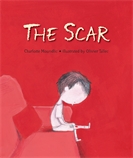
The Scar

The title drew me in.

The way the red background swallowed the illustration of the small boy on the cover.

I was in tears by the time I was partway through the book.

0763653411.med

The Scar, by Charlotte Moundlic, is the story of a young boy preparing for, experiencing, and ultimately surviving the death of his mother.

This leaves a metaphorical and literal scar on him.  When he falls and scrapes his knee after his mother’s death, he remembers how she used to soothe him.  When the scrape starts to heal before he does, the boy keeps scraping at it to keep the comfort of his mother alive.

It was around this point that I really started crying.

Death, loss, self-mutilation – what kind of children’s book was this?

For the child who’s lost a parent, exactly the kind that needs to be written.

There’s no shielding those children from the pain, the hurt, the ugly truth.  They live the nightmare.

I was reminded of a man in a writer’s intensive that I took who told the story of student with special needs who found nearly every task throughout his day difficult.  He wanted students like him to read a story about them.  Even though it might be a difficult story to tell, a difficult story to read, there were children who needed a narrative to which they could relate, a way to know they weren’t the only ones to have experienced this.  They were not alone in the universe.  Maybe there were even people who overcame their difficult obstacle.

And while extremely poignant and slightly heartbreaking, The Scar does end on a positive note.  The boy, though always sure to miss his mother, allows the scar to begin to heal.

So what on the surface once seemed revolting, is now something we can look at without cringing – and, for some children, is absolutely essential.

Standard
anxiety, Living, medication

Dosage

A split pill in a shot glass every other night


imagesSwinging open the cabinet door,

tired on the nights it’s empty,

still annoyed on the night’s it’s not.


A twitch, a shake, tension.


A task, another tired tendril pulling me down.


I’d stop if I could.

It’d be worse if I did.


What’s worse –

The ailment or the cure?


An oblong blue missile and its snapped companion.

One and a half ovals.


Tiny pale packages with the ability to contain my fears.

And yet, they dissolve and disperse throughout my body.


Is the volume the same – just not in a concentrated form?

Standard
Children, motherhood, parenting

School Shopping

Ah, the joys of school shopping.  I was exhausted by the time we got home and I hadn’t even tried anything on.

I remember marathon days of deciding an entire school year’s worth of wardrobe in one hot, sticky summer day, the feeling of peeling off shorts and pulling on long pants in a cramped dressing room so unnatural.  And forget if you tried to find a winter jacket, the smooth silky lining of the sleeves so cold against your short-sleeved arms.

Yesterday wasn’t one of those marathon days.  My mother had wanted to buy each of my girls a back-to-school outfit.  I was merely the consultant and chauffeur who scoured the sale racks for basics while the girls tried on clothes.  I would share with you the details of my extreme couponing, which I am so stoked about, but that is not relevant at this time.

Once I’d discovered there was nary an item to be had under $3.99, I would wander from rack to rack looking at the cute patterns and prints of fall ’13.  There were a few revolting numbers with lace and sequins that gave me flashbacks of Madonna’s ‘Like a Virgin’ video.  There were some shiny jeans that looked vaguely like hot pants.  There were some open weave sweaters a little too sheer for my mother-of-grammar-school-aged-children liking.  Maybe I’m just paranoid for the teenage years and want to set the no-sheer standard now.  But there were a lot of fashion forward clothes that were modest and something I’d be comfortable letting my kids wear.

images

That said, there were a lot of clothes, that if they were in my size, I’d wear.

A disclaimer. I hate kids’ clothes that make them into mini-me’s.  I find it creepy in a Toddlers and Tiaras sort of way.  I feel that kids should be kids, allowed to be and/or kept innocent, modest, and cute for as long as possible.

But I was jealous as I roamed the racks.  I wanted to buy some of those outfits in my size.  I found myself taking cues from the fashion trends I was seeing in the kids’ section.

This depressed me in two ways.

One, it reiterated mass media/marketing’s pull on our children to grow up too quickly.  Pop culture, fashion trends, merchandising drive our children’s ideas of what’s cool and how to be.  A dwarf fashion plate at age eight stalking the cat walk.

Two, with limited funds and the fact that my children actually have a place to go each day, their wardrobe wins out over mine.  They will be better dressed than I will this fall.

I do feel comfortable with everything we bought the girls on this back-to-school shopping excursion.  They will be both fashion-forward and appropriate, cute and trendy.

The colorful birds on skinny jeans will continue to fly through my imagination, while combinations of coral and navy dance through my head.  At least I seem to have kept my girls as girls for one more year.

Image from Tobi Fairley

Image from Tobi Fairley

Standard
Children, Literacy, Weekend Write-Off, Writing

An Unexpected Beaver

A dancing dragon and a firefly met on a moonlit night.  They began to talk and play when suddenly out popped a beaver.  They jumped, then laughed and laughed.  Their unexpected visitor added fun and excitement to their meeting.images


The above scene transpired in the puppet theatre at the library yesterday.  My three year-old, in the guise of the beaver, taught me an important lesson about humor in story.

While the dancing dragon and firefly were compelling enough in their budding friendship and moonlight dance, the beaver’s unexpected entrance added another layer of depth that hadn’t been there.

Even the dragon and firefly, as played by her sisters, laughed – not just me in the audience.

It is the unexpected or turning of conventions on their heads that makes the best humor.  It also makes for fresh, unpredictable plots.

Novel, indeed.

Standard
Children, Humor, motherhood, parenting

Yoga with Kids

By adhering to the following prerequisites, you too can have a complete yogic experience with your children.


image from NPR

image from NPR

  • Start by choosing your mat.  When your children see you roll out yours, they will immediately clamor for one of the remaining mats (tip: be sure to have only one of each color and one less than the number of children).
  • Place yours in an open area, free from obstacles and other people.  Your children will fill in the void.
  • Set your yoga strap at your side, easily accessible during your practice.  Your children will be able to grasp it easily as well to whip each other.
  • Don’t forget yoga blocks – in case you need extra support during a stretch.  Or a teething ring or projectile.
  • Clear your mind.  Your children will ping around like ping-pong balls no matter what venomous thoughts you entertain.
  • Lie in repose.  Ignore that fact that a toddler’s thick skull could sucker punch you in the gut at any moment.
  • Oh, and be sure to slide your sandals off before lying down, but keep them close by.  Your particularly feisty child may need a missile to launch at you for not arranging her not-right-color mat properly.
  • Range through the poses at your own pace – not that of your instructor.  You need to adjust for puppies crawling through your downward dog, snakes wriggling under your bridge, monkeys hanging onto your tree.
  • Accept your body as it is.  Don’t force the sore muscles of your shoulder or your tight hamstrings.  Your children will do that when they knock into you, sending your warrior tumbling.
  • Move your yoga practice outside for inspiration and variety.  Tell your children they may play nearby if they tire of yoga.  They will tire of yoga, but will stay right by your side, taunting and pleading for snacks and your attention.
  • Scan your body for areas of tension.  Notice the up-tick in your blood pressure as your children attempt acrobatics off the couch onto the yoga mats.
  • Do not abandon your practice before it is finished.  You came here to find inner peace and relax, dammit.
Standard
Living, motherhood

What I’ve Learned in a Week

The selection of cheese at Wal-Mart is appalling. images-2

Wal-Mart has apparently been accepted into more than just our vernacular as spell check just corrected me with hyphen placement.

We look like tyrannosaurus rex when we walk along the road texting with our little tiny arms.

My nearly four year-old is a yes-woman, flashing her smile at all the right times to attempt an early release from time-out.

My six year-old is perfecting well-aimed barbs in an attempt to make the world run her way.

My eight year-old is stuck between an attitudinous pre-teen limbo and a cuddly, sweet girl.

I’m taking the life of my already tenuous midsection into my own hands when I dare lie in savasana with a three year-old lurking.images-1

Namaste is not in a three, six, or eight year-olds vocabulary – at least not in its proper use.

It is near impossible to find board shorts with an inner liner.

Aloe is a wonder ‘drug’.

Fall is coming.  I can feel it in my bare shoulder peeking out from under the quilt in the morning.

You can still go to the playground in the rain if you stay under the trees or in the big wooden ark.

Whole-wheat o’s covered in honey are like crack to the playground set.

The amount of times I’ve been told to ‘not get old’, apparently it’s not advised.

Even if a story is wholly written in your head, it’s still not easy to get it down on paper.

Those plants with the pointy seedpods in my garden are butterfly weed. images

Firefly larva eat slugs, hunting them by their slime trail.

Even though I hate slugs, I still find that fact revolting.

A week, while packed with infinite moments, goes by in an infinitesimal flash.

Standard
anxiety, Living

A Beast by Any Other Name

Is it better to know what ails me?

The malady and its moniker?


To know the reasons for things, for ways of being


To understand, anticipate, cope


Or does knowing give doom the upper hand?

Roll the boulder to the lip of the precipice?


Does it give power to what once may have been a bad mood, an off day, a stressful cycle?


Does it feed the beast –

and destroy the hope that there is an other side to this, an end and new beginning?


A beast that walks in the shadow of that boulder, goading me on . . .

Standard
anxiety, Living, Spirituality

The Moment

I’ve been trying.

I’ve set aside novels (temporarily) for the beautifully poetic spiritual tome I was too young to read the first time around.

I’ve felt the wideness of my collarbones and my elbows hanging directly below my shoulders.  I felt my head float above my neck and my thoughts detach.

I’ve felt the taut string of the universe pulling me forward, rushing past the green leaves of trees, toward the white billowy clouds against the brilliant blue sky.

I’ve heard the hypnotic rhythm of the acoustic guitar goading me on.

I’ve tried to speak new words rather than the tired routine trod into my brain.

I'm trying to embrace my monkey mind

I’m trying to embrace my monkey mind

I feel the vacillation.

Between the old and new, the positive and the negative, the healthy and the easy monotony.

It always seems to be one or the other.  Never both.  Never a balance.

Or maybe it is both at the same time.

Maybe it is everything all at once and I can’t be one thing at one time and something different at another.

The older you get, the more you carry with you.

It’s a special moment when you can set it all down and float freely through the universe – if only for a moment.

Standard
anxiety, Living

Weeds

The mosquitoes actually held off long enough the other night for me to do some weeding in our vegetable garden.  In that time shortly before the gloaming, when the heat of the day was finally fading as the sun dipped between the trees and the wind rose up to fill its space, I loosened the earth all around my feet, gently extricating snap pea tendrils from crab grass claws.  There were weeds with plump, red stalks that looked like they would ooze moisture if I snapped them.  There were delicate rounded leaves with lacy white flowers.  They were under and around and throughout – an integral part of my garden – perhaps more numerous than the plants that were supposed to be there.

At times, I had to stand back and survey the leafy patch below me.  Bent over in the worst possible posture for my back, it was hard to distinguish the plants from the weeds.  At eye level, all the leaves blended into one range of green.  It was hard to tell where the clover ended and the pea leaves began.  The heart-shaped leaves of the green beans melded with tall stalks of pointed leaves.  There were even imposter marigolds with tiny yellow buds.

It almost scares me, the uncanny ability of nature to so closely mimic ‘actual’ plants with its weeds and then to germinate them right next to the others so they have the best possible chance at survival by blending.  Think about it, the first weeds a gardener pulls – even if it’s in the five-second walk to her driveway – is the tall spindly one sticking out like a sore thumb.  These others are stealth, imposters of the best kind – or most insidious depending on whose side one takes.

It’s no wonder, then, that I have a hard time distinguishing my bad habits from productive practices; destructive behaviors from healthy ways of being.  The roots of the less desirable plants of my life are invasive, wrapping themselves around my more likeable attributes and behaviors, making themselves almost impossible to extricate – or at least harder to distinguish or even notice.  Without stepping back to take stock, my life is one solid plane of green, weeds and all; the different shades and shapes indistinguishable.

Making the rounds at our local farmers’ market, I stopped to talk with a woman who had woven some beautiful baskets (who also happens to know a thing or two about gardening; she harvests worms for composting).  One skinny, oblong one with a graceful arch of a handle caught my daughter’s eye.  The woman directed my attention to a small ceramic plaque stitched to its front.  ‘Weeds’, it said.  She told me of the Native American tradition of placing their worries in a basket such as this to put them away; make them go away.  I joked how you could also take weeds as a literal worry as a gardener.

But as the day went on, I marveled at how symbolic that little basket and the word etched on its front were.  If I don’t take the time to stuff those weeds into a receptacle of some sort, they will crowd out the good in my life.  The weeds of worry, perfectionism, over-catastrophizing, unrealistic expectations, not prioritizing, not slowing down enough to come to a gentle stop rather than a screeching halt.  I need to cultivate my garden in such a slow, gentle way that I see the weeds as they pop up and handle them one by one, rather than waiting to turn the earth over and start over because they’ve taken over.

I think I need a bigger basket . . .

I think I need a bigger basket . . .

Standard