A new mother, five week old strapped to her abdomen, stood nearby as I spoke to another returning preschool mother as we all three watched our little ones play.
My anxious hackles were actually down, since my daughter had had a few play dates with this other mother’s daughter between the end of last school year and the beginning of this one. I knew her well enough that conversation seemed to come easily – a small miracle for me with nearly anyone other than family or close friends.
Seeing this new mother navigate a newbie preschooler with infant in tow brought me back to my own first experience with preschool – a time otherwise known as the year that shall not be named.
What a difference between the easy, breezy tenor of today and the hell on earth that nearly every morning was as I unwittingly struggled with postpartum and getting three children out of the house each morning.
Forgive me as I recite the Virginia Slims cigarette commercial catch phrase.
from a t-shirt of the same name
I try to tell myself that as I ease my muscles down from the twitchy edge.
I try to remember that time – only to make any morning issue seem that much easier now.
I try to recall just enough to vindicate my survival – not send me down the path of PTSD.
And I try to share the short version of my story, not to scare young mothers or one up them, but to provide a sympathetic show of support. Even if it’s just a knowing smile to show them they are not alone, that they are not the only one who struggles with such pedestrian endeavors.
And to remind myself that yes, I have come a long way.
My therapist told me that, while I may have had underlying anxiety for years, it hadn’t presented itself until I had one, two, three children because up until that point, it had been manageable. I could handle it. I’d organically and subconsciously found coping mechanisms. The fact that I could no longer manage it didn’t signal failure, but a new tenor to my life that was above and beyond – and that wasn’t going to change anytime soon. I balked at taking medication to control it, but she pointed out that there is nothing I can do to control the level of stress that accompanies three children – while I can assist my bodily systems and psyche with medication.
Intellectually, I understood it. I trusted her and her care. But there was a part of me that didn’t truly want to buy it. The control freak in me raged. I can do this! Even while popping the pills, I thought somehow, someday, I’d overcome this. I’d whip that three-kid schedule and lifestyle into shape and surmount the odds.
Then one day, four years, ten months into the anxious maelstrom that had become my life, I found myself alone. There was movement, noises on the edges of my consciousness, but it was gentle, distant. My husband came to kiss me goodbye before leaving for work and then I was truly alone.
I debated going back to sleep, but figured I’d be in that half-conscious state that would leave me feeling worse than if I’d gotten up early. I did roll around in my head various scenarios of what I might do with my time, but more mind blowing than my options sans kids was the quality of the time sans kids; that is, unfettered. There were things I wanted to do, things I should do, but nothing I absolutely had to do. For several hours, the majority of this fine day, I had to answer to no one.
I could eat when I felt like it. Nap when I felt like it (which I did end up doing to counteract the non-sleeping-in). Pee when I felt like it. I could open that new bag of crispy treats at midday and eat as many as I wished without vultures swooping down upon me. I could concentrate unencumbered on the tutorial for a new software program that’s been languishing on my desktop for lack of time (and be inspired to take said nap before returning to it 😉 )
There’s no such thing as perfection. I did need to intersperse my chosen activities with household duties due to the threat of family members coming to see the house for the first time. But even that may have been a blessing in disguise, as I finally found a home for the mound of summer attire that had taken over a chair in my room – which, again, would never have happened had I not been alone.
It was at some point during all this alone time, however, that I sat on the couch and stared at the gloomy scene out the rain-speckled window. I was still tired, I was still mushy-mush. I wasn’t channeling Gene Kelly in all my solitary resplendence. I was still the non-prioritizing, neurotic perfectionist able to unravel at the drop of a hat if things didn’t go according to plan.
The thing was – the plan was much more likely to stay stuck without three little whirling dervishes to spin it apart from the inside out. And if not, I could adjust accordingly, changing course according to my needs and neurosis. Or just chill out for the day until my thin skin thickened up accordingly.
It’s so much easier when things fall apart for one person than a whole tribe. And much easier to put the pieces back together. Actually, it would be more accurate to say that the whole tribe does not fall apart; in a poignantly fortunate way, I suppose, just its leader. And when it’s up to the leader to keep the tribe together, her own loose pieces rattle together until she has a day alone.
And since those days are few and far between, medication it is. At least I don’t drug alone.
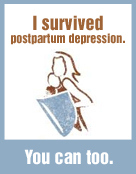
When I started this blog chronicling my survival as a mother postpartum, I sought out other blogs with a similar focus. My research took me all the way to South Africa. I found Lebogang and her blog, For His Love. A woman living a totally different life in a totally different part of the world felt the exact same way as me. I was so glad to read my story on her pages with a different set of characters and timeline, especially since she was further along in her story, which meant I, too, would make it. After all, that’s what the badge in the bottom right hand corner of her page said:
I survived postpartum depression. You can too.
This image was like a magic talisman to me. I clicked on it, half-expecting, I think, the spontaneous appearance of the how-to handbook for solving all my problems. This mythical handbook did not appear – but Postpartum Progress did, which is, really, the next best thing.
Postpartum Progress is the brainchild of Katherine Stone. She has built and branded a maternal mental health empire. It started, as she says, with the blog, then a conference, and is now building its nonprofit status. But while it started with Stone and her own struggle with postpartum OCD, its success is in the amazing community she’s created for women who all-too-often feel completely alone.
Simply their social media feed is enough to inspire hope, with affirmations, informational tidbits, and links to in-depth articles. The blog and website offer a wealth of information and resources, that would help any woman while away the wee hours of the panicked postpartum morning before the doctor’s office opens. And that may be precisely the point that Postpartum Progress exists. To offer a voice and ear 24/7 to a struggling population whose problems do not adhere to office hours and are not as cut and dry as a short symptom list.
A disclaimer on all their pages states that the information and advice is not a substitute for professional care and consultation. However, it is a place to start the journey and a companion throughout it. It offers a place for women who have no vocal allies in their everyday lives, due to stigma, to find friends and examples of success despite struggle.
It is organizations like Postpartum Progress that give me hope for the empowerment, validation, and vindication of all women suffering from perinatal mood disorders. Even ones like me, who are post postpartum.
They didn’t ask me to fill out the maternal mood questionnaire when I arrived for my annual physical today. I guess I’m no longer in the danger zone of postpartum. I no longer have a baby. My children are older. I’m more experienced. Everything should be easy-peasy at this point.
Or maybe they didn’t ask because my doctor knows. My chart already says ‘depressive disorder’. She just refilled my script for a low-dose of antidepressant. There’s no point in screening because we’re post-diagnosis.
She asked how I was feeling, how I was faring. A shrug of the shoulders. An approximation of one on my lips. Hunky-dory, doc. Some days are worse than others. I’m not cured, if that’s what you mean. I don’t want to run screaming from the house with my hair on fire – and haven’t for a while – but I still tend toward blah.
Maybe I’m expecting too much. I mentioned that I still have down days, but perhaps that’s the normal up and down of life. Yes, she said, you shouldn’t feel numb; you’ll have high points and low points. The lows seem so miserable, though. I know everyone has days when they don’t want to get off the couch, but my reasons seem so much more melancholy. A hollow near my heart, scooped out of the space where my joy once was. It’s not non-existent, but I haven’t noticed yet a day when the balloon inflates fully to fill that space.
I felt cheated somehow in not being ‘screened’. That it doesn’t matter since I’m beyond the threat of postpartum? That I’ve been given my happy pill so I should just shut up and take it? That I’ve been asked the same questions before and still don’t have any definitive answers?
But I suppose the screening isn’t perfect anyhow. A mother I know posted this status update after one of her trips to the doctor’s office.
At my physical I had to answer depression screening questions. One question was: “Do you feel like you’re failing your family or letting them down?” I laughed! Instead of circling the sometimes, often, or usually, I wrote in “Of course I do – I’m a working mother!”
No one questionnaire is going to get at the heart of each and every mother’s difficulties. I suppose it’s a step in the right direction that someone, anyone is asking – even if it’s a sheet of paper on a clipboard. But it should only be a beginning. Precisely because that question was laughable to that mom in its ironic understatement, we need to illustrate and represent all facets of a mother’s struggle – and give her the tools to do so – in order to help her when she needs it.
Click for an online screening tool via Kent State University (not specific to maternal mood disorders)
It’s become an all-too-familiar image associated with postpartum depression. A mother, out of her mind due to internal and external stresses, drives her children into a lake. The reasons vary. She may think she’s protecting them from an unseen spectre lurking at every turn. She may be trying to protect them from any harm she might inflict as an unfit mother. Whatever the motivation, the stories usually stem from some sort of irrational attempt at ‘saving’ the children under her care.
Last week, the body of water was the Atlantic Ocean rather than the ubiquitous lake. A pregnant South Carolinian woman attempted to drive her minivan and three children into the ocean on Daytona Beach. Bystanders sprung into action, pulling the children from the van, while the mother, still trying to head into the waves, apparently said, “We’re okay, we’re okay, we’re okay.” Thankfully, in the end, they all were.
While reports of a diagnosis have not yet been made, I knew instantly this woman’s actions must have stemmed from some sort of perinatal mood disorder. Of course postpartum was the first thing to pop into my mind, but then I learned she was pregnant. Not outside the realm, people. It’s not as if these mood disorders and psychoses obey that post determination like the flip of a switch. The machinations that power the beast start churning before the baby pops out.
Indeed, this woman’s sister called police requesting a ‘well-being check’, knowing her sister was having difficulty. The police suspected that as well upon speaking with her, but “conclud[ed] she couldn’t be held under a Florida law that allows for detention of people believed to be impaired by mental illness and who possibly pose a risk of harm.” They did arrest her after her release from the hospital later that day, however. With three counts of aggravated child abuse and a charge of attempted murder.
I do not condone the maltreatment of children and most definitely anything that could lead to their deaths. However, the charges brought against this woman chill me to the bone. Simply hearing the story – before any facts – I knew she could not be able to exercise right judgment. Her sister recognized it. The police officer who interviewed her earlier that day recognized it. And yet, she is slapped with such a charge?
There are other issues at play. She came to her sister in Florida to escape a supposedly estranged husband back in South Carolina. She said she didn’t want him near the children. The sister said she spoke of demons. But then she also told police, “she’s … having psychosis or something or postpartum.” Volusia County Sheriff, Ben Johnson, said “one goal of charging her was to make sure she gets help for any possible mental issues.”
“This is a tragic event. And our goal is to get her into the system so that we can protect the children and take whatever action we need to help her, too,” he said.
I certainly agree that she needs help, help needed so badly she cannot even recognize it. But is this the way we help those with mental illness? By charging them criminally?
And what do we tell the children? The children reportedly told officers, “Mom tried to kill us.” No child should have to go through such an ordeal. But I certainly hope all the support staff that come into contact with these children temper their words. I hope they avoid judgment and stick to the facts: their mother needs help.
Resources (all info and quotes come from the following articles):
The baby of the family wanted to look at her baby book yesterday. She always wants to look at her baby book. It has become a chore. Dragging the behemoth book off the shelf, finding a place where it can lay supported across our laps, turning the pages for her so they don’t get bent. Like so many things in life lately, it’s a task I don’t want my child/children to do because I have to do it with them. I don’t have the energy or desire to do so. I have other things I’d like to be doing. I have other things I should be doing.
We sat yesterday, wedged side to side in the rocking chair I used to nurse her in, with the book stretched between us. I flipped through the pages with her as I usually did: answering random questions with half my attention. I’d seen all this a hundred times. I’d lived it, though it seemed like an alternate reality, eons ago in a fog.
There was a time, a long time, I couldn’t bring myself to create this baby book of hers. I couldn’t peer into the thin nylon parting gift of a bag from the hospital that held all the paperwork and memorabilia. Perhaps opening it up would release the demons I’d stuffed deep inside. Or that I’d carried home from the hospital.
I remember that bag as a turning point. It taunted me as it hung listless from the closet doorknob of the nursery. It twisted and banged against the door as we opened and closed it. It loomed in my eyesight as I sat in that rocker and nursed.
I think I finally emptied the bag because I was so sick of looking at it and its reminders.
Now all those reminders are bound up in that baby book.
That she forced me to look at yesterday.
I maintained psychic distance until I looked closely at the pages of her actual birth. I still search her face for signs of sibling similarity. I still try to pinpoint the moment between the pictures where they lost her bracelets in the nursery. From that point on, is there still sibling similarity?
It’s a tired routine. It’s not as fresh and real as the anguished feelings that drove it in the first place. But I still look. When I force myself to really see, I still look.
I never want to look at the pictures again. I want to box them up and send them with her when she’s grown and going out on her own. I love her as she is. I don’t want to become the person I was when she was born. Looking at pictures of her from that time, brings that me back.
Ironically enough, I bonded with this baby of mine. We share the most loveable, profound moments. I never wanted to hurt her or give her away or wish her out of existence. But somewhere in that hospital room, I split in two. Thankfully, one half was the loving mother who was able to give her what she needed. The other half? That’s not so easy to define. That’s me. Inside out, soft underbelly exposed to the harsh world. Quivering. Questioning. Knowing that she was screwed as the first labor pains hit because, even at the end of nine months of burgeoning, she still hadn’t prepared herself for this birth.
And as much I liked to think it was behind me, it came crawling back in as I looked at those pictures. Maybe that’s why it’s such a chore to drag that book out.
Will I always cringe to remember that time? Will it always elicit the same feelings, years, decades, lifetimes passed?
Four years is far too long for a fourth trimester.
When does the depression start? Is it the instant the partum becomes post? When the final product is pushed from its incubator?
My writers’ group got into a discussion of postpartum depression last night based on the arrival of a box of books on a doorstep. The doorstep belonged to a fellow writer; the box was full of copies of the book she’d just finished writing. She said she was saddened by its arrival. When asked why, she said she wasn’t sure; she’d have to think about that. She said it was almost like postpartum depression. But she couldn’t say why. And she said she didn’t really know all that much about postpartum; that she’d never had it, though she’d birthed several children.
Someone asked, was she sad because she’d have to say goodbye?
This question assumes that she enjoyed her time building and birthing this book. That it had grown inside her and expanded her heart and mind to the point of exploding with love and pride. That would make a good case for depression upon its release. This symbiotic element of herself was now separate. There most definitely would be a feeling of loss upon the shearing off.
But what if the division and multiplication of cells riots against the verisimilitude of a woman’s life? Against her will. Her expectations. Her idea of time lines and schedules. In that case, depression would come post haste.
The birth does not usher in a sadness at goodbye. It is the greeting – most often with a big wet smack in the face – of responsibility, duty, expectation. The idea that she’ll be instantly in love with this mewling little being in front of her.
When really it has nothing to do with that child at all.
When it comes right down to it, while it’s enacted by the burgeoning and birth of that little being, postpartum depression is all about the mother. Her reaction to it. The way her hormones wreak havoc on her systems and sanity. The total upending of her reality and orientation of existence.
I didn’t want to say goodbye to the little lovely who sits by me now four years older and bigger. I don’t associate her with the things to which I want(ed) to say goodbye. I would’ve loved to say goodbye to the shit that came with her preparation for and entry into this world. I still would. The sadness started way before the postpartum period. And unfortunately, it still doesn’t fit in any sort of tidy box.
Addie May Hirschten
*** A HUGE addendum to this post: It is NOT selfish to see postpartum as all about you. I think many women don’t receive the help they need because they think it’s wrong to think about something other than their baby. However, I don’t want my post to be construed as a devaluing of the utter miracle of and attendant caring for a newborn. We must get the help we need as women so we can go on to be healthy mothers and healthy individuals.
“I pledge my commitment to the Blog for Mental Health 2014 Project. I will blog about mental health topics not only for myself, but for others. By displaying this badge, I show my pride, dedication, and acceptance for mental health. I use this to promote mental health education in the struggle to erase stigma.”
It’s not everyday that I can proudly wear the badge of my illness, but the badge above — this badge I’d slap on my forehead and parade around town.
A Canvas of the Minds is an amazing website dedicated to an amazing cause: spreading awareness of and eradicating the stigma of mental illness. A team of talented authors share knowledge, personal struggle and triumph, and, perhaps most importantly, a reflective surface to show us we’re not alone. It is a team to which I am extremely proud to say I will soon be contributing!
When my water broke at the end of my third pregnancy, it released the flood waters of postpartum depression. What I didn’t know was what else was dammed up behind that. ‘Regular old’ depression, I suppose, and most definitely, anxiety. In some ways, my life has never been better since this deluge; in others, it’s sucked eggs – big, nasty, rotten ones.
But awareness makes a huge difference in all lives – those struggling to achieve mental health and those alongside them.
So bravo, A Canvas of the Minds! And bravo to all of you out there fighting the good fight.
To everyone: please consider taking the ‘Blog for Mental Health’ pledge yourself. Do it for yourself or in support of those you love . . .
The American Psychiatric Association defines dysthymia as depressed mood most of the time for at least two years, along with at least two of the following symptoms: poor appetite or overeating; insomnia or excessive sleep; low energy or fatigue; low self-esteem; poor concentration or indecisiveness; and hopelessness.
With all the myths and tragedies running around my head lately, it’s perfect poetic justice that the word dysthymia comes from the Greek. And I’m starting to think that’s what I have.
My raison d’etre in this land of depression (or whose labor and delivery unleashed the beast) is now approaching four years old. My depressive symptoms linger on. They’ve certainly lessened, that’s for sure. I no longer want to chop off my fingers, run out the door and never come back, or think I’m a completely horrible, terrible mother. But like a thin fog that spreads layer after misty layer until the terrain is no longer recognizable, it’s lurking and oozing its way into the corners of my life. On the days the sun doesn’t shine, I’m chilled to the bone, the damp crawling inside and refusing to leave.
Postpartum has passed the baton to dysthymia.
The Internet can give you whatever leverage you need to make whatever case you want so I can prove it.
Depression that begins as a mood fluctuation may deepen and persist when equilibrium cannot be restored because of poor internal regulation or external stress.
Postpartum = mood fluctuation
Poor internal regulation = my anxiety-ridden self
External stress = meeting the needs of three small children
Equilibrium null and void = deepened and persistent depression
I also never had the appetite or sleep disturbances associated with clinical depression, but have my fair share of “anhedonia (inability to feel pleasure), social withdrawal, guilt, and irritability,” which the American Psychiatric Association is considering adding to an alternative definition.
Nothing like self-diagnosis. But if it’s an open and closed case of dysthymia, why am I not responding to treatment? The article mentions recovery. I’d like some of that please.
I think there’s a hole in the fabric of mental health for women beyond the grasp of postpartum, but still not functioning in a productive and positive way. If a traumatic event, which birth and what follows can be, unleashes a maelstrom of symptoms that were lying just below the surface, what then? What can we do for those women who don’t fit the textbook mold of either postpartum or major depression?






 Swinging open the cabinet door,
 Chopping Potatoes