Mental Illness

Coming Round the Mountain

After I wrote my last post, I came across notes with the title of this entry.

From years ago.

Ironically, they referenced a book by Emily and Amelia Nagoski entitled, Burnout: The Secret to Unlocking the Stress Cycle.

Seriously.

I’d say you can’t make this shit up – but I literally did.

In fits and starts I have been working my way towards this puzzle – for years.

At the end of my last post, I said “I should go back to the beginning of this latest cycle”.

On some level, my mind, returning to that little coffee shop table repeatedly over the last few years, has known it needed release. That it’s been dragging around all the stress and feelings associated with that deluge of depression and fighting my way back to the surface. And three years ago, when I drafted this ‘mountain’ of notes, I even discovered a big part of why I haven’t been able to let go.

“Magazines tell us that if we just drink ten green smoothies a day, we’ll feel great and look great, our kids will say ‘please’ and ‘thank you’ and our boss will give us that promotion.  And if none of those things happen, it’s because we failed to drink the ten green smoothies; it’s certainly not because of systemic bias.
 
The message is consistent and persistent – whatever is wrong, it’s your fault.  It can’t be true that the whole rest of the world is broken or crazy; you’re the one who’s broken and crazy.  You haven’t tried hard enough.  You haven’t done the right things.  You don’t have what it takes.”

Amelia Nagoski, DMA and Emily Nagoski, PHD

It was in the months/year leading up to January 2020 that I made my first ever attempt at bullet journaling – and it was to track the administration of my natural supplements. Increase to two DHA, take Zen GABA twice daily, add 5-HtP. The fact that I hadn’t ‘cured’ my anxiety and depression just meant that I was adhering to the protocol closely enough. And so I went into logistical overload to ensure I’d given it my best shot.

And I realized two things. That the supplemental schedule was untenable with all that my day already demanded of me – and that it wasn’t enough. While it did improve or ameliorate certain aspects, it did not destroy my depression.

But why couldn’t I trust my body, my own intel?

Obviously what bothered me in 2020 and since then is much bigger than a slender bottle of petite pills.

I still must work on releasing the emotional gak associated with that transition – but it plays into the larger cycle of self-actualization and acceptance I’ve been working through for the larger portion of my life.

Message around the other side of the mountain . . .

Mental illness is not a failure on your part.

Standard
Mental Illness

Harnessing the Seether

“Seether” hits differently as a middle-aged woman.

As a 16 year-old, I was obsessed with the song from Veruca Salt, with its hard-hitting guitar, sick riffs, and angry lyrics – but I was a bit mystified by who exactly the seether was.

I saw it as someone or something outside of her, trying to control her or change her actions – which makes total sense, seeing as how the rage of teenage years is totally self-righteous and almost always directed outside of oneself.

A nasty break-up. Parents trying to tighten the leash. Managers not giving us enough shifts or pay.

Now, as a middle-aged woman with real reasons for rage, I see that the seether is within me.

In January 2020, I had hit the bottom of a very low low. Not as bad as, but the lowest I’d been since, post-partum depression.

Two and a half years earlier, I had weaned myself off the antidepressants I’d been on for nine years. It was a combination of that often false sense of good health that medication management can give you and refill snafus. In the ultimate combination of Yankee can-do attitude/Catholic flagellation, I figured it was time I was healed enough to handle it on my own.

And I was, for a while.

Whether the meds hung around in my system for awhile or my naturopathic/lifestyle aides helped or I got worse in only slight increments, I was doing okay. Until the increments started stacking up the other way and there was such a big pile of mess, I was fucking depressed. Like bad.

I relived the ridiculous feeling of failure/guilt that I felt the first time I went on meds and went to see a psychiatrist nurse practitioner for the first time.

My anxiety for this appointment was beyond. I was all wrapped up in avoidant behaviors, irrational thoughts, nerves, worry. Of course I was running late. Of course there was road construction blocking the entrance to the building I stared at as the clock ticked by. Of course it was raining as I realized I parked in the wrong lot and rushed my then toddler over the adjoining stone wall. Of course I busted into a podiatrist’s office like a crazy woman to get directions to Unit 8.

When I arrived breathless and sweaty at the reception window, the sanctimonious office manager asked me how I was doing. I think he actually thought he was creating a pleasant atmosphere. I was so amped up with anxiety, for once, I answered honestly.

“Horrible.”

I still haven’t figured out whether he had no personality or I set the tone for our relationship with my snarky response.

Late that afternoon, when my husband had returned from work and all the kiddos were settled, I stole away to a quiet coffee shop for a writing session. I still hadn’t processed all the high-energy feelings from the day. I was likely feeling some sort of post-adrenaline slump. I managed a journal entry and this.

I knew it wasn’t enough for the blog that usually helped me think through major mental health journeys. But it was all I could muster. It was all I had.

I was devastated by the complete control my irrational thoughts and fears had over me. And that was coming at the tail end of a harrowing descent into depression.

Periodically, over the last four years (that also included a worldwide pandemic, Holy Mother of God), that little table in its dim corner, complete with coffee cup, has come to mind. The incompleteness of my thoughts that day – and since. How that is a story I have needed to tell. But haven’t been able to. How I should go back to the beginning of this latest cycle – but haven’t been ready to.

I still don’t know if I am.

But “Seether” helped me recognize the strength and sorrow of that rage within.

Perhaps it’s time to process it – and harness it.

Standard
Photo by Paul Bulai on Unsplash
Mental Illness, Survival

What no one ever tells you

about your worst bout with whatever mental illness you’ve had

is you’ll put yourself back there

every. other. time. you struggle

forever.

Every time

you get oh so tired

or life’s bitter edge rubs sharp against you

or you just can’t crawl deep enough into the corner of the couch –

You will think,

here it comes again

it’s back

I’m falling down the rabbit hole once more.

And then, a flicker at the edge of your consciousness.

It’s midafternoon; you haven’t taken your meds

The sun hasn’t shone in days

A deep mood does not mean a depressive down swing.

But the feeling is so unsettlingly familiar

it sets off alarm bells

of a flame that once fueled an inferno

Standard
Mental Health, Mental Illness

Red Hot Reminder

I had just taken my morning meds when I went to light the woodstove. 

Reduced to embers and ashes from the night before, I had to start fresh and stacked the bricks of compressed wood dust in their faintly cheerleader-ish pyramid.  I twisted two long tears of newspaper into loose spirals and set them inside.  Usually a small square of firestarter set atop would be all that was left. 

But this morning, I picked up the medication information sheet that shipped with my newest refill of meds.  I usually just recycle it.  I’ve received dozens, if not hundreds, before.  This morning, for whatever reason, I tore it into quarters and laid them over the delicate spirals of newspaper, tucking the firestarters in as if for bed. 

The opposite ends of each coil of newsprint burst into light at the touch of the match, that crawled toward the center as usual.  But the information sheet, made of a heavier weight and sitting atop it all, didn’t catch right away.  It sealed in the tongues of flame and made the smoke swirl above the bricks in a pulsating plate. 

One quarter of the sheet, that rested vertically, served as a firebreak.  On one side of it, the fire roiled, yet the paper seemed untouched.  On the opposite side, the words of warning, of various side effects and negative outcomes attached to this tablet meant to cure me, to fix my foibles – glowed, as if alive with molten lava; not painted or poured; moving, active – and yet about to disappear.  About to be consumed by the heat and flame.  At their brightest and most brilliant – about to fade into oblivion, no longer legible or meaningful.  Not even holding shape or form, a hot rush of ethereal, ephemera.

Obviously, I am a sucker for symbolism. 

And so, as I sat and stared into the fire, amazed and mesmerized by what very likely was a mere reaction of the ink to the heat of the fire, I pondered glowing prophecies and potent mystical messages.  I know that seeing warnings like ‘may cause nausea or stomach upset’ in a rosy hue doesn’t make them magical or more enjoyable.  But as someone always ambivalent to ‘fix my mood’ with meds, the occurrence seemed to have some sort of message.

I’d thrown the paper in the woodstove this morning on purpose.  Prescriptions and warnings and medical material litter my life and countertops and brain.  How I would love to wake in the morning and walk out the door without having to take something so life doesn’t seem so overwhelming.  But as much as my stubborn will desires and tries to snuff it out of existence – the problem, the illness remains. 

Sometimes I need a red hot reminder to stay the course and keep healthy.     

Pexels/Free Range Stock
Standard
Living, Mental Health, Mental Illness, Survival

Incremental Illness

It’s easy to ignore when it creeps up on you,
increasing slowly, by small degrees

Or not even ignore –
just not even notice

the paranoia that maybe you’re not cool enough to hang
the resentment for the life you do not have
the loneliness
the inability to relax
the overwhelm over everyday things:
shopping, showering, getting out the door

Just not feeling
talking, going, doing –
                              it

Until one day it’s suddenly all you can see,
all you can feel

And you have to deal with it all at once

Standard
Depression, Mental Illness

This is My Bag

Jennifer Butler Basile

This is the closest I’ve gotten to Kate Spade.

A purse that may or may not even be an original piece.

I don’t know her.

Yet, when my husband told me yesterday the breaking news about her death, my mood instantly plummeted. I stared at the black and white text and felt the sobs come.

Not because I know her. In a cliched way, I know her pain. In a frightened animalistic way, I see how quickly I could become her.

Facebook friends who know mental illness posted their sadness and support at the news. Some hinted at public posts with ugly comments and sage advice given too late. But I don’t read comments – of the general population anyway – for my own mental health.

And then one of those comments wormed its way into a personal post I saw.

It was easy for me to lament that stigma was still alive and well, that we’ve so much farther to go, and how sad it is that people still think that way – when I hadn’t read the comments. And then I saw how alive and well stigma is, how much farther we’ve to go, and how scary it is how some people think.

To think that suicide is a choice. To think that those who have reached the point of contemplating suicide are doing so as part of a rational decision-making process. That they eschew their many blessings in life purposefully.

Suicide isn’t supposed to make sense. That’s the fucking point. The mind, the psyche is not working properly. Depression is replacing the authentic voice of self with lies.

You would think the fact that it strikes down even people with blessing piled upon blessing would make people realize that there is something more to suicide than horrible circumstance and selfish choice.

May God save us all.

Standard
anxiety, Depression, Living, Mental Health, Mental Illness, Survival

Holiday Hangover

Is it Tuesday already?

It came as quite the shock this morning when I had to wake up and rouse myself and kids to face another school day.  The holiday weekend seemed much longer than three days, as if we’d all already slipped into summer mode.

The long weekend was some weird sort of stasis.  It was neither too long nor too short; not stupendous nor horrible.  It was good.  In the midst of PMS and prepping for my two-year-old’s birthday party, I managed to not lose my mind and then relax a bit and enjoy the rest of my weekend.

Yet, even though I cleared out a wood pile that had been lingering in the yard and set up my compost area; even though I cleared a garden bed and planted two long-waiting potted plants; even though I enjoyed laughing with my husband and girls as we ate our first outdoor ice cream of the season – my thoughts turned last eve to how it all may not have been real.

The fact that I survived and thrived may have been a fluke.  The fact that I managed to not only be productive, but enjoy it; that I could not only enjoy my children, but feel joy with them; the fact that I wasn’t overly irritable, low, or unmotivated – I couldn’t just be in these wonderful feelings.

As I looked to a return to routine, I wondered whether I’d fail on my own.  Without the buffer of helpers in the house, would I be overwhelmed with the task of caring for my little one?  Would I feel trapped without the option of another set of hands if I had to tend to a household task or take a moment for myself?  Would my mood plummet without the excitement of a holiday weekend and the drudgery of the everyday?

It is said that comparison is the thief of joy.  Depression is as well.  It’s also said depression is a liar.  It is.  It is telling me lies about how I may fail.  And anxiety is helping spool out its prophecies far into the future.

I may have reached a point where therapies and supplements are finally coming together for my success.  But I cannot trust that.  If I do, the bottom of what I wish for so vehemently may fall out from underneath me.  I may have just had a pretty great weekend.  But even that, I can’t enjoy.  Because I figure my balance is due and I must pay up at some point.

directv-soggy-groceries-large-4

iSpot.tv

I look forward to celebrating the holiday where the right treatment and my own ability to sit in and take a moment for what it is converge; where no thing is the thief of my joy.  That will be a true celebration.

Standard
Living, Mental Health, Mental Illness

So Much Blah

For such a bland, nonspecific word, blah actually does a lot.

At the end of last month, I started a mood tracker to get a closer look at and more specific language for my moods.  I’d been using blah too much and too widely.

Now that I’ve been pinning my days and moods to – what I thought were – more specific descriptors, I realize just how evocative blah is for me.

Blah is not wanting to get off the couch – either from physical exhaustion or lack of motivation – or both.  Blah is not knowing where to start when faced with a day’s plan or duties.  Blah is not knowing how to structure a day with no plan or duties.  Blah is feeling off.  Blah is not wanting to get dressed because you haven’t had the time to shower or because nothing would feel as comfortable against your skin as pjs.  Blah is worrying about an unnamed idea.  Blah is not wanting to interface with people.  Blah is not eating because nothing seems appealing.  Blah is eating candy or snacks that will bring on more blah for sure – but perhaps will be a happy treat.  Blah answers the question, ‘How are you?’ with a shrug because blah really isn’t sure – even if things aren’t that bad.

Blah is a lot of ‘not wanting to’.  Blah must be a toddler.  Or a moody teenager.

Blah comes to visit me a lot – and not because I have all of those in my house.

I wanted to get away from using blah to describe my state of mind because I wanted something more specific.  I don’t know that I realized how many versions of blah there were.

In my mood tracker, I opted for descriptors like ‘not focused’, ‘not productive’, ‘unsettled’.  According to those little squares of color on my chart, there’s been a lot of unsettled lately.  I think I just switched blah for unsettled.  I need to unpack the feelings in that paragraph above and figure out the different shades of blah or unsettled or whatever I want to call it.

blahblah

from sillyoldsod.com


Standard
Mental Health, Mental Illness, Recovery, Survival

Post Script

The following is not advisable, nor is it recommended or endorsed by any of the information herein; the anecdotes serve as a reflection of my personal experiences. Do not take the same road I have.

 About three and a half weeks ago, I weaned myself off my antidepressant of seven years. For all the advice I’ve heard saying not to do so without medical supervision and all the times I’d poo-poo’d those who abruptly stopped medications – I weaned off my meds without medical supervision having made the decision totally independently.

I’ve written before about the panic that ratchets up watching the tablets dwindle in my amber colored bottle of sanity; about the same reasons I take them leaving me overwhelmed enough not to call the doctor for a new string of refills. It happened the same this time.

Except this time, I’d been growing ever more resentful of that daily bitter pill, something to remember, something to lean on heavily, something to possibly poison me.

In an as-yet-to-be-seen brilliant realization, I decided to space out my tablets to make them last longer – ‘until I got a refill’. I think that was my rationalization. I went down to one for several days, half for several more, and then a quarter.

Also around this time, however, I began reading A Mind of Your Own: The Truth About Depression and How Women Can Heal Their Bodies to Reclaim Their Lives by Kelly Brogan. Now, if the rest of my follies here are not endorsements, this most certainly is not an endorsement of this book. It took me an awful long time to swallow – pun possibly intended – what Brogan had to say. After years of coming to terms – mostly – with taking antidepressants, here was an in-your-face account of how they were absolutely unhealthy and unnecessary. The whole first half of the book told me in no uncertain and sometimes holier-than-thou terms that I had been duped and made a terrible decision for and possibly irreparable damages to my body.

As I said, I started reading this book around the same time I was weaning. I did not read one ‘expert’s’ book and change my entire life regimen around it. As I was already tapering these ‘evil’ meds from my system, however, I was curious to see what other options could help me complete this process.

The second half of Brogan’s book is the best; the part where she gets to the heart of her mission: helping women live healthy and whole lives. I don’t know that her tone was less sanctimonious or I was better able to temper it with my own decisions of what would/would not work for me. Her plan focuses on a four-week implementation of diet, detoxing the home, meditation, exercise and sleep – a four-pronged approach to keeping the body and mind on track.

There is a lot in this book that resonates with me – some of which I already do, in fact. However, the four-pronged approach makes that panic rise in my chest almost as much as the rattle of fewer and fewer pills in the bottle.

When I started meds, feeling so like a failure for needing them (no projection, just my own neuroses), my therapist said, “this is the tenor of your life right now. Whether or not you were previously suffering with a mental illness, you were able to cope. Now, mothering several children, there are significant unalterable circumstances that make you unable to cope. Your medication can help you do so.”

Tenor still untenable.   Nothing new there. Well, actually there is a new kid.

So perfecting diet, sleep, mindfulness, exercise, clean living – all factors dependent on me, everyday, in my imperfect life is a little terrifying. Especially considering that failure, which is inevitable really, means a depressive state. No big.

Back to weaning: Brogan advises her 30 day detox before weaning to reset your system first. Ha. That may have helped. It also may have helped if I didn’t wean in the last week before my period as I prepped and embarked on a week-long trip with all four kids solo only to return, take two weeks to prep for school, and pack for one final vacation that ends on the eve of the new school year. Timing is everything.

There were times I wanted to scalp myself or my children that first week; times I wanted to scream louder than the baby refusing to just.go.to.sleep; scared that the crying jags meant my depression was coming back; irritable and snippy with my husband; and in a much lesser, yet slightly amusing development, America’s Got Talent’s package materials and any high note hit by a contestant made me well up.

Brogan warned me the withdrawal symptoms might present as a relapse of the original condition. Who’s to say I was struggling because I desperately needed the pill to supplement my body or give it a crutch?

I didn’t complete a long yoga session last week seeking clarity of mind in regards to all this. I was finally sick and scared enough at the skin and muscle getting looser around my frame and the big kids were shoe shopping with their grandparents. The amount of tension in my muscles shocked me. I sobbed at even the slightest release of it. Not the wet, slimy tears of a betrayal or breakdown, but the semi-silent, breath-catching heaves of chest with a few slick tears sliding down from the corner of eyes when I unsquinched them long enough to let them fall. I didn’t realize how much I’d been carrying until I tried to let it go.

And that was just the physical.

As trite as it may be, I had an epiphany on the yoga mat that morning. Even if I was taking medication to take care of my mental health, I wasn’t taking care of my self. I’d forgotten to force time for the things that keep my soul alive. Stretching, meditative thought and moments, reading, writing.

Did I need to stop meds to hit rock bottom hard enough to make the burning fire of my calves burn a hole in my consciousness? Perhaps not. Would I recommend cessation of meds as a path to clarity? No. But stopping meds to see where my mind and body were at this point in my life, nearly eight years out from the offending episode of postpartum, and then having such a visceral reaction to the stress in my life and body – that sent me an important message.

Regardless of what my decisions are in regard to lifestyle and care, self-care must be part of it. Placebo or perfect chemistry, a pill isn’t a miracle. All cylinders of my life, my soul must be firing.

Life will never be perfect. Even if I decide to follow Brogan’s regimen or another with or without meds, there will be times I fail. I can’t control circumstances outside my body, my sphere – hell, even in my sphere. (Did I mention I have four children?) But perhaps with the balance of self-care, I can temper the abberations. It’s a tall order, but right now, it’s keeping my mind centered on care – not maintenance or even just keeping the lid on.

That’s a pretty compelling read for me.

Standard
Living, Mental Health, Mental Illness, Recovery

Many Peaces of Mind

By sharing our stories, we encourage others to do the same.

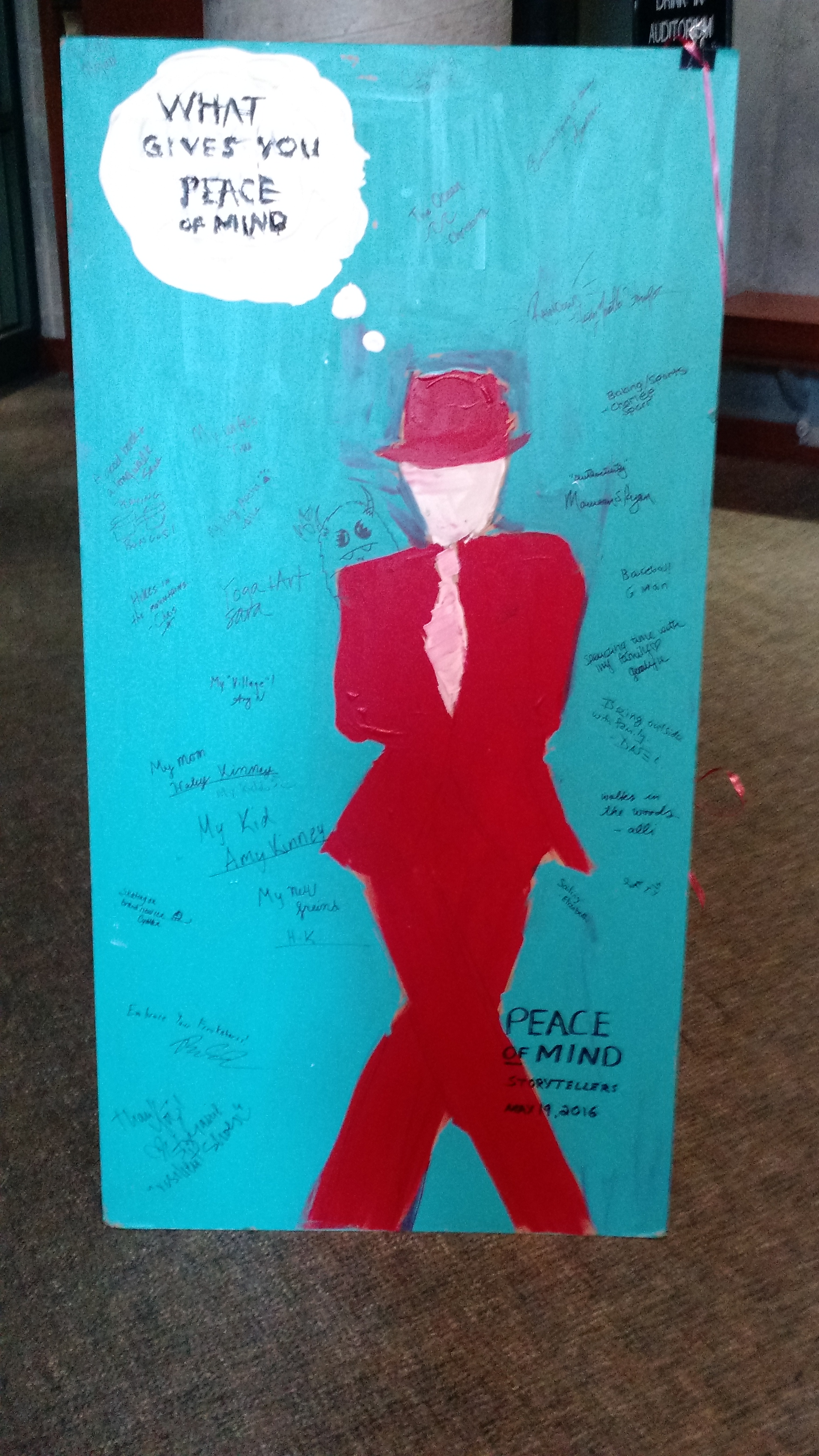
This was a major theme of the Peace of Mind Storytellers Series I attended yesterday. By breaking the silence surrounding mental illness, we also break the stigma. We allow people to admit and accept the struggle and begin recovery.

wp-1463799297391.jpg

As an anxious person (also mere weeks away from delivering a child), attending a day-long event with hundreds of people I’d never met solo was a little nerve-wracking. But I’d been awarded a free ticket through a generous contest by a local mental health facility, Butler Hospital. I’d been following and loving the organization sponsoring the event, PeaceLove Studios, for several years. And the format of the event, like our state’s own local version of TED Talks, sounded pretty cool. As a writer, I am a little obsessed with stories, after all. Add the mental health aspect and I was hooked.

Once the speakers started rolling out, I realized this was not just like our state’s own local version of TED Talks, it basically was one. The speakers hailed from around the country and world. They ranged from college students to policy-makers and changers to international celebrities. While I hadn’t recognized all the names beforehand, I was impressed by the vitae of these individuals – and even more so by the enthralling stories they shared.

wp-1463799329728.jpgLike Faith Jegede-Cole who said mental health has to do with the health of your soul. Michael Thompson who said the goal is not to focus on just the 1 in 4 who suffers from mental illness, but all 4 – to get the others to listen. Kate Milliken whose own family’s silence over mental illness moved her to create a platform for patients and caregivers living with MS to share their experiences. Amelia Grumbach wishing someone else would take control of her life because she couldn’t/didn’t trust herself to do so. Philip Sheppard, a soul-stirring cellist, urging the attack of any creative endeavor without the fear of creating crap. Simon Majumdar saved by love of food and its serving of soul. The rhythm of Steve Gross’ (left) spoken word carrying the buoyant message of the right attitude affecting everything. Butterscotch following her heart’s desire without compromising for anyone. The mother’s love of A.J. Wilde holding her son, Devin, as he found the key to unlock his autism. Ryan Brunty’s lovable yetis expressing the depression he’d been living with silently beforehand. Stephanie Prechter’s fierce devotion to learning as much as possible to support and treat people like herself and her father who suffer with bipolar disorder. Mark Hedstrom moving Movember into the mental health space. Ross Szabo creating a curriculum so that mental health is not something we look at only when something’s wrong, but taught much like physical health education from kindergarten to grade 12 and beyond.
The wide range of experiences of these speakers broadened my perspective of mental illness and health. One of the speakers said, after all, we all have stuff; we’re all human. There are different brands and flavors and struggles, but one thing we all have in common is trying to walk this world with grace and contentment – at least most of the time.

All of these storytellers did so yesterday with beauty. Through their various creative presentations, they gave swell to that part of the soul that makes one glad to be alive, through the ugly and transcendent, the low and the dizzying highs.

The Peace of Mind Storytellers showed in a grand way what PeaceLove Studios is doing everyday: using expressive arts as a therapeutic device for all individuals languishing, battling, flailing, and/or surviving life with mental illness. What ninety participants got to take part in after the series of speakers. Myself included.

I was transported back to the first PeaceLove workshop I’d attended with a friend a few years ago. While in a different space with different people, the atmosphere was the same: a safe place to create, process, emote, and share. Several participants commented that they didn’t consider themselves artistic, but due to the open-ended nature of the activity and low-pressure environment, they enjoyed creating. Another said that while she hadn’t started with any idea in mind, a plan slowly took shape on her canvas – and that it was symbolic and cohesive. I felt similarly. Exhausted at the end of a long day, I didn’t think I was up for any grand metaphor. But what rose to the surface in that quiet, stream of consciousness state was perhaps exactly what my psyche needed at this time. Indeed, what came out reminded me of my constant struggle for balance. But in that gentle unfolding, it wasn’t frustrating as it usually is, but a quiet reminder that it’s a process, about maintaining peace of mind, not achieving it and moving on.

In the grand and small movements of my day at the Peace of Mind Storytellers Series, the ebb and flow of life was reflected. The entire day was a reflection of life at its best and worst and the journey we all make together. Bound by our stories and in the sharing, we can achieve peace of mind indeed.

wp-1463799315756.jpg

Painting by Jeffrey Sparr, PeaceLove co-founder

Standard