anxiety, Identity, Living, Mental Health

Damn the Weather, Man

That’s a very precariously placed comma.

I don’t wish eternal damnation upon all meteorologists, nor do I have the authority. However, as an anxiety-sufferer who already has enough on her plate, weather reports add another element of doom and gloom.

Perhaps if I didn’t live in New England at the ever-encroaching tail-end of winter . . .

from realbodywork.com

Perhaps if the cold clime didn’t make my already shriveled trapezius muscles jerk ever upward . . .

Perhaps if I woke up in the morning, looked at the thermometer and decided on my wardrobe at that moment on current conditions . . .

Perhaps if I could notice the gentle unfolding of the season with my own eyes rather than through the lens of radar screens and predetermined dates on the calendar . . .

Maybe, then, I wouldn’t be psychologically distraught at the impending snow storm we’re about to get.

I wouldn’t be worried about the fresh shoots that I’d unearthed beneath their layer of winter leaves. I wouldn’t bemoan the loss of soft earth between my fingers that I’d felt just this weekend. I wouldn’t begrudgingly look at the lightweight fleece jacket hanging forlornly on the doorknob.

I wouldn’t feel trapped. I wouldn’t feel like I was experiencing a relapse into unforgiving ways. I wouldn’t be nervously anticipating the loss of something I’d only barely gotten a grip on.

Driving home and noticing shutters pulled tight against the windows of a historical building that I swear I’d never noticed shut before, I actually thought of banishing all weather reports from my existence. If I didn’t know I was supposed to be battening down the hatches, I might delight in the snow. At the very least, I’d adjust accordingly when I woke up that morning by pulling on my knee socks and down coat. I wouldn’t obsess. I wouldn’t worry. I might actually live in the moment.

And that, dear people, is really what this is all about, isn’t it? It never really was about weather reports. That’s my irrational psyche’s way of pulling attention away from what is really at the heart of the matter. If I can blame the weather man for my obsessive tendencies, then I don’t have to take the onus on myself. That I can’t live in the moment. That I can’t still the whirling dervish in my mind and so must look to external forces, such as a lovely spring day, to calm me. Or, in their absence, to name as the reason for my failures.

If only the sun were shining, my heart would be light.

If only spring had truly sprung, my mood would refresh.

If only I had no prior knowledge, I wouldn’t obsess and worry.

If only it were that easy.

(Though weather reports and the attendant technology do pull us out of synch with the natural rhythms of the earth and our surroundings. 😉 )
 

Standard
motherhood, Uncategorized

“What if the ‘Best Years of Your Life’ . . . Just Aren’t?” an article by Liz Sharp

It’s easy to hate the elderly woman in the grocery store.  I think we’ve all met one.  The thing is, it’s easy for her to say you’re experiencing the best years of your life, because she’s no longer there.  She’s suffered through them, blocked out the truly horrific parts, and sees them now through the rose-colored lens of nostalgia.  I would venture to say that 99.9% of these old women hated their circumstances when they were up to their knees in baby duties (and dooty) themselves.  

Unless they came from the generation before the one the author of this article references – the one that was told she could have and do everything.  Maybe they did just focus on motherhood.  But I tend to think that pesky ‘id’ was stirring things up even before society got in on it.  That’s a whole other animal in and of itself.

I’m on my third turn around the mommy merry-go-round – and, if God has pity on me, my last (yes, there’s an animal behind that, too).  I am much more aware of the increasingly solid weight on my lap.  I try to hold each grasp a bit longer, bury my head into the sweet-smelling hair of childhood.  I’m learning the gratitude, but I’m still not the old lady in the grocery store.  And I still think it’s perfectly acceptable to think she’s off her rocker without being off mine.

Link
Living, Perspective

No Longer Negative Space


The way light shows through the gaps in a loose stone wall.


Unless you approach at a certain angle, you miss the open spaces – circles, angles, different shapes brilliantly back-lit. Looking down, it’s a solid mass. Standing even with it, a barrier of boulders. If you get down on your belly, study it head-on, the passageways are there. Light spills through the windows of opportunity, possibility. Against the bright backdrop, even the cold, dense masses of each individual stone etch beautiful silhouettes.


But you only see the relief if you look from a certain perspective.

On the level.

With a discerning eye.

Bringing the bright background into crystalline focus, letting the dark foreground fade into a fuzzy blur.


photo from an article by Joe Silvia

Standard
Uncategorized

Mental Health Bloggers Widen Their Support Systems on WordPress.com

Great article outlining some great resources! Two of which I’m proud to be a part!

Michelle Weber's avatarWordPress.com News

When we start a blog instead of simply keeping a private diary, it’s because we want to connect with others. When you start to blog, you join a community.

It comes as no surprise that many bloggers are drawn to online communities as a place to work through challenges — to heal and process, find others with similar experiences, and seek (or offer) support. There are lots of supportive communities around WordPress.com: women dealing with breast cancer, people managing diabetes, parents of children with unique needs, and many, many more. Throughout January, we’ll be zooming in on how bloggers use WordPress.com to support their health and wellness.

Today, on the heels of the Blog for Mental Health 2014 kick-off, we’re focusing on mental health. Read on for a look at the many ways WordPress.com bloggers use their sites to improve their own lives, and the lives of others who have…

View original post 856 more words

Standard
Art, Identity, Writing

Six Degrees of Memoir

Six words.

Choose them carefully because that’s all you have to tell your life story.

Should be easy, right? Anyone can complete a story that’s only six words long.

But can it encapsulate an entire life? Can it fully relate the defining moment in someone’s life? With only six words, you have to precisely concise.

Or is it even possible to pin down a life in six words, several characters?

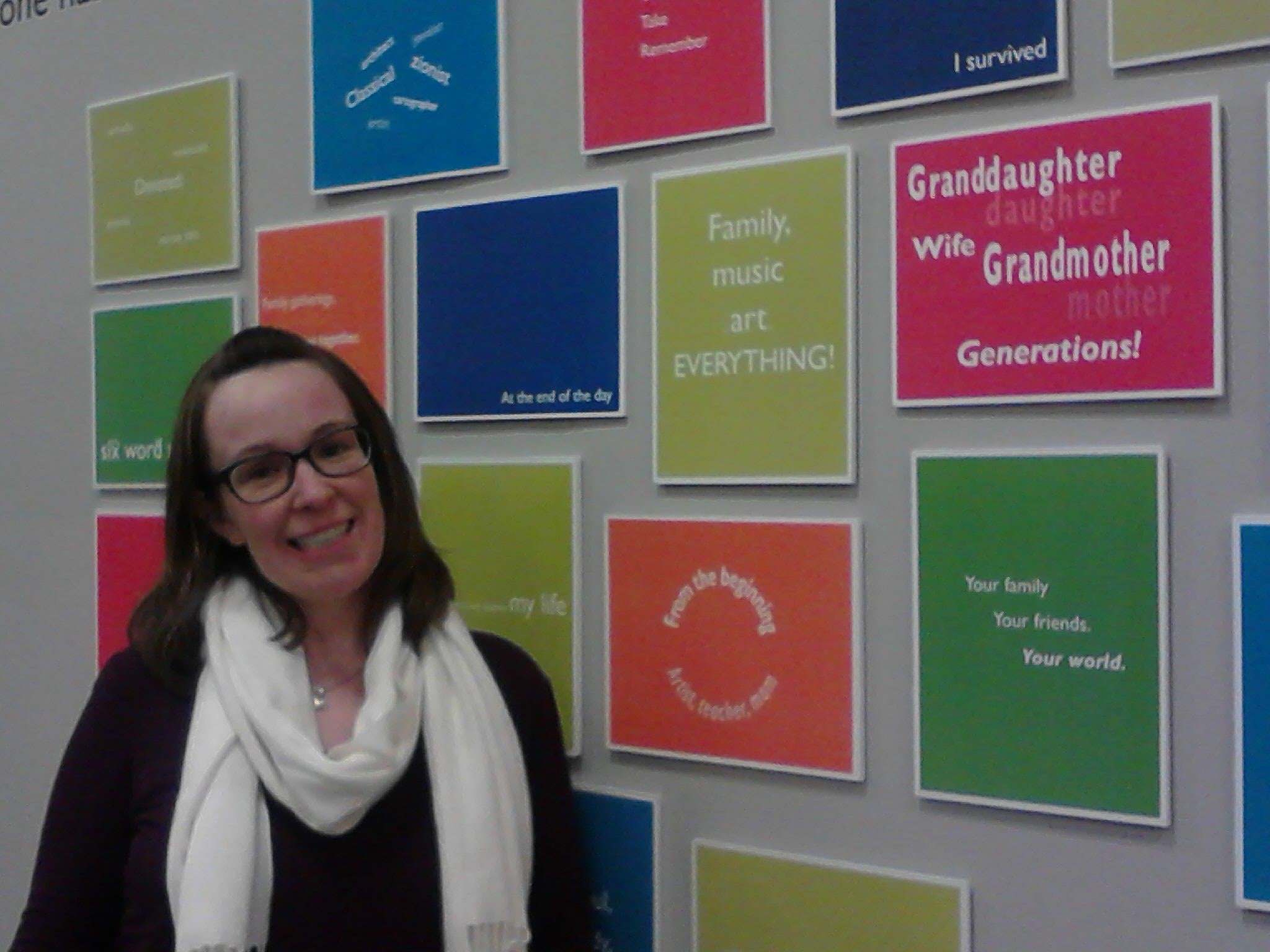
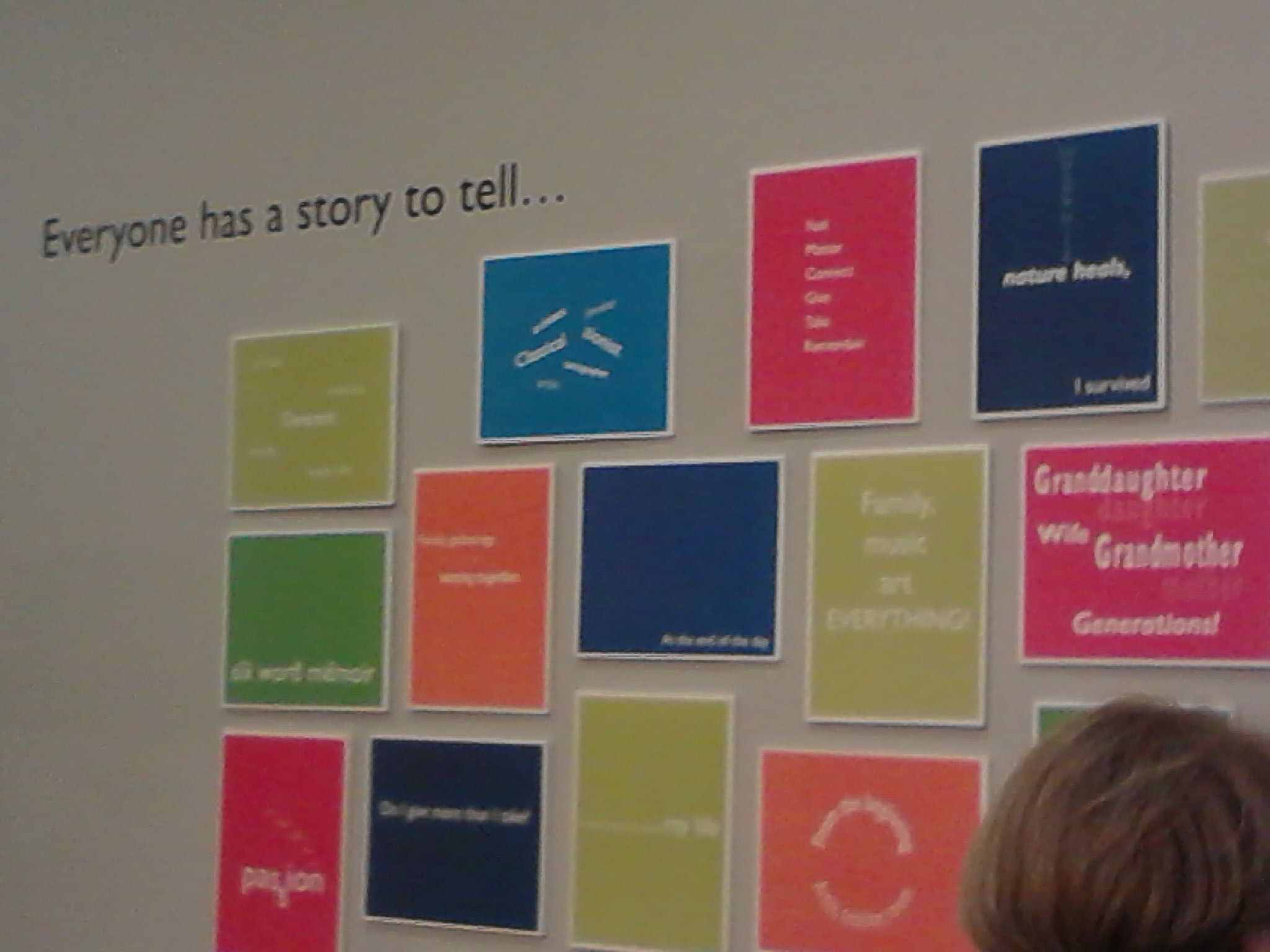
That was the conundrum I faced with ‘My Six Word Memoir’, a calling for and exhibition of this unique artistic narrative at the Jewish Alliance of Greater Rhode Island.

D by wall

A dear friend connected with the organization encouraged me to participate in the project, an offshoot of Larry Smith’s Six-Word Memoir challenge. The Jewish Alliance challenged the “community to rethink the notion of writer and memoir and offer a simple platform to share the short, sharp story of your life.”

everyone has The opening night of the exhibit, my friend and I circulated amongst  on-lookers and other writers. Some writers gave themselves away  with the click of a camera by their memoir. Others pointed theirs out  sheepishly when I commented on them. One of the organizers  admitted “[her] six words are always changing,” which segued nicely  into a conversation with another participant about the difficulty of choosing just one story. We discussed the distinction between a story and the story. Would bits and pieces of our lives represent it as fully or richly as an agoniziplace to tellngly selected six-word summary? Or more so? Someone had asked her whether her memoir was too simple. She’d countered with, ‘But is it?

Perspective is everything.

What seemed like a simple exercise in writing opened up many philosophical  and existential conversations – personally, as I sat at my keyboard, and  collectively, once I joined the audience at the art gallery. I realized that what  I put on my ‘canvas’ was not what others brought to it from their own  experiences. And what I read in theirs wasn’t necessarily what they  intended. Another case of artist vs. art critic. Writer vs. reader response.  Intent vs. interpretation.

Who can say that any one of the versions is wrong? Who can say that any one of us is finished writing the story of his or her life? It is the meditation and conversation that comes with that truly defines us.

mine

* A special thank you to the Jewish Alliance of Greater Rhode Island for offering this project and showcasing it in such a palatable way in Gallery (401).gallery 401

Standard
Mental Illness, postpartum depression

Into the Depths

It’s become an all-too-familiar image associated with postpartum depression.  A mother, out of her mind due to internal and external stresses, drives her children into a lake.  The reasons vary.  She may think she’s protecting them from an unseen spectre lurking at every turn.  She may be trying to protect them from any harm she might inflict as an unfit mother.  Whatever the motivation, the stories usually stem from some sort of irrational attempt at ‘saving’ the children under her care.

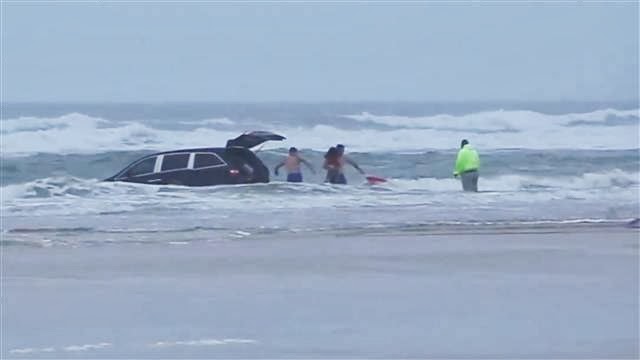
Last week, the body of water was the Atlantic Ocean rather than the ubiquitous lake.  A pregnant South Carolinian woman attempted to drive her minivan and three children into the ocean on Daytona Beach.  Bystanders sprung into action, pulling the children from the van, while the mother, still trying to head into the waves, apparently said, “We’re okay, we’re okay, we’re okay.”  Thankfully, in the end, they all were.

While reports of a diagnosis have not yet been made, I knew instantly this woman’s actions must have stemmed from some sort of perinatal mood disorder.  Of course postpartum was the first thing to pop into my mind, but then I learned she was pregnant.  Not outside the realm, people.  It’s not as if these mood disorders and psychoses obey that post determination like the flip of a switch.  The machinations that power the beast start churning before the baby pops out.

Indeed, this woman’s sister called police requesting a ‘well-being check’, knowing her sister was having difficulty.  The police suspected that as well upon speaking with her, but “conclud[ed] she couldn’t be held under a Florida law that allows for detention of people believed to be impaired by mental illness and who possibly pose a risk of harm.”  They did arrest her after her release from the hospital later that day, however.  With three counts of aggravated child abuse and a charge of attempted murder.

I do not condone the maltreatment of children and most definitely anything that could lead to their deaths.  However, the charges brought against this woman chill me to the bone.  Simply hearing the story – before any facts – I knew she could not be able to exercise right judgment.  Her sister recognized it.  The police officer who interviewed her earlier that day recognized it.  And yet, she is slapped with such a charge?

There are other issues at play.  She came to her sister in Florida to escape a supposedly estranged husband back in South Carolina.  She said she didn’t want him near the children.  The sister said she spoke of demons.  But then she also told police, “she’s … having psychosis or something or postpartum.”  Volusia County Sheriff, Ben Johnson, said “one goal of charging her was to make sure she gets help for any possible mental issues.”

“This is a tragic event. And our goal is to get her into the system so that we can protect the children and take whatever action we need to help her, too,” he said.

I certainly agree that she needs help, help needed so badly she cannot even recognize it.  But is this the way we help those with mental illness?  By charging them criminally?

And what do we tell the children?  The children reportedly told officers, “Mom tried to kill us.”  No child should have to go through such an ordeal.  But I certainly hope all the support staff that come into contact with these children temper their words.  I hope they avoid judgment and stick to the facts: their mother needs help.

Resources (all info and quotes come from the following articles):

http://www.cnn.com/2014/03/08/justice/florida-mother-minivan-ocean/

http://www.cnn.com/2014/03/07/justice/florida-mother-minivan-ocean/


Standard
anxiety, Poetry

To Your Corners

I want definition.

I want nice, neat little boxes.

If not black and white, then broad black borders to contain the colors within.


Classification. Order.


I don’t want things to merge, to blend, to intermingle.


I want to draw a line between thoughts and feelings.

I want to shut off that part of me responsible for irrational.

I don’t want to be able just to identify it, but send it packing.


There’s a difference between knowing and feeling.


I can know it all I want. I have to be able to feel it.

Standard
Depression, postpartum depression

Four Years a Fourth Trimester

The baby of the family wanted to look at her baby book yesterday. She always wants to look at her baby book. It has become a chore. Dragging the behemoth book off the shelf, finding a place where it can lay supported across our laps, turning the pages for her so they don’t get bent. Like so many things in life lately, it’s a task I don’t want my child/children to do because I have to do it with them. I don’t have the energy or desire to do so. I have other things I’d like to be doing. I have other things I should be doing.

We sat yesterday, wedged side to side in the rocking chair I used to nurse her in, with the book stretched between us. I flipped through the pages with her as I usually did: answering random questions with half my attention. I’d seen all this a hundred times. I’d lived it, though it seemed like an alternate reality, eons ago in a fog.

There was a time, a long time, I couldn’t bring myself to create this baby book of hers. I couldn’t peer into the thin nylon parting gift of a bag from the hospital that held all the paperwork and memorabilia. Perhaps opening it up would release the demons I’d stuffed deep inside. Or that I’d carried home from the hospital.

I remember that bag as a turning point. It taunted me as it hung listless from the closet doorknob of the nursery. It twisted and banged against the door as we opened and closed it. It loomed in my eyesight as I sat in that rocker and nursed.

I think I finally emptied the bag because I was so sick of looking at it and its reminders.

Now all those reminders are bound up in that baby book.

That she forced me to look at yesterday.

I maintained psychic distance until I looked closely at the pages of her actual birth. I still search her face for signs of sibling similarity. I still try to pinpoint the moment between the pictures where they lost her bracelets in the nursery. From that point on, is there still sibling similarity?

It’s a tired routine. It’s not as fresh and real as the anguished feelings that drove it in the first place. But I still look. When I force myself to really see, I still look.

I never want to look at the pictures again. I want to box them up and send them with her when she’s grown and going out on her own. I love her as she is. I don’t want to become the person I was when she was born. Looking at pictures of her from that time, brings that me back.

Ironically enough, I bonded with this baby of mine. We share the most loveable, profound moments. I never wanted to hurt her or give her away or wish her out of existence. But somewhere in that hospital room, I split in two. Thankfully, one half was the loving mother who was able to give her what she needed. The other half? That’s not so easy to define. That’s me. Inside out, soft underbelly exposed to the harsh world. Quivering. Questioning. Knowing that she was screwed as the first labor pains hit because, even at the end of nine months of burgeoning, she still hadn’t prepared herself for this birth.

And as much I liked to think it was behind me, it came crawling back in as I looked at those pictures.  Maybe that’s why it’s such a chore to drag that book out.

Will I always cringe to remember that time? Will it always elicit the same feelings, years, decades, lifetimes passed?

chap4-headerFour years is far too long for a fourth trimester.

Standard
Art, Writing

Process of Procrastination

This is how I spent the better part of my afternoon yesterday.

Photo by Jennifer Butler Basile

Actually, it’s how I spent the better part of the last few years. Or should have.

If you are the one person who happens to notice the bottom corner of my blog, where I post which book is currently on my bedside table, you might have been wondering what the hell was taking me so long to read The Process of Sculpture by Anthony Padovano. I’ve actually been reading it longer than I’ve been advertising it.

This highly informative tome of the processes of sculpture was loaned to me by an artist generous of her time and talent – and trust. My aunt took me to meet her friend, Sarah Blair, years ago, at the origin point of the trajectory I’m still on to write the young adult novel of Dmitri, the seventeen year old who desires to eschew the family tradition of plastering for sculpture. This sculptor was the subject of my very first interview as an author. I felt so official, doing research, for my novel. She happily answered all my questions, showed me her work, and sent me out the door with a text she’d studied in art school.

I wonder if she knew how long it would be before her book came home?

The book sat, pregnant with possibility and inspiration, in my rolling writing office at my old house, and on the writing desk I’d graduated to after we moved. It held the scratching and scribblings of my interview notes and beginnings of detailed notes on its contents. It waited when I’d lost forward motion on the project. It taunted when I picked the project back up and had no excuse not to crack its cover. It inspired me with its epiphanies that could be applied to sculpture and life. It lulled me to sleep at night. It awoke new insights into Dmitri and his story.

After mining its surfeit of information, I blessedly, rejoicedly finished it!

And yet, I couldn’t take it off my bedside table. I had yet to transcribe the nuggets marked by myriad sticky tags, rippling their rainbow tongues at me from the edges of the pages. I should be moved on to the next book. I should be typing a new title into the little corner of my blog. Alas, I had unfinished business.

After days of putting off the seemingly tedious task of transcribing quotes and notes about the practical and procedural side of sculpture, I sat down and realized Anthony Padovano spoke about a lot more than just sculpture. He spoke of artistic process. He spoke of life philosophy. Of beauty. Of meaning. Of right and wrong. Of finding one’s voice and when and when not one should use it. Of how to use it.

Yes, he and Sarah Blair taught me what Dmitri needs to know as a sculptor, what I might find him doing on any day in his studio, but also about the artistic process all around me. Of the importance of art and the valuing of it, in our world. How it shapes and defines our lives.

The book’s rainbow tongues had transformed into technicolor teeth on my computer, as I filled the edges of the screen with each completed point. Light from the windows behind transfused even the opaque white parts of the tags with a brilliance. Soft, gentle, but brilliant. The sense of accomplishment I felt upon closing that book with a solid thunk was brilliant. A job well-done. Finally.

Now I can write my book, armed to the technicolor teeth with sculpturing knowledge and a better understanding of what makes Dmitri tick. I could, in theory, build an armature with materials from the hardware store and mix my own plaster with which to mold it into life. I definitely can return Sarah’s book to her in good conscience and thank her wholeheartedly for sharing the process and molding the shape of my book.

Standard