Maternal Health Month, Maternal Health Month 2014, Mental Health, Mental Illness, motherhood

May is Maternal Health Month


May is actually Mental Health Month. If you were hanging around these parts at this time last year, you’d know that all too well. Every day of May, I posted something germane to that topic: reflecting on my own struggles and successes, reviewing symptoms and warning signs, offering hopefully helpful resources. While I got increasingly more depressed the more posts about my own depression I logged, it was a valuable exercise. So much so, that I’ve decided to do a similar one this year.

Since the plot line of my mentally-ill life spiked with the birth of my third daughter, I decided to tighten my focus onto maternal mental health. In no way am I discounting any of the other myriad aspects of mental illness and/or health, but those surrounding mothering and the female hormonal system are an animal in and of themselves – a big, nasty, brutish, spiky-haired one, may I add.

Colloquialism has us turning into fierce mama bears when our children are threatened, but what of the threats that come from inside us?

This month, I hope to explore that and perhaps lay some of that hair back down.

Join the pack.

There are so many of us out there, even if it feels each of us is trapped in a dark cave all alone.

A general banner for Mental Health Month, but I chose the image of this woman alone on the beach because very often, our family is fine, we're the one (feeling like we're) struggling all alone; that there is something we must fix within ourselves before we can connect with the family.

A general banner for Mental Health Month, but I chose the image of this woman alone on the beach because very often, our family is fine; we’re the ones (feeling like we’re) struggling all alone; that there is something we must fix within ourselves before we can connect with the family.


Standard
Living, Perspective

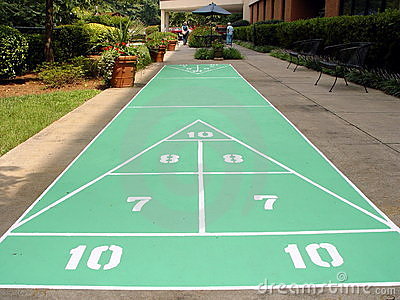
The Zen of Shuffleboard

Hanging out in a 55+ community can teach you a lot about life.

It’s never too early for happy hour.
It’s never too early to paint a driveway.
It’s never a good idea to force the disc in a game of shuffleboard.

I’d never played shuffleboard before. I had images of straw-topped gentlemen sipping gin and tonics smoothly gliding the disc as if across a sheet of ice. Tropical printed shirts in a calmly boisterous competition. Just the lines of the court themselves, all crisp and geometric, spoke to me of an art deco paradise.

And then I picked up a cue.

While my husband attempted to reign in our three spastic shuffleboarders, akin to three ninjas on speed on their first day of weapons training, I quietly sneaked to the adjacent court. I pulled the cue behind me with the gusto of an archer and swung my arm forward toward the disc, visualizing a tremendous skim to the far end of the court. Instead, the disc flipped back onto the golden shaft of the cue before smacking the ground with a clang like a dinner plate on the kitchen floor. This scenario repeated itself, with ever more epic flips, flops, and failed forward motion. I figured the more oomph I put behind it, the better the outcome.

Until I actually paid attention to the lessons my husband was trying to impart to our tiny samurais.

“Don’t push it.”
“Hold the grip lightly with one hand.”
“Rest the guide against the disc and slide it forward.”
“Take a few steps toward the disc and move your arm in one fluid motion.”

When I worried less about sending the disc into kingdom come, it went farther. When I forced it less, I got more. When I thought of the cue, the disc, as one long extension of my arm, my effort spun itself to the far end of the court.

When I got all amped up, when I tried to muscle things to my desired outcome, it flopped. All that pent-up energy, all that roiling muscle mass did nothing. It actually hurt my efforts. When I put in what my wound-up self would consider a failed attempt – no gusto – I had more success.

On the hollowed court of the silver-haired, I learned that nothing good comes of forcing an outcome. One must work in concert with the circumstances placed on the playing field. For the force to be strong, one must focus intentionally and let go of force.

Who would’ve thought a retiring past time would hold such potent lessons?
Standard
Living, Perspective

Framing the Scene

I always thought of the shadowed lines drawn by the slats of blinds to be something out of film noir. They always brought my mind back to the darkened auditorium of college, watching Double Indemnity and looking for clues of deception and danger within the frame.

This morning they make angles askew, geometric light patterns. Faint shadows paled by bright sunlight. Dull, flat gray; luminous white back lit by soft yellow.

How ironic that time of day,
quality of light,
the way your eyes flip the image, the brain perceives soft or sinister,
can totally change the mood, your mood.
The way you’ll approach the situation, the day.

It’s really all in the lens we choose to peer through.

Image from James Woodward

Image from James Woodward

Standard
Spirituality, Weekend Write-Off

The Red Tree: A Child’s Story, A Depressive Tale, and an Allegory All in One

Imagine not wanting to get out of bed in the morning. Not because you stayed up too late or the air is too cold – but because “the day begins with nothing to look forward to.” Forcing yourself out of bed only makes “things go from bad to worse.” You maneuver through a world that “is a deaf machine”; where “darkness overcomes you” and “nobody understands”. Ironically, you are on the inside – locked there by regret – looking out at the “wonderful things [] passing you by.”

Now, imagine you are a child.

In Shaun Tan’s The Red Tree, a young girl is the one going through all these machinations, these miserable feelings. The book jacket summary lists them as “inexplicable feelings”, which though they are, will be immediately recognizable to anyone who has had them. The swirling, at times, surreal illustrations Tan has created to accompany his text add an otherworldly depth that show their meaning perhaps more than the words can. Upon repeated inspection, you find more and more layers of detail and meaning.

This could be a story of a child trying to find her place in the world, which certainly can be daunting itself. I, however, saw deeper evidence of despair. Perhaps my dark lens of depression is translating the clues to match my view, but Tan’s story seems very much to match the trajectory of depression. This book is an amazingly evocative, yet straightforward treatment of a condition that words often fail. It would be perfect for children who may be suffering – either themselves or through someone close to them – to understand what’s happening and that they are not alone. My depressed self sees utter value in that. My paranoid mother hen heart breaks at the thought of a child suffering this way, scared that my own brood may be subjected it. I would call this required reading for struggling adults and extremely-valuable-but-hope-you-never-have-use-it with children.

Still, there is a thread of hope at the end of the story, that doesn’t always come with depression. Just as “the day seems to end the way it began, [] suddenly there it is right in front of you bright and vivid quietly waiting just as you imagined it would be.” In the book, it is a red tree growing from the center of her room that makes the girl smile. I wanted to shake the book and say, “But what is it? Why can’t I find the solution so easily? Just make it appear?” That’s when I thought maybe I was approaching this as a downward motion rather than from the bottom up.

I leafed through the pages once more, searching for the flashes of red I’d only slightly registered the first time. As the girl awakens on the first page, a red leaf is mounted on the wall above her bed. While black leaves swirl around her, the red leaf follows her through every scene. At times, it lies forlornly on the ground or is buffeted by the wind, but it is always there. When she returns to the quiet reflection of her room at the end of the day, there is a small red sprout, which quickly grows in the beam of light shining through the door she opens.

Though I didn’t realize it until I had reached rock bottom, that red leaf of the Holy Spirit followed me around the whole time. It waited patiently for me to open the door so I could flourish in God’s light and love. So instead of some magic trick I hoped to perform, healing myself, I just had to open myself to the guidance and care that was there all along.

How perfect that this epiphany came in time for this Good Friday. Even when Christ was at his lowest, He called out to the Father. He suffered so that we may have peace. And just as importantly, God never abandoned Him through all his trials.

Now I just need to be open to God’s uplifting power rather than the downward pull of depression.

* All quotes from Tan, Shaun.  The Red Tree.  Vancouver: Simply Read Books, 2008.


Standard
Mental Health, Mental Illness

Stand Up For Mental Health: Crazy Good Comic Big Daddy Tazz | Crazy Good Parent

Big thanks to Crazy Good Parent for sharing this clip from Big Daddy Tazz – and the entire ‘Stand Up for Mental Health’ initiative. Get ready to laugh! (Beware – some language)

Stand Up For Mental Health: Crazy Good Comic Big Daddy Tazz | Crazy Good Parent.

Standard
Living, Poetry

Laundry List

Poetry recitals, preschool sing-a-longs,
spring picnics, slumber parties, school vacation,
First Communions, community events, social commitments.

With so much fun to be had,
how can one have any fun at all?

Just looking at the list wears me out –
and I haven’t even thought of doing the laundry yet.

Good thing the laundry looks happy - because he's going to be there for awhile.

Good thing the laundry looks happy – because he’s going to be there for awhile.

Standard
Poetry

Soak a Single Moment


Tart and sweet,

warmth running down my middle.

The cricket click of a processor.

The whine of refrigeration.

The wave of radiation shimmering in the shadow box of mullions.

No matter where I am, I can find the glow of the sun.

It and I travel all over, and yet, connect –

if I look, if I feel, if I stop to soak it in.

Sometimes the grandest thing to be done

is to do nothing but soak in the sun.


Standard