
Imagine you are in your happy place
It wasn’t my meditation
Do you like to float?
I can never fully let go
Let the salt water buoy you
I want that for her
You are free
We all want the same thing

Imagine you are in your happy place
It wasn’t my meditation
Do you like to float?
I can never fully let go
Let the salt water buoy you
I want that for her
You are free
We all want the same thing
My big kid is home from college.
While her younger sisters have all returned to previously scheduled programming (albeit sleepy and missing vacation), she is still home for a few more weeks.
Most of her days are filled with making back money spent on tuition and checking in with friends from home, but she found herself with an open weekday yesterday. I had already scurried off to an oil change appointment when she awoke, receiving a text as I packed up the work I’d brought with me.
“When will you be home?”
“15 min. Why?”
“I’m bored.”
Having her home, even as a grown woman child, has brought me back to the younger days: of mine as a mother and her as a kid. When home was truly home base. Where we spent a majority of our time. Possibly in pjs – or maybe princess dresses. Where the living room became ball pit, blanket fort, vet clinic.
When it was all on me to occupy and entertain them – and fight to find time for myself.
We ended up clearing the living room floor to lay out yoga mats, her muscles tense and tight from standing all day at work (and yes, I realize the irony as I type that about a 20 year-old, but I will not one up her discomfort with my old ailments. My tongue is clamped between the teeth of my allowing her own experience in her own body. With age comes at least the attempt at maturity. And it is important to maintain our musculature at any age. I digress . . . ). She doesn’t usually do yoga on her own and I have a Pinterest board full of yin yoga routines, but I wasn’t sure she’d want to do the slow reflective yoga of middle age. I knew I was not all in for an energetic round of sun salutations. (God, this says so much about our stages of life). We popped on YouTube and I selected a Flow for Beginners video. Figured we could meet somewhere in the middle.
I was amused to find that both of us grunted and groaned as we assumed different poses.
“I got your Ujjayi breath,” I thought as I exclaimed.
Bones popped in their sockets and muscles shredded tension as they screamed.
“I didn’t realize how tense I actually was,” she said.
“Looks like you could’ve used yin yoga,” I said.
Ironically, I had a scheduled free online drawing class immediately after our session. Always my sketcher/doodler, I figured she could do that with me like we’d done yoga together.
And here is where it really became like the good old days.
While I collected my materials, set up the laptop, and grabbed a cup of tea, she took up residence on the couch with her phone (instead of a tablet of old) and watched videos at full volume. First, I entreated her to come draw. Next, I told her to turn down the volume. Finally, I fended her off as she bugged me.
Here’s how that went . . .

It wasn’t as bad as doing yoga with toddlers (yes, I’ve done that, too), but it certainly brought back memories. And while she certainly got my goat, as she’s wont to do and you can tell by the look in my eyes, the whole evolution told me a lot about where I’m at.
That I’m still learning how to make time for myself. That I’m better at it than I was. That it’s a continual process, not a height to be achieved. That kids can be annoying at any age (yours or theirs). That kids will still need you at any age. That I can look back at that time I found incredibly tough and realize I did things right, we had fun, and they felt love.
All because my twenty year-old first born got bored.

Am I the only one who finds the relentless stream of self-improvement programs this time of year depressing?
Not only because their purveyors are capitalizing on someone’s idea of self-worth
Not only because they remind me of my own lack of self-actualization and self-love
— Or maybe that’s what drives my major bone of contention:
That it is never as simple as ten steps, six sessions, and three weeks.
There is no miracle mini-session that can cure the complex web of what has gotten us to our present state of . . .

And that’s what I think depresses me.
The false hope.
How many times can a title draw you in, only to be left wanting more after a superficial few paragraphs.
When nothing exterior can help, when it’s all an inside job.


The election of Barack Obama signaled the dawn of post-racism in America.
And yet here we are, sixteen years later, in the murky half-light of a sun that just can’t break through the clouds.
Series like The Madness, recently released on Netflix, reflect this atmosphere our nation finds itself in.
Woke enough to see stories of personal growth fighting alongside and against systemic racism.
Enlightened enough to document and criticize constructs that oppress and limit.
Yet realistic enough that Muncie Daniels’ living nightmare seems very much a possibility.
Growing up white in the last few decades of America, fictional TV did (and would) not offer the true experience of people of color. Eric Estrada offered a palatable Hispanic citizen as an officer of the law. Robert Guillaume spoke a perfect King’s English as he politely answered the door. Hollywood very much curated the vision of people of color. If we did see the struggle of their experience, we certainly didn’t blame ourselves for it.
We decided we wanted to have as many Black characters as possible in the show. Part of what I think we did in the show, and I think is really cool, is that this is a show anyone can watch and enjoy, and we are treating our Black characters, our primarily Black cast, like most shows treat white characters. They can just be people. They can be themselves because they’re not one of the two Black people in the show [and] have to represent all Black people. They can just be people.
VJ Boyd, co-showrunner The Madness in The Hollywood Reporter
In The Madness, Muncie Daniels’ struggle is very real. He must balance internal conflict with the outside forces that threaten to destroy him.
Muncie Daniels’ situation is amplified and magnified for dramatic effect, but the frustration and helplessness that he feels very early on – in conversation with Kwesi (even before he’s forced to drop his case) and especially in the interrogation room with Philadelphia police – are palpable. They are meant to be and feel outsized here because often the constructs racism has erected are unscalable. A person of color may not find himself at the center of a conspiracy master plot, but the exaggerated elicited emotions here serve to prove the effect in any situation where personal actions and the truth don’t necessarily enter into the equation.
The generational experience also weaves a meaningful thread through this story. Muncie is haunted by the ghost of his father’s actions. Isiah, while somewhat of a father figure, also reminds Muncie of his resemblance to his father’s flaws. Demetrius corrects his father on the terminology of his generation when Muncie tries to say D’s friend lives in the projects. And while Kallie is also Muncie’s offspring, she is just older than Demetrius to offer a sage outlook on his performance as a father and what his actions and attendance say about him. The many ages and stages of living in the racial state that each generation did are well represented and contrasted. The interactions between generations do well to represent the influence and evolution of experience.
It is refreshing to see a mainstream series accurately reflect what has survived the ‘post-racism’ movement of America. Unfortunately, there is always another Rodney Kraintz, as he himself posits to Muncie in the final scenes. There is always a larger, more powerful, and insidious construct pulling the strings behind the scenes.
Our nation has ticked the needle to a vibration just high enough to reflect the struggle and validate the experience – but not enough to dismantle the attitudes and oppression.
Great change always begins with the artistic vision and lens, but how do we, as individuals and a nation, change the unjust reality people of color face in our nation?
We can start by exposing the madness for what it is and not allowing it to activate the madness within us.
As always, any social commentary of racism and its wide-reaching effects made in this blog are made with full acknowledgment of the fact that they are through the lens of my whiteness.
Related:

I wrote a poem about loss.
No one died, but all around me there was empty space with the possibility.
When we worry, when the unknowns build into an ugly catastrophe
it’s easy to be overwhelmed by the gravity of it all.
In the stark cavity created by the spidery black legs of a thinly padded plastic chair and the expanse of institutional white tile below
sat the plastic bag
holding the physical items that tied personality to my baby
The ones she doffed for an anonymous starched gown
that dwarfed her inside
all of the unknown
While I sat staring at the obscenely transparent plastic holding but a small part of her.
There is nothing so sad as a clear plastic hospital bag.
Kite-string thin threaded through plastic puckers
pulling at the corners, ripping at the seams
The material trappings of this world lumped at the bottom
Empty expanse of cellophane spread out for the world to see
Contained for safe keeping
Inconsequential in the aftermath
Who cares for scrunchies and soft socks
When the immaterial has left this mortal coil

When we ACCEPT the role of mother, others EXPECT a whole host of duties and obligations to be met. Feeding (if from the body) and love are the only absolute definites by mom. There is no reason others cannot rally around mother to help fulfill the myriad requirements. Unfortunately, due to the myriad reasons discussed throughout this theme of modules, ALL of the expectation often does fall to mom – leaving little room for little else.
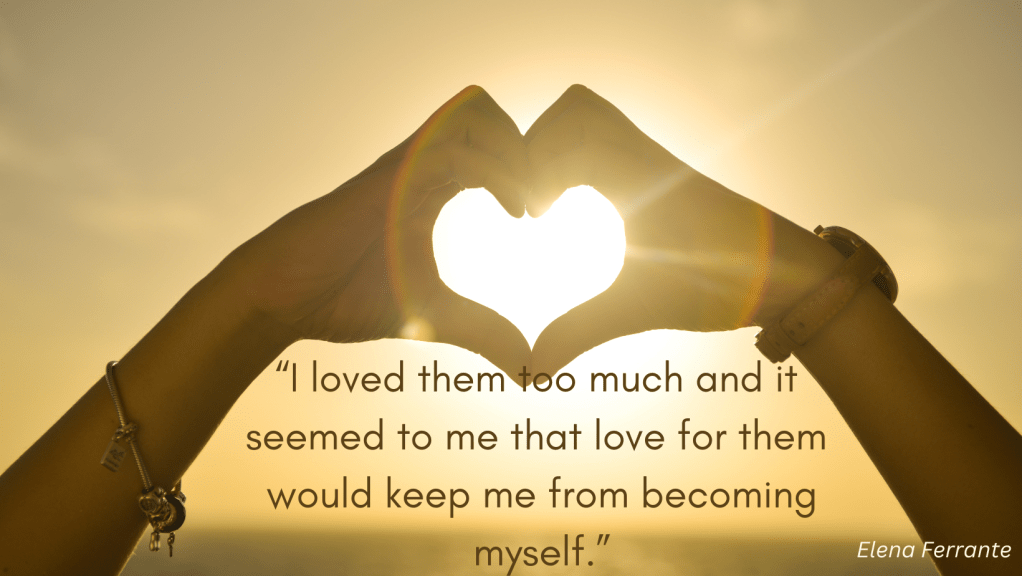
Of course a woman has an identity outside of mothering. Maintaining and nourishing that part of herself, however, often becomes one more responsibility for her to manage. In the daily onslaught of caregiving, it can sometimes be left behind.
Graeme Seabrook and Beth Berry both have done work describing women who one day find themselves with grown children and no sense of purpose. They both also support women in strengthening their personal selves alongside their mother muscles.
There certainly must be a way to embrace oneself while loving our children extravagantly – without leaving like Elena Ferrante’s Leda did for three years.
Or falling into mental illness.

None of the protagonists in the above mentioned plays are mothers – and yet part of their experience is familiar. Whether it be by her child, partner, or the patriarchy, every woman has felt she has not been sufficiently regarded at some point – or increasingly so with each year. And while this does not mean every one of them/us is descending into insanity, it is not outside the realm of possibility with repeated exposure and/or lack of change (systemic or personal).
If the discrepancies are too large between the expected version of ourselves as women/mothers and our reality, therein lies the rub. One that will rub us raw if we don’t find some way to bridge that gap. Or let that foreign shore drift farther and farther away as we move toward the who and what we want.


While we’ve seen the evidence of odds stacked against women and mothers time and again, it’s also clear that our smart strength has ensured continued success despite it. Still, there is no reason our jobs and lives should be any harder. But until society reforms the (lack of) support structures that be, women will continue to rail against the injustices in both overt and covert ways.

While the above description would fit a modern feminist author, it actually describes English and American writers in the nineteenth century. While the cultural mores of the time wouldn’t allow overt criticism, they were “especially concerned with assaulting and revising, deconstructing and reconstructing those images of women inherited from male literature . . . the paradigmatic polarities of angel and monster.” Gilbert and Gubar go on to say, “Examining and attacking such images, however, literary women have inevitably had consciously or unconsciously to reject the values and assumptions of the society that created those fearsome paradigms.”
While fighting for authentic experiences in our own lives, it is empowering to see ourselves reflected in the pages we read for enjoyment and enlightenment. Not images created by someone else that vilify those who dare buck the system.

Self-help. While the initial image that comes to mind may be a busy mix of paperbacks and spiral-bound workbooks on a bookstore shelf, this was actually another field in which women subverted the system from the inside out. It was at the crux of a “giant upsurge of interest in women’s health care.” (Cleghorn 283)
In their 1973 book Witches, Midwives, and Nurses, Barbara Ehrenreich and Deirdre English said that “every effort to take hold of and share medical knowledge is a critical part of our struggle.”
Self-Help has somewhat morphed into ‘self-care’ these days – but only in the truest sense of the word. In real activism and attention to policies as well as true self-work and growth – not merely beauty routines and out-priced treatments.
Ten years until I graduate.
My dad used to say that the start of a new school year was his favorite time of year. It meant crisp yellow pencils, a bright pink eraser. A fresh start.
I do recognize the importance of cycles, their ability to restart or refresh us.
But I feel like I’ve been in school f o r e v e r.
Thirteen years of my own. Four years of college. Eight years of teaching. Then herding, leading, prodding my own for . . . fifteen?
There was a time when the sight of a school bus would spark anxiety in me. On weekends away from the classroom already too short, I needed no reminder of that place that triggered so much in me. And perhaps it is residual tension from those teaching years that bubbles up as I cycle through the start of each new year with my own children.
But I feel like a prisoner in this academic calendar.
Last year I had a student in every educational environment.
Elementary, Middle, High School, and College.
All represented.
It was a cool factoid. A sign of our wide-ranging and crazy family. I named the blog post I never wrote: All Ages and Stages.
Now as I anticipate walking another child through the college gauntlet, when I don’t even feel I’ve recovered from the last go-round, I’m tired.
I will support the homework and the lunch-making, the pick-ups and drop-offs, the reminders and subsequent nagging, the atta-boys and better-luck-next-times.
But I look forward to the day I finally graduate.
Yes, I am singing Third Eye Blind as I type the title . . .

In nature
I wonder how many streams
is too many streams

Excepting flood stage
what is the maximum
confluence
of streams

Because
we humans
are not smarter
than nature

and yet

we try to support
multiple inputs,
audio video sensual,
all at once

It is no wonder
our consciousness
shuts down
zones out
is washed away
 Chopping Potatoes