Children, parenting, Poetry

Dark Matter

Where does a backpack go
confined inside four walls?
Does it sprout legs
and walk off?
Will the underlord of the couch
reveal his hostage?

Where can a blank book hide
from prying eyes?
Filled with private words,
its thick cover is not enough
to disguise it from vengeful fingers and pens.

An errant sock, a puzzle piece, a lego gone astray –
inanimate things seem to take on a life of their own
when children roam the home.

image by Terry Broder

image by Terry Border

Standard
childbirth, dialogue, help, motherhood, postpartum depression, pregnancy, prevention, Recovery

More to the Story

I spent an hour and a half sitting on the basement floor of my local library the other morning.  I’d found the general Dewey decimal neighborhood I’d wanted and set about meeting the locals.

One good thing about living in a small town on a frigid morning and rushing the library doors as soon as they open is that you have nearly the whole place to yourself.  I was the one who flipped on the banks of fluorescent lights as I descended the stairs.  I sipped from my travel mug of tea as I decided which books would aid me in my research journey.  I read nearly an entire chapter of one that I eventually set back on the shelf – one I’ll certainly return to, but didn’t match the goals of today’s project.

Today’s project is preventing postpartum depression.

Though I checked out nine books, welcoming jokes from the clerks at the front desk as to what kind of wagon I’d need to transport them to the car, none is about postpartum depression.  One is about ‘regular old’ depression.  Others have a few pages, maybe a section specifically about postpartum.  But not one of the towering stack I selected gave an in-depth discussion of postpartum depression.

In the online catalog of our state’s inter-library system, there were some, but still not that many.  And none that looked, on first glance, like they offered the kind of practical information and solace that a woman in the throes of postpartum would want or need.  I know.  It doesn’t take much to put myself back to that hopeless place I experienced myself.

I ended up checking out mostly childbirth preparation books or ‘how-to’ guides to pregnancy, which made my children, upon seeing Mommy read a book with a woman’s round belly on the front, very suspicious.  Two of my girls put in orders for a baby brother.  I asked my eldest if she’d want me to be pregnant, to which she said, no, but if you were I’d want a brother.  Only now do I see the irony in their thinking I needed to read another book about pregnancy after three times around the mountain.

Been there, done that.

But this time, I was trying to read these pregnancy preparation books with new eyes.  Having been through it and having had the experiences I did, what would help me do it differently?  Or more importantly, what support systems would have kept me from plunging into the depths of despair?  And how can I apply those to helping other women?

I was surprised to enjoy Ina May’s Guide to Childbirth (Ina May Gaskin) as much as I did.  I figured that title would be one I skimmed to find anecdotes or info pertaining to postpartum, but I am thoroughly enjoying delving into the personal accounts of unhurried, gradual childbirths.  I am rediscovering the empowering parts of my own labors and deliveries – the first two for their strengths and victories, the last for my eventual triumph over seemingly insurmountable odds.  With that last one as my capstone, I’d forgotten the positive parts of pregnancy and childbirth.  Remembering that gives me something to help women to which to aspire.

The disparity between parts of my own experience and beautiful birth stories brings into sharp focus those areas that can serve as triggers, flashpoints for distress and disorder.  And by beautiful, I do not mean perfect or idyllic.  As Anne Cushman says in The Mindful Way Through Pregnancy, “labor and delivery are wild and messy and animal and angry and bloody and painful.  The transcendent act of giving birth is made up of the earthiest of elements: bodily fluids, a hospital gown stained with blood and excrement, the bruises left on your partner’s arm by the agonized grip of your fingers.” (Piver 16)  All this is normal, to be expected.  That’s not what we need to worry about.  We (women, mothers, humans, physicians, therapists, ob/gyns, midwives) need to help women recognize when there is cause to worry.

So maybe sitting on the floor of my local library and freaking my kids out with pictures of the ocarina found in one of my books will help me figure out how exactly to do that.  As with anything, it’s all about dialogue.  Whether that dialogue comes through books at the library, blog posts, or conversations with doctors, expectant and newborn mothers need to know there’s more to the story.

Standard
Identity, Spirituality

Epiphany

In high school, somewhere around the time I began to expand my vocabulary, realize the power of words – and prep for the SATs? – I came to love the word epiphany.

This phenomenon also coincided with my own spiritual awakening, but ironically, it had little or nothing to do with the three wise men heralding Jesus’ birth.

I would excitedly proclaim I’d had an epiphany when some amazing truth would whack me between the eyes. An amazing idea or affirmation. When the whoosh of a flock of shorebirds made my heart swell with the certainty of who I was as I stood sentinel on a sandbar.

As life rushed in to fill the free spaces, however, the epiphanies got fewer and fewer – until at some low point, they stopped. A noisy, dissonant place where even the chorus of bird calls could not be heard.

And yet, I still maintain our Christmas tree until January 6th. I still display Jesus and His cast of adorers in the creche. I try, I try to push back the doing, the speaking, the thinking – to open space for His coming.

And in short bursts, He has. I’ve opened windows just small enough for a spark to shoot through. A movement in a certain direction. A push toward a way of being.

I want the lightning bolt, but it can’t strike as readily under all this stuff. The circuit is closed. A spark will have to do. But great flames can burst forth from a tiny spark. And purify everything in their path.

from tcc-online.org

from tcc-online.org

Standard
Awards, Weekend Write-Off, Writing

2014 in review

Thanks to Wordpress for this informative and humbling report on the chopping of potatoes this year.  There is work to be done – but only on my part.  You, dear readers, have always been the bomb!

Here’s an excerpt:

The concert hall at the Sydney Opera House holds 2,700 people. This blog was viewed about 9,400 times in 2014. If it were a concert at Sydney Opera House, it would take about 3 sold-out performances for that many people to see it.

Click here to see the complete report.

Standard
Depression, Living, Survival

Let-down. Easily?

The excitement I felt as a child spying Christmas lights through the trees, the twinkling points brightening the darkness, a magical apparition amidst a black backdrop – to say that’s gone away as I’ve gotten older would be a lie. It may have dimmed, but it hasn’t disappeared altogether.

Long drives to relatives’ houses, country roads turned unfamiliar by nightfall, the conical Christmas trees aglow in the windows we pass become the markers, the golden deer high on a hill the waypoints.

Our family traveled to one relative’s house both Christmas Eve and the following Saturday. The same route, the same sparkling spectacles, but somehow, within the space of a few days, the lights had lost their magic.

What once signaled possibility, now was a sad reminder that it was over; the points of light now a poignant prompt of what was. Looking at those lights depressed me in a way I couldn’t name. Not in the way it may have as a child, if Santa hadn’t brought me the one thing I coveted. Or knowing the time of unlimited treats was over. Perhaps because all the preparation leading up to that one day, all the hours reduced to a mere twenty-four, passed by in a flash. There was nothing now to which to look forward.

The lights would soon go out. The joyous strains of Christmas carols would end. The bleak days of winter would set in.

The end of the season is capped with the celebration of New Years’, but that’s always depressed me nearly as much – if not more.

A time to recount what we’ve done wrong during the past year, our mistakes, opportunities missed, amazing moments gone. Waiting in a suspended state, on edge, for – a kiss? A hangover? A mess of confetti to clean up? To wake up the next morning bleary eyed and cranky. What an auspicious way to herald a new beginning. The fact that, for years, New Years’ also signalled the end of vacation for me and the restart of my teaching schedule certainly didn’t help. That was anxiety-inducing and depressing in and of itself.

The whole of the time period between Christmas and New Years’ is a weird dead zone. There no longer is the excuse or mask of Christmas to impel us to at least fake happiness. There is a winding down, a let-down – with the building stress of creating a killer list of resolutions, ways to make our flawed selves better, to overcome our frail ways, to defeat the demons plaguing us for years in this one year. No pressure.

There is a hollow space in my chest during this time. A sadness somewhere behind my eyes and down in my throat. It is a return to normal. A return to a time with no distractions. While stressful with its added expectations and tasks, the time leading up to the holidays gives lots else to think about – rather than our problems. Or at least a good way to avoid them. Now it’s back to ‘ordinary time’.

And while that may not be the designation on the Church calendar at this time, that’s what it feels like to me. No longer extraordinary.

I know if I remove the decorations, the piles of gifts, the social commitments, there is the ultimate fulfillment of my wildest expectation in the birth of Christ. In the silence that follows all the earthly tumult is His quiet peace. I know I’m missing the point if I mistake the silence for sadness, when it should be taking me truly to the heart of the season, the true meaning. Perhaps that’s what the hollow is – the fact that I am missing it. But it is sometimes hard to cross the bridge between knowing and feeling – not because I do not want to, but because my body, or brain chemicals, or something won’t let me.

There is always the problem of unrealistic expectation. If I go from moment to moment, living it for what it is, sucking the marrow out of this minute, rather than anticipating the next, I will enjoy rather than lament. But I’ve always found it hard to balance preparation and mindfulness.

A couple of things I may try:
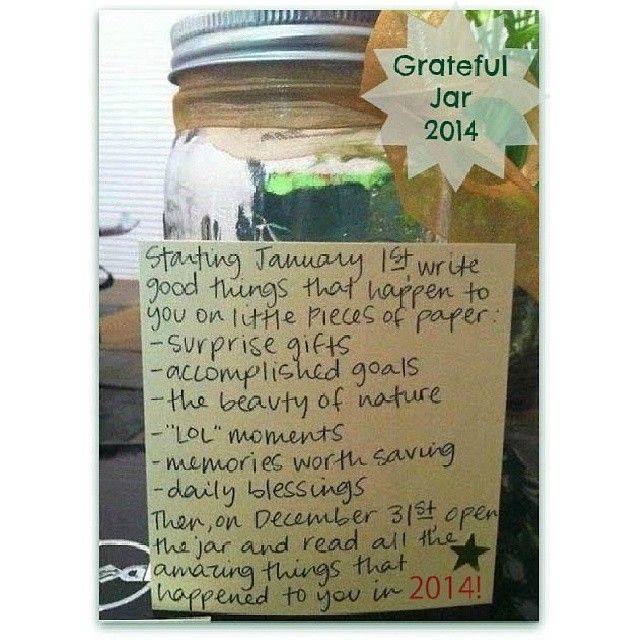
gratitude jar

Reading these next New Years’ Eve would put a positive focus on the end of the year, what I’ve gained and experienced rather than what will be lost.

Also, viewing the holidays in the terms put forth in this post from Life at the Circus would help keep my perspective from being skewed negatively and keep the absence out of the space after the holiday.  It may even keep me from feeling less in the pressure to make New Years’ resolutions.

May you all continue to see and feel the light of the season – even in the darkness behind your closed eyes. May you find ways to make that light last throughout the year to come.

Standard
Living, Recovery

After(math of) Christmas

After holiday dinner, it’s back home to sweet potato peels on the floor.
curled into ribbons just before rushing out the door.

Dehydrated cantalope cut in the corner,
casualty of a frenzied fruit salad creation.

Boxes and ribbons and crumpled tissue paper
cast about the foot of the tree.

Accumulation of cookie crumbs and candy wrappers,
born of abandoned brooms and dustpans.

Time to pack things away instead of pulling them out,
to undo what took so long to do up,
unwind what’s so tightly wound.

After all the expectation and anticipation,
there is a void –
filled with the scraps of what was pretty and bright.

from xmasfreak.com

from xmasfreak.com

Standard
Weekend Write-Off, Writing

Always in Season

But I am sure I have always thought of Christmastime, when it has come around — apart from the veneration due to its sacred name and origin, if anything belonging to it can be apart from that — as a good time; a kind, forgiving, charitable, pleasant time; the only time I know of, in the long calendar of the year, when men and women seem by one consent to open their shut-up hearts freely, and to think of people below them as if they really were fellow passengers to the grave, and not another race of creatures bound on other journeys.  And therefore, Uncle, though it has never put a scrap of gold or silver in my pocket, I believe that it has done me good, and will do me good; and I say, God bless it!

— from A Christmas Carol by Charles Dickens

Standard