perinatal mood and anxiety disorders

The Connection You Never Knew You Needed

Postpartum Support International (PSI) was founded in 1987 in Santa Barbara, California by Jane Honikman, who was spurred on by her own experience with postpartum mood and anxiety disorders in the 1970s and the obvious need for social support for new mothers.

Now headquartered in Portland, Oregon, PSI has expanded across the United States and into 36 countries. With helplines, peer support groups, and professional training and resources, it is a bastion of maternal mental health.

While PSI came on my radar over twenty years into its tenure, spurred by my own struggles, it quickly became a source of hope and continued utility and inspiration. All the women I’ve met in the maternal mental health space have been incredibly affirming and supportive. To be able to amplify those connections and community on the PSI blog is a true honor. Read my piece below:

Standard
mother vs self, Uncategorized, Write to Heal

How Did We Get Here?

In 2012, I began this blog as an exploration of my experience with postpartum depression. I wasn’t doing it to publicly rehash all the difficult details; I was hoping that in sharing my story, women who had been to the deepest depths that I had wouldn’t feel so hopelessly alone. And I did find others. They found me. I’ve forged some amazing friendships through the wonders of the web.

In the first part of 2015, I embarked on a new leg of the journey. My research began in earnest, collecting evidence of pre- and postnatal care and experiences, outcomes and interventions – all through the lens of maternal mental health. I completed Postpartum Support International’s Perinatal Social Support Webinar Series. In July, I attended Postpartum Progress’ Warrior Mom Conference in Boston, the first ever large-scale gathering of survivors of perinatal mood and anxiety disorders.

I was poised to bring my advocacy to a new level.

I sent my ‘baby’ off to kindergarten – and a month later, got pregnant.

Truly, she was the pleasantest surprise.

My past experiences armed me with a proactivity I hadn’t had in previous pregnancies. And I see now that my knowledge and experience have deepened in the intervening time to enrich my advocacy even more.

Still, even with my depression ‘managed’, motherhood was challenging. And not in a growth mindset sort of way; in a soul-sucking, all-encompassing sort of way. I realized that mothers needed support whether they were suffering from a mental illness or not. Untenable conditions with no support could mean a tip into mental illness. And even if it didn’t, what of a mother’s mental wellness?

With writing being such a cathartic and expanding experience for myself, I sought ways to share it with others. How could I use journalling prompts, easily accessible and customizable to anyone – even if they weren’t in love with writing like I was, to aid women in their journey to authentic and fulfilling mother- and personhood?

In a synthesis of my writing, experience as an educator, and lived-in motherhood, the idea of a workshop was born. A chance for women to share their experiences in a community of empathetic peers and to explore their own personal questions, fears, joys, and challenges through writing. A release and a way forward.

I knew I wanted to offer the inaugural in-person workshops in the month of May, to coincide with Mothers’ Day – not to commemorate that holiday, but to give mothers an alternative celebration of themselves in a world that often lets them down. This finally happened in May 2023. I gave three workshops in three different locations in my surrounding area. But that only served those within driving distance. Readers and supporters reached out to me from other states, even Canada, suggesting a virtual option.

Nothing can replace in-person dialogue and the energy of community and I am no Zoom-inista – but the subscription series was born. I tried to translate the thought and writing prompts into weekly sessions across a monthly theme.

I endeavor to make this a virtual community, even if the gathering place may initially be in the comments section of each weekly module. With the dream of gathering us all in a center of our own someday. A center dedicated not only to the worthy and fulfilling vocation of motherhood – but to the sacredness of our individual personhoods as well.

Standard
Mental Health Month 2017

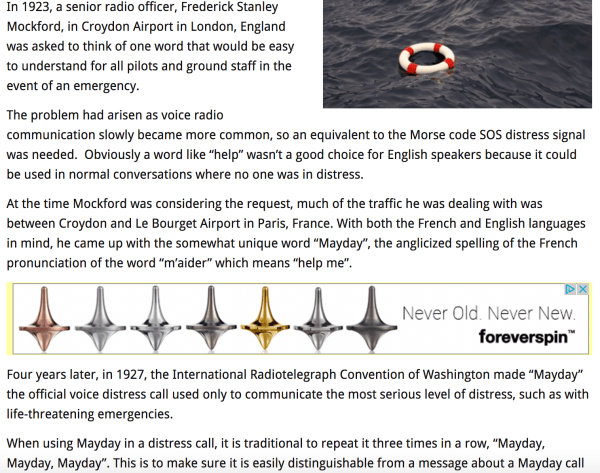
Mayday, Mayday, Mayday

M’aider: help me

repeated three times in a row

internationally recognized distress call

Next 31 days – third May I’ve tackled mental health issues for a month straight

It is Maternal Mental Health Awareness Week, the beginning of a month dedicated to opening dialogue and resources to all women in the perinatal realm; that is, attempting to conceive, prenatal, postpartum, and living the dream.  There are air quotes around that last phrase there – because sometimes mothering can be a nightmare – for too many reasons to list here, but May is a month dedicated to the mental health of mothers, be their struggles situational, emotional, or physical.

As maternal mental health is an issue close to my heart – and psyche – I endeavor to share my own experiences throughout this month and explore others’ and share information.  The fact that I haven’t made it each May since the inception of this blog is an illustrative example of my life and the raison d’etre of the blog itself.

While I was blogging in 2012, I’d only just started my fifth month.  And while I’d signed my name in ink and blood on its byline, I don’t know that I was fully in mind of where my daily life and mental health intersected.  By 2013, I felt comfortable enough in the platform to tackle a month-long series to raise mental health awareness and work to eradicate stigma.  Even then, I still saw the month as other; a separate function of my blog.  I showcased the fabulous Blog for Mental Health Project, but hadn’t taken the pledge myself, feeling unworthy since my blog wasn’t dedicated solely to discussion of mental illness and health.  By 2014, I was ready to laser my focus on not only mental illness, but the flavor that burned the back of my tongue after the birth of my third, inciting this whole process: maternal mental health.  Ironically, this laser focus blew everything wide open.  I began to realize that my blog was always focused on mental health even if I wasn’t discussing DSM or sharing the latest research; because mental health, whether an individual accepts it or not, affects every. aspect. of. one’s. life.  

And then, 2015, I didn’t log daily posts during May.  Perhaps I was burned out by the idea of daily posts with my three minions around.  Maybe I felt I’d saturated my serial idea.   I know I wasn’t naive enough to think I’d covered it all.  Maybe I was naive enough to think my life had hit critical mass and I didn’t have the time.

Because in May of 2016, irony of all ironies, I gave birth to my fourth child.  Another surprise.  Another girl.  But a new beginning with no mental health issues – other than the low-grade ones I’d been dealing with for the previous seven years.  Needless to say, a month-long daily series did not occur with a newborn.

Enter 2017.  I’m going to try to climb back on the horse, though it may look more like the dark ride of the ring wraith than the victorious march of the Mother of Dragons.

I’m not promising anything – except my ever-continuing support of all those struggling with mental health issues.

Standard
Depression, pregnancy, Uncategorized

I Wept

For the pregnant woman
who loved her child enough to stop taking the psychopharmaceuticals she desperately needed
to guarantee its unencumbered growth –
and that of her paranoia and compulsion
until she threw herself and that unborn child off the top of her building

Because she loved her child so much and had run out of ways to keep her safe

For the grown man
acutely aware of his condition and how to manage it
with a cocktail of meds and careful counseling –
until one tile shifts out of place and sends the rest clattering to the floor in an instant

Because he thought he didn’t have to look over his shoulder for the rest of his life

I wept for their stories, their lives, their pain
I wept for the syncronicity, the melancholy, myself

I wept
because there is never a safe enough distance from the places they – I’ve – been


As inspired by the June 6th edition of Fresh Air, “Pregnant Women With Depression Face Tough Choices, No Easy Answers” with author Andrew Solomon.  Click below to listen – well worth the time.

pregnant-depression

Standard
postpartum depression

Down in the Valley

When I first heard the idea of postpartum depression in fathers, I thought it was a bunch of hooey. I knew, with the interests I have and the topics I research, I should jump wholeheartedly into the facts of the phenomenon, but I harrumphed at the links and passed them by. Men simply and physiologically could not experience the hormonal onslaught and the horrific physical demands of the perinatal period. I felt that such attention on males would only distract from the already poorly represented female population of sufferers. Could they really have it so bad?

And then I participated in Postpartum Support International‘s webinar on ‘Involving Dads and Partners’.

Dr. Daniel Singley, a psychologist with The Men’s Center for Excellence, opened the webinar with a discussion on relationship issues, stating that one must look at perinatal depression within the arc of a couple’s relationship, as they directly affect each other. Also, a couple’s childbearing years usually coincide with a dip in relationship satisfaction already occurring, an interesting factoid that may explain a lot.

ushaped curve

With the modern expectations of hands-on and collaborative fathering, there has not also come guidelines for how to do that. Fathers are told they must support mom, but they aren’t told how. They must be strong for her, but all without anyone having their back. Gender differences often don’t allow for solicitations for help either. If there is an underlying mental health issue already, such conditions exacerbate it.

Parenting is new to both parties – not just the mother. There is a vast body of knowledge yet untapped in human experience until a parent holds that fragile little being. Insecurities and lack of self-confidence abound in both sexes as they navigate these new waters.

Having only walked in my own flattened out shoes, I dare say women still have the larger burden. We had to push the human out of our bodies. We have to recover from that onslaught while some of us continue to sustain baby with our bodies through breastfeeding. And the huge learning curve of caring for an infant comes with the mantle of harrowing hormones (Feel good hormone, my right raw nipple).

However – Dr. Christina Hibbert makes a good point. In excerpted text from her video, Postpartum Mood Disorders: The Couple’s Experience, she describes how a husband feels he cannot do anything to help the women he loves so much as she suffers. Another husband says ‘it’s as if an alien abducted my wife, returning someone who looked like her and acted like her, but was totally different.’ I showed this part of the webinar to my husband. He paused, nodded thoughtfully, and said, yeah, that’s about right.

This is where looking at postpartum in terms of a spousal relationship is important. As if an individual’s depression weren’t complex enough; as if birthing a child weren’t enough of an event; as if worrying about raising that infant to adulthood safely weren’t overwhelming enough; there is the irrevocable effect the whole evolution has on your relationship. And if it’s a truly loving and compassionate one, watching your partner devolve into depression would certainly take its toll on you.

I was in my own vortex of hell; I couldn’t see anything beyond it. I would hug my husband and thank him for staying with me, other days asking if he’d leave me for all the trouble/misery I’d caused. But I had no idea what his experience was like until I heard these descriptions on this webinar. The pain and grief he experienced. My heart ached anew. For the ways my depression had hurt him and how I was helpless to fix it.

Postpartum – and any other brand of – depression is truly a familial condition. It is not, nor even should be, a solitary journey. Unfortunately, many times the family members are drawn into the negative effects whether they like it or not. But with awareness and support, the weathering of and coming out of can be that much kinder and gentler.

I should not have scoffed at the idea of postpartum depression in dads. Perhaps it is the flawed nature of the term in general. The field is moving toward the broader and more comprehensive term perinatal mood and anxiety disorders (PMAD), which I agree is much clearer and effective. Fathers do not experience the perinatal phase exactly as mothers do, but then, each mother experiences the perinatal phase in a different way.

Everyone involved in the perinatal process needs understanding and openness, warmth and wisdom. Then, perhaps we can all make it up the mountain on the other side of the valley.

Standard