mother vs self, Write to Heal

Sharp Contrast of COVID

In March 2020, the Atlantic proclaimed COVID-19 a ‘disaster for feminism’.
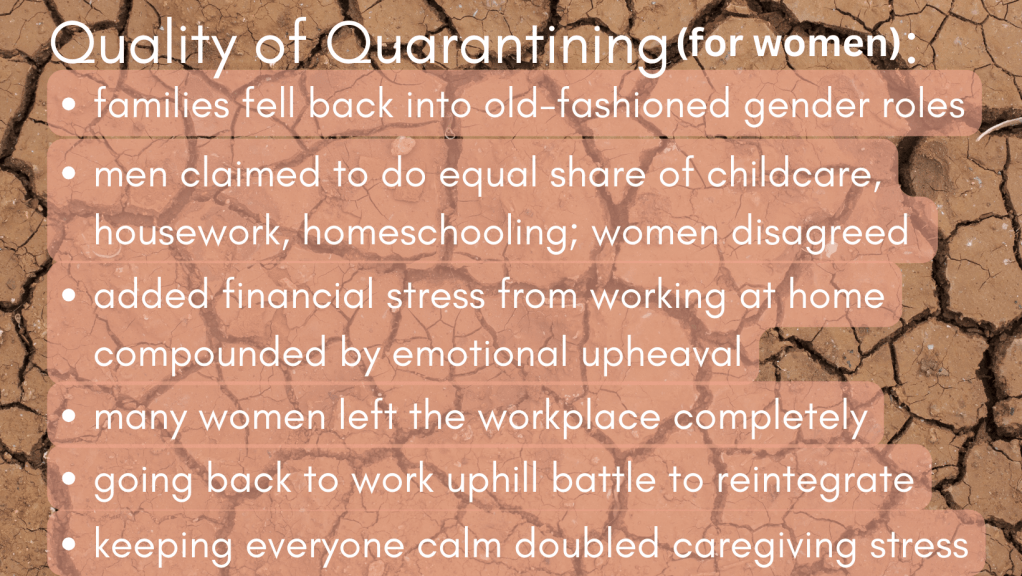
Most of the added labor created by dining rooms turned into classrooms and kitchens into childcare centers fell to women – not because they were the sole caregiver, but due to . . . outdated gender norms? And the added stress of overseeing remote learning brought into stark relief not only the difficulty of teaching, but our nation’s exploitation of school systems as childcare. It emphasized the lack of actual options mothers had. Pandemic conditions also exacerbated the fact that women especially don’t have jobs that support or flex with parenthood.

9 out of 10 working mothers said their mental health had been negatively affected by school closures

2021 TUC survey
A sobering realization, becoming increasingly clear to me, is that . . .

Bridging the gap, between where our support systems are currently and where we women need them to be, will only ever occur when women, likely mothers, force the movement themselves.

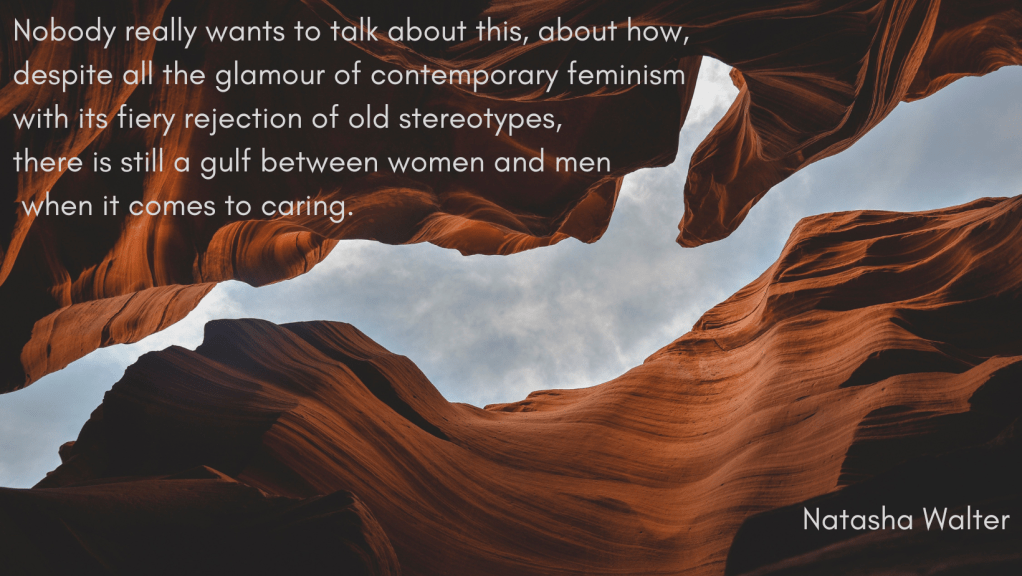
You don’t get any fame or followers these days for banging on about the second shift or the feminine mystique, so who wants to be associated with that kind of feminism today?

Natasha Walker

And why not? It obviously still needs to be talked about. My college freshman’s philosophy final had an essay prompt discussing Simone de Beauvoir and it startled me to see how misguided her interpretation may have been! (I didn’t push the issue because I wasn’t going to reteach an entire semester’s worth in the swiftly closing window she had to complete her essay)

Many young women I have spoken to seem to consider ‘feminism’ as a dirty word. Because they feel its usefulness has been worn out? Because they don’t agree with all tenets of every sub-movement? Because they don’t hate men?

The belief that women deserve equal opportunities and specialized options tailored to their current situations and leveled up as conditions equalize – is not a dirty idea, movement, or revolution at all.

COVID exacerbated a lot of what was already there. Now we all need to recover.


COVID Confidential

What was your COVID experience like?

  • Were you working? Did your employment situation remain the same or change? How?
  • What was home life like?
  • Were your children involved in an educational program? What did that entail for you?
  • What fears did you have?
  • Were there any positives about lockdown/pandemic? For you? For work? Family?
  • What did COVID shine a spotlight on that did NOT work about your life – either something that changed for the better or something that got so bad it really stood out?
  • Did your experience highlight any systems that were failed or broken in your life?
  • Is it possible to brainstorm ideas for how those might be improved if they still affect you?
Standard
motherhood

Shadow Work

“What are you doing tomorrow?”

My twelve year-old often asks me this as we bid each other good night. 

After years of staying home amidst the push and pull of patriarchy vs feminism, I instantly sense a trap. 

Why do you ask?  Why do you need to know?  Who put you up to this?  What do you want me to do?  Are you insinuating that I do nothing with my day?  Do I need to account for all my time?

Her reaction the first time I came back at her made me realize, that while her query had triggered me, my tone was not meant for her.  She was simply wondering what mom was going to do while she spent the day at school.  She knew how her day would go, but not mine.  Perhaps it was also an acknowledgment of how much I do to take care of her and her sisters – so what did that entail when I wasn’t physically with them?  Maybe, hope of all hopes, she was actually wishing for/validating some sort of relaxation from or reward for my toils.  That’s most likely reaching, but she is empathetic for her age. . .

I chose to leave the workforce when my first children were small, when they needed full-time care.  Having four children, that time stretched to encompass the younger ones as they came along.  As they all began to spend more time out of the house, I remained at home because there were always varied schedules, sick days, afterschool obligations – and that was before the inconsistencies of COVID life.    

But as they get older, and I angle myself toward both personal and professional pursuits – though none as of yet in a structured or official capacity – I wonder if the assumption that I will always be there is stunting the growth of all of us.

I wonder if we (mothers, women, parents) set ourselves up for more work and less appreciation by being available to our children.  By being there every afternoon after school, do they assume we’re the snack purveyor, chauffeur, laundry service, backpack picker-upper?  By doing less – or by being home less, as in working – would they appreciate us and what we do more?  The only time they usually acknowledge what I do is when it’s not done.  So if they are left to do more things for themselves, would they appreciate when I do complete a task for them more?  Because of its special quality, its novelty, or unexpectedness? 

In supporting our children and being there for them, are we making them less able to actualize themselves? 

Don’t get me wrong, I feel the heft of the unloading of a day’s troubles in a walk home from the bus stop.  I cherish the teachable moments that occur as we unpack their belongings and experiences.  I revel in the jokes and laughter as we all come together again at the end of a long stretch of separation.  These are valuable moments – for me and, I hope, for them. 

But the in-between moments. 

The assumption that I will pick up the slack because I don’t answer to a bell-schedule or time-clock.  That the jeans/leggings/sweatshirt they love will always be in the drawer when they reach for it.  That I will unlock the door at the exact moment they reach for the knob even though they have a key hanging from a hook slung over their shoulder. 

Perhaps I am rehashing the existential loop of my own childhood/mother’s experience.  Perhaps I am perpetuating another generation of children who live in a world of the laundry fairy and the fairy godmother, who don’t see the magic beyond the end of their noses because it’s always been there; who don’t sense the wizard behind the curtain because they don’t look long enough to see it ripple – or aren’t allowed to approach and draw it back for themselves. 

Work/life is a balance.  Supporting our children so they can flourish while allowing and urging them to apprentice in their own lives is as well.

It’s ALL in a day’s work. 

Standard