
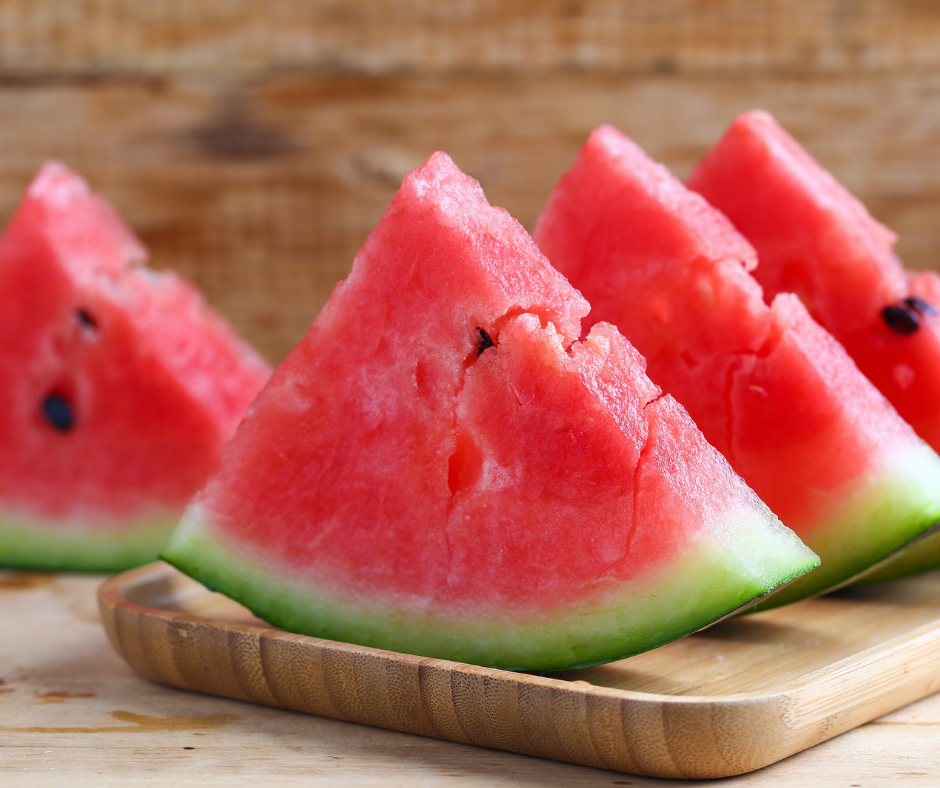
When I was pregnant with my second child and teaching English/Language Arts to twelve and thirteen year-olds, my belly grew in line with the progression of the kids’ knowledge and the school year. If they hadn’t figured it out at the start of the year, it soon became apparent.
One morning, a co-teacher came to me with a story about a shared student, very intelligent and matter-of-fact. She said that Paul had asked her in homeroom whether I was pregnant.
“I hope so, Paul. Either that or she swallowed a watermelon.”
With no hesitation whatsoever, he responded, “Well, I vote for the watermelon. Babies make a lot of noise.”
She turned what seemed to be an obvious question into a playful response; he turned it into a truthful commentary on raising kids.
Each summer when my young children would happily devour sweet cool watermelon, inevitably a black shiny seed would be ingested. Usually, they’d complain if they even spied one in their slice, but one always seemed to slip through. After repeated ignored attempts to explain their harmless nature, how they’ll only provide some fiber … I finally just responded with, “Uh oh, looks like a watermelon is going to grow in your belly.” After the shocked look of disbelief, I’d follow up with, “Yup, it’s going to sprout right out of your belly button.”
And that’s just what happens to the crocodile in Greg Pizzoli’s picture book, The Watermelon Seed!
On the first several pages, he pontificates on his love for the fruit:
I like it for breakfast.
I like it for lunch.
I like a big salty slab for dinner . . .
and I LOVE it for dessert!
But then the unthinkable happens – with a page as dark as the seed itself.
Crocodile is worried the vines will come out his ears rather than his belly button, but the look on his face is the same as my girls’ always was.
It ends up being only a close call for Crocodile and he is not scared straight from his obsession with watermelon. Neither have seeds kept my girls away from watermelon in the long run.
The Watermelon Seed is a funny, playful, relatable book for kids. Emergent and early readers will be able to access the language on their own, but toddlers, preschoolers, and early elementary will love the hilarity of it in a read-aloud. Even older children and students will be able to appreciate Crocodile’s conundrum and it can offer a bridge to childhood memories for discussion or narrative writing. Pizzoli’s illustration adds to the comedy with some pretty epic facial expressions from Crocodile. The graphic shapes and block letters as well as use of color give the entire story an accessible and universal feel.
Just as it did for me, The Watermelon Seed may conjure funny and happy stories – at the very least, sweet summer memories of chomping watermelon.

