Literacy, Writing

Blank

Words haunt me in my dreams, in my waking hours

They carve themselves in my grey matter

They pull my hands in loops and lines

The click of keys, the satisfying clunk of return

Bits and pieces of phrases and lyrics

Familiar yet fleeting

Disparate yet part of my collective consciousness

Inspiring love, eliciting hate

Droughts or a copious spate

A blank screen, a taunting cursor

Time to sit, reflect, create

A swirling maelstrom in my brain

I cannot settle on a name

Standard
Intimacy, Living, motherhood, parenting

Making Whoopee

In the middle of the pain-induced delirium of my first labor, I turned to my husband and said, “How can something that is so much fun lead to so much pain?”  We laughed: at the absurdity of the situation; at the fact that I could still joke in between contractions; at the ultimate truth of the statement.

And little did I know that as we pressed forward into parenthood, that statement would stretch and morph to encompass so much more.

When we returned home with our infant, my husband and I camped out on the couch passing the baby between us.  They fell into dreamland while I fell into the throes of a fever, my milk coming in with a vengeance.  I didn’t know why I had the chills, why I couldn’t lift my arms higher than my shoulders without hurting, why my baby wouldn’t latch on . . . I just watched my husband sleeping peacefully, the baby nestled on his chest, and shook with wracking sobs, realizing that the one I needed most couldn’t comfort me because some other little thing needed him even more than I did.

When we added a second child to the mix, the house was never quiet enough, the baby never had uninterrupted sleep, our nearly-three year-old never caught a break.  The pained look on her face when one of my tirades went a little too long and a little too loud broke my heart – because I was afraid I had broken hers.

Baby Number Three ushered in a matrix of physical and emotional pain unimaginable.  It took me months to figure out what the hell was going on and years to fix it (or work on it – I’ll let you know when I’m done).

Then there’s the toll parenthood takes on the bond between husband and wife, or ‘Mom and Dad,’ as it seems you will now forever be known as.  In the beginning, doing the act that landed you in this predicament in the first place does not seem appealing at all; never mind the doctor’s estimation that you will be back to ‘normal’ in six weeks, ludicrous.

In fact, I used my pregnancies as warnings to others.  When I overheard two of my twelve year-old students discussing sex, I piped up, “I hope you’re not thinking of becoming sexually active,” at which their pretty little jaws hit the floor.  I went on, from my perpetual position behind my desk because I was too tired to stand, “Because you don’t want to end up like me.  I’m married and it’s hard enough.”  At a wedding shower about a month before the due date of my second-born, I told the bride not to break any of the ribbons from her presents.  Circling my belly with a pointed finger, I said, “This is what happens when you break a ribbon.”

But that weird mind-blanking trick that humankind’s desire to procreate does to our memories soon kicks in, allowing you to forget the (seriously) gut-wrenching pain and remember the joy of intimacy again.  That is, when time and circumstance allow.  When you’re alone.  When the kids are sleeping in their own beds.  When you’re not so exhausted you fall asleep before your head hits the pillow.  When you can think like man and woman and not Mom and Dad.

Just last week, as my husband reached for me, brushing my arm in the process, I cried out, “Ow, watch out for my boo-boo!”  Nothing like the mention of a decidedly kid-term to ruin the moment.  Even when they’re not there, they’re there.  But, all parents somehow find a way around such dilemmas.  You lock the door.  You find a way to connect without hurting the various wounds you’re nursing.  And you learn to have fun.
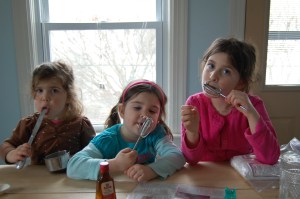
 

When we were invited to a party at our newlywed friends’ place, we decided to bring whoopee pies for dessert.  We thought they fit well with the southern menu of pulled BBQ, cole slaw, and corn bread, but also that they were somehow apropos for newlyweds.  Wink, wink.  Then the girls, who love anything sweet, wanted to help prepare them.  I couldn’t help but see the irony as I watched them.  Here, in living color, devouring what was left of the frosting, were the literal fruits of my labor.

That’s what you get when you make whoopee.  Three gorgeous girls.

It’s been a long road since the first pangs of labor, but I wouldn’t have it any other way.  And I wouldn’t do it with anyone other than my husband.  (Wink, wink).

Standard
postpartum depression, Recovery

No Salt in this Wound

There really is no point to a saltine – except for the salt, of course.

For some reason, as many other kids, I loved them when I was little.  I think it had more to do with trying to stand it upright in between my top and bottom teeth or shoving it in my mouth in one bite rather than any great gastronomic pleasure.  I didn’t return to them until I carried whole sleeves of them around with me during my bouts of morning sickness three times over.  That’s the telltale sign of a pregnancy, isn’t it?  The white, crinkly cellophane pulled open at the seam, the stack of perfectly pointed squares cascading out into the open, and hopefully, into your belly to quell the ravaging beast that threatens to ruin every waking moment – not just those in the morning.  A friend’s mother says that she hasn’t touched a saltine since her pregnancy over thirty years ago.  I can’t say I blame her.  It is not a pleasant connotation when that’s your last memory.

So, imagine my surprise, when I found myself chowing down on them as I rushed to an appointment in the car.  So light and insubstantial, I was flying through the sleeve with reckless abandon – actually just savoring the salt and waiting for some sort of gratification from the mush that the enriched flour had turned to in my mouth.  I had bought them for the kids, but running late and low on fuel, I needed a quick and easy – if not satisfying – snack.

After I’d downed a quarter of the sleeve, the sharp bite of the salt searing into my tongue, I realized what I was doing.  I was eating saltines!  After a miserable last pregnancy, I avoided at any costs anything that reminded me of those memories that made me shudder.  I gave away all my maternity clothes with great aplomb.  I threw out the sitz baths and lanolin left in the house.  A wicked pack rat, I even sorted through and shredded all paperwork from the hospital.  Saltines fell into this category.  I didn’t fling them out my window, a crazed cracker hail sending birds flying, I just didn’t even think of pulling a box off the grocery store shelf.

In one conversation with my therapist in that first year of recovery, I explained how I felt as if I were grieving a death.  I marked each familiar date, each holiday, each anniversary of some hard memory – noting it, like the rung of a ladder I had to climb to get up and out of this hole.  ‘Okay, I’ve made it past that one,’ I’d say.  I’d survive one set of negative memories at a time and start to wipe them away with new ones.

It wasn’t easy and I knew I wasn’t suffering the same grief as someone who had actually lost a loved one, but, as my therapist so astutely pointed out, I was suffering a loss – the death of my life as I had known it.  Things were totally – in some ways, irrevocably – different.  It was time to move forward with the positive and with this new knowledge and see what would happen.  Life certainly wasn’t over – it was just different.

As was the action of eating a saltine.  I wasn’t a kid crushing one into my mouth as I cavorted on the beach with my parents.  I wasn’t a desperately nauseous woman at the mercy of her upset stomach (and those damn hormones).  I was an adaptable survivor who could do simple tasks again without the crippling connotations once associated with them.

Saltines have never tasted so good.

Standard
motherhood, parenting, postpartum depression

My Lifesaver

“I save you.”

My two-year-old daughter said this to me one morning as I dressed her.  She reached up from the changing table and grasped my arm, hugging me to her.

“You save me?” I asked.

“Yeah,” she said, a smile lighting her sweet little face.

She’s been playing games of chase, tag, and intrigue with her older sisters, which is no doubt where this line came from, as they ran from imagined assailants.  But these three small words held a much deeper meaning for me.

If it weren’t for Angela’s love – and my love for Angela – I might not have survived the three years that have elapsed since the news of her coming.

I read recently that humans have an evolutionary predisposition to always think the worst.  If we did not anticipate danger, we would get eaten by the wooly mammoth hanging around the corner.  If we didn’t worry constantly about starvation, we wouldn’t feel compelled to gather berries for the coming winter.  If it were always sunshine and roses, the species as we know it would not exist.

However, in the modern age, where thankfully we do not have to parry with wooly mammoth, this predisposition makes living a life of gratitude really hard.  Being genetically wired to pay attention to the negative, the positives of our life fade into the background without a concerted effort on our part.

And, sadly, I can say that I let that happen throughout my pregnancy and postpartum with Angela.  Letting the blessing of a child be outweighed by the unexpected timing of it.  Letting myself be buried by the drudgery of day-to-day rather than being uplifted by the wonder in her eyes.  Letting myself founder instead of accepting the help I needed.

There were times when I could pull those positives back into the foreground.  Little arms wrapped tightly around my neck.  Sitting in the living room, surrounded by my husband and the girls.  Watching the three of them splash in the bathtub.  I even started a gratitude journal as a concrete reminder of the blessings all around me on a daily basis, especially helpful on those days when the clouds made it impossible to see them.

It was through the filter of Angela’s unconditional love that I began to see the world differently.

If at the end of the day, chaos ruled, but our kids were safe and happy, all was right with the world.  If things didn’t go according to plan, maybe that was because God had a better one.  And if we weren’t happy, maybe that meant we were supposed to be doing something different anyway.

I decided to do a lot of things differently.  Acutely aware that there were some things in life that would choose me with no regard to my misery, I decided to only choose things that would bring me joy.  I found myself contemplating risks I never would have taken pre-partum.  With newly opened eyes, there were new possibilities.

It was Angela who gave me eyes to see.  She gave me back my life.  If her birth – and the resulting struggles – hadn’t happened, my serious examination of my life and place in this world wouldn’t have happened.  And every time I got lost or distracted by the discouraging things around me, her two little arms around my neck reminded me to come back to center – to the heart of what truly matters.

Angela returned the wonder to my eyes.  Watching her find her way in the world inspired me to find mine.  She is the ultimate gift of love – and isn’t that the greatest blessing of all?

Standard