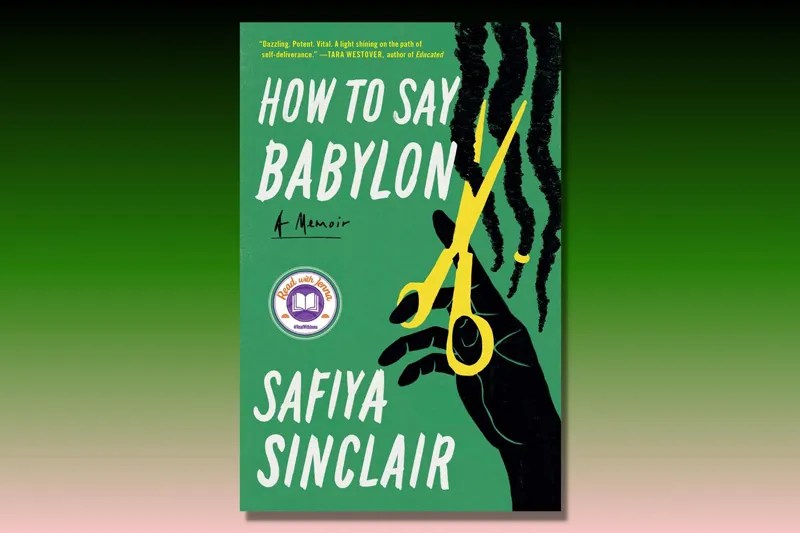
“I sounded the lines out aloud, feeling the rhymes growing delicious on my tongue. Later I went to the Encyclopaedia Brittanica and looked up William Blake. I couldn’t believe it. He died nearly 170 years before me, but his words grew a thriving forest in my head. A thought, I understood it then, and its incendiary mind, could outlive itself. A well-made word could outspan carbon, and bone, and halved uranium. Until now, I imagined the world divided in two halves: the world of the spiritual, of my parents: Jah and levity, vibrations, energies, and chakras. And then, there was a world of things I could measure and understand, visible and knowable. Now, I felt there was another world just out of reach. A gossamer wing flashed against the bedroom window. I took out my journal and wrote my first lines of poetry in vines of cursive. Wings in the sunlight, wings against my dress. I pulled wing after luminous wing from my mouth. Watching them flutter alive with each word, my hands a vibrant garden. The poem was called ‘The Butterfly,’ the first to pull itself from the soft veil between all worlds, a seam to slip through to any place, any time. I knew then that as long as I had a word that leapt aflame in my mind, I would always be living in an age of wonder.”
from How to Say Babylon: A Memoir by Safiya Sinclair
When she can’t sleep at night, she tries to remember the details of all the rooms where she has slept: the one she shared with her parents until the age of thirteen, the ones at the university residence and the Annecy apartment facing the cemetery. She starts at the door and makes her way around the walls. The objects that appear are always linked to gestures and singular facts: in her room at the summer camp where she’d worked as a counselor, the mirror over the sink where some boy counselors had written in her red Diamond Enamel toothpaste, ‘Long live whores’; the blue lamp in her room in Rome that gave her an electrical shock each time she turned it on. In those rooms, she never sees herself with the clarity of photos, but blurred as in a film on an encrypted TV channel. Or she sees a silhouette, a hairstyle, movements – leaning out of a window, washing her hair – and positions – sitting at a desk or lying on a bed. Sometimes she manages to feel she is back inside her former body, not the way one is in dreams, but more as if she were inside the ‘glorious body’ of the Catholic religion, which was supposed to resurrect after death with no sensation of pain or pleasure, heat, cold, or the urge to urinate. She doesn’t know what she wants from these inventories, except maybe through the accumulation of memories of objects, to again become the person she was at such and such a time.
My grandmother was a connoisseur of the written word.
She devoured it voraciously.
Oftentimes, seeing her car in the library parking lot, I would find her among the stacks or bump into her in the lobby, fist full of the next adventure to be had.
As my own love of writing deepened in high school, she began to share what she deemed stellar examples of its use. A clipping of newspaper, a strong Op Ed, a well-executed essay.
She’d come of age in the glory days of the Providence Journal, her own brother disappearing into its whole block of a building for work each day. It was a stalwart of journalism and professional writing.
Naturally, then, I came to appreciate those writers and articles she’d send. With my parents referencing Ken Weber’s hiking guide nearly every weekend, I became interested in the sparse yet beautifully evocative language of his nature columns. I fancied myself ‘the next Ken Weber’ as I detailed my own rambles. And as an adult, I discovered more of my own writers.
G. Wayne Miller was a name I was accustomed to seeing in the by-lines of the Journal. When he did an ongoing series about mental health in 2014, I followed closely. How encouraging to see a close-up view of the many facets of mental illness and its treatment in our state. When he retired from the Journal in 2022, I was glad for his accomplishment; sad for the loss of such thoughtful coverage.
Through the wonders of LinkedIn, I stayed abreast of his work with Ocean State Stories (housed within Salve Regina University’s Pell Center). Imagine my surprise and delight when he reached out to me recently to be the subject of one of the Q&A features on their site.
When your writing comes of age with a steady diet of talented writers, fed to you by loved ones, part of the literary fabric of Rhode Island – and then one reaches out to you . . . it’s as if fairy dust has burst from the folds of clipped newsprint.
Thank you, Wayne, for taking the time to read my work and offering the space for me to share it. Your care and attention to mental health already impressed me. Your encouragement of fellow writers means perhaps even more.
I started watching Bodkin because I love a good mystery.
I sound like the little old ladies who used to check Agatha Christie out of the library, but I’ve been a fan since my Nancy Drew days. Read my first Agatha in junior high. Wrote the book report. Went on a Criminal Minds bender when my youngest was an infant. Nothing like a sleep deprived foray into psychologically deviant minds.
Now my cup of tea is usually accompanied by a procedural. As long as the sun shines, I can deal with initial gore or grit for the sake of a suspenseful solution.
I needed a new binge and there was my recently added Irish series to fill the bill.
Sure Gilbert was goofy (buffoon actually is how Dove refers to him) and the archetypal turns of phrase were expected, but my ancestral funny bone appreciated the familiar. Both Dove and Seamus’ stand-offish yet authentically honest wit was a salve to my Celtic soul. And the series itself has a self-deprecating manner. When minutes after the trio of protagonists steps foot in the local pub Teddy staggers up from his barstool and sings a lyrical ballad, Dove mutters behind her pint, “That does not usually happen.”
But the frame of Gilbert’s incessant search for the ‘story’ is what truly makes this series sing. Eventually we learn that the silly American came to Ireland for a story better than the one he was living, but everything starts with the fatal effects of Dove’s insatiable search for spilling the truth. As mysterious details come about, we learn it is the story of Dove’s past that haunts her. Emmy is only just realizing that she has a story.
Stories and folklore are integral to Irish culture. Within the larger frame of Gilbert’s podcast, there is Samhain. Nestled within that is the historical tradition and tragedy unique to the town of Bodkin. From that comes the many layers and intertwined threads of the daily interactions of the townspeople.
But around episode six, Gaelic becomes global. It opens with Gilbert describing folktales as not only stories, but warnings, saying that “in Ireland they tell the story of the fetch. The fetch is your supernatural doppelganger. And if you happen to see yourself, to see your fetch, it means you’re going to die.”
I’ve been reading Timothy White’s Catch a Fire: The Life of Bob Marley, wherein he goes into great detail of the Rastafarian and Afro-Caribbean traditions that influenced Bob Marley’s life and lyrical philosophies. Around 1964,
“He [Bob Marley] believed he was possibly under siege by obeah-directed demonic forces and might soon need a ‘shedda-catcher’ (shadow-catcher, a myalman). Omeriah [Marley’s grandfather] . . . had performed such services for others . . . in the country, when someone believed he had lost his shadow, meaning his temporal soul force.”
Timothy White
And a few years later as Marley learned the tenets of Rastafarianism, Mortimo Planno explained that “before we are born, we have a name, and when we enter this world, we get a new name. In each man is a separate genesis joined to that name, and most men learn their name only at the hour of their death. A very few, however, learn it beforehand, along with the knowledge of their own end.”
Ireland and Jamaica are very different places, but the parallel story of knowing or seeing, naming oneself brought these two together like connective threads spun across the sea. Every culture, every individual yearns to distill its story and yet stretch it in relationship with others. Story, for every one of us, is crucial to existence.
In the final scenes of the series, as we hear Gilbert’s closing words and transition into Dove’s epilogue, we hear that it’s not so much what has happened in the past as what story we choose to tell about it. Which is such a powerful reminder. Not of fabrication, but of which details we choose to focus.
How frequently do we cause ourselves pain with a negative monologue? By frontloading our failures? By refusing to showcase the successes?
If we can’t change the things that have happened, maybe we can change the story we tell.
Dubheasa Maloney
Just as a narrative shifts with a new point of view so does our outlook with a different lens. There are times, however, when the lens is a prism reflecting many of us in its image.
Her kitchen is tiny – the size of a large cupboard – but perfectly arranged and stocked so that she has everything at hand when I drop by to discuss when we might make the said gnocchi. ‘Ora!’ she insists, unfazed by the notion of improvising a cookery class on the spur of the moment. ‘Now!’ She is already spooning coffee into the aluminum Moka pot and placing it on the stove: hospitality is, it seems, the first duty for every Italian.
A Year in the Village of Eternity: The Lifestyle of Longevity in Campodimele, Italy by Tracy Lawson
A small kelly green hardbound book with a gold embossed border and square locking mechanism.
Even then, in the dire days of second grade, I failed to fill in the daily pages.
Perhaps the slot at the top of each page to fill in the date was where my ongoing cycle of expectation/failure/guilt got its perfectionist start. If only there were simply blank pages with no open forward slashes for month/day/year, maybe then I would’ve been free to record my thoughts as I wished, order them as needed.
But it was only this summer that it took me two entire days to write one entry in my journal. Now the pages were wide open, but my days were not. The stream of thoughts were interrupted when sports practice actually ended on time one evening and completed in fits and starts when swim lessons turned into extended splashing in the shallows. As parents beckoned with outstretched towels, I began to stir from my chair. But my little leapfrog still happily skidded her hands across the surface of the water even as her classmates began to leave. And her older sisters were likely still snoozing. So why not let her play a while longer and finish my thoughts?
Staying seated in that chair strained every productive perfect bone in my body.
Will another mom see me with my head down and judge me as putting my child in danger? (I looked up every few words and rose from time to time to make eye contact with her) Should I go home and check on her sisters? (I’d texted and only one had risen and started to think about breakfast) What laundry/dishes/errands need to be completed next? (The list was never-ending and would still be there when I got home)
Why did letting my child extend her playtime in the outdoors feel like a bad choice?
Because, in this instance, it meant that I got to fill the lines on my pages and my cup. Because in a daily schedule/vocation/lifestyle (ie motherhood) that society orders as self-less, it seems self-ish to take a few minutes for oneself. On a perpetual treadmill, it seems wasteful to sit and stare into space.
But just as it did my daughter well to soak up some sunshine and wonder in the lapping water, it did me well to off-load some thoughts and feelings onto the page, synthesize others, and start with a clean slate.
In that instant I couldn’t change the tempo of my life, I couldn’t create time, but I chose to step out it. I chose to do something that would allow a refreshed me to step back in.
And we all have that choice.
Whether we draw, doodle, sketch; list, pen lengthy diatribes, or long poems; write letters to someone with whom we’re angry, our younger or future self; discover truths buried deep in our hearts or a simply profound recognition – journalling is whatever we make of it and accessible to us all.
All it takes is a piece of paper, something to write with, and a willingness to be open.
This may be the exact diary I had! Minus the kelly green and drugstore sticker!
Usually I use Weekend Write-off posts as a place to share an update on my own writing, thoughts on process, or an excerpt from the book on my bedside table, but today I am excited to feature a young writer with a wise outlook. Sometimes it takes the eyes of a child to put things in perspective.
As a child, I’d spent hundreds of hours playing The Game of Life. According to Hasbro, you begin life as a phallic pink or blue peg (a fitting introduction to the patriarchy).









 Chopping Potatoes