Mental Health, postpartum depression, prevention, Recovery, Survival

Point of Contact

I entered the world of mental health advocacy kicking and screaming.  Some days, quite literally.

Studying English?  Easy, I loved literature and writing.  Teaching?  A way to purvey that love to another generation while parlaying it into a paycheck.  Motherhood?  An extension of the love my husband and I shared.

Postpartum depression and anxiety?  A most unwelcome and unpleasant recalculation in my life’s journey.

For years, I looked for reasons.  I hadn’t recalibrated my compass, had I?  What had happened to lead to this catastrophic turn of events?

I am not the grand cosmic poomba of all things so I cannot answer those questions with any sort of certainty, but I do know that my struggles awakened a raw, yet steely inner strength I’d never had before.  They fostered an empathy of a whole new level for others’ suffering; for the mantle of motherhood and all its ‘come-withs’.

I had to polish some ragged rock I’d gotten caught up on and dragged along on my journey into at least a burnished gem.  Something positive had to come out of all that suffering.  And perhaps even prevent another woman from travelling the same path.

I started this blog as a way to tell my story, which very few knew.  I thought, with complete disclosure, I might open the dialogue for others.  At least become an ally in an all too commonly silent struggle.  Perhaps I didn’t tackle postpartum directly enough – for many of my discussions and observations were integrated with my life.  However, I still haven’t decided if that was/is a failure, for mental health struggles quickly become an intimate part of one’s life, touching all parts of it.  It also hinted at some version of depression/anxiety becoming part of my ‘new normal’.

And with my ‘new normal’ so different from my old one, I began to develop further plans for burnishing rocks into gems.

I knew what I wanted to do, but with no clinical experience, I had limitations.  I could not mention the word ‘therapeutic’ in any official capacity.  I was petrified that if the programs I had in mind reached the end of my personal experience and empathy, that I wouldn’t be able to help someone in crisis.  

I embarked on a series of webinars offered by Postpartum Support International.  The Social Support Training series, one session every other week, stretched from January to June of last year.  While many of the participants were clinicians in the field of maternal mental health, the course was user-friendly and aimed at individuals interested in starting and supporting groups of mothers in various presentations of mental health.

The Social Support Training was the perfect first step toward a solution.  It offered a wealth of information – statistical and anecdotal, researched and proven – paired with the assurance that social support people are not meant to be clinicians.  They are meant to offer a safe place for mothers to gather and vent, ask questions and talk, discover resources and camaraderie, and just be.

I finished the series a few weeks before I headed to Boston for Postpartum Progress‘ first annual Warrior Mom Conference, the first ever maternal mental health conference for survivors of PMADs.  With my new-found knowledge and training, I looked forward to building on that momentum and connecting with other moms doing the same.  While I did that, I also found parts of me that hadn’t fully healed.  I realized I still had my own work to do and how very complex maternal mental illnesses are.

That fall, my PMAD baby started full-day kindergarten and, though scared as hell, I began formulating plans to kick my ideas into high gear.  I applied for a scholarship offered by Postpartum Progress and the National Council for Behavioral Health to be trained in Mental Health First Aid, which I was awarded a few weeks after discovering I was pregnant with my fourth child.  I faltered, wondering how I would enact my plans with a newborn baby.  But then, they were never my plans anyway.  And now I would have the full-circle experience informing my advocacy.  Up until now, I’d only ever experienced the postpartum piece of mental health; now I could speak to both pre- and postnatal.

I spent two days in New London, Connecticut with two fabulous humans from Child & Family Agency of Southeastern CT learning how to assess and support a person’s mental health status.  Again, the trainers stressed that we were not expected to diagnosis the individuals we come into contact with, but to assess their situation and determine whether they need additional help.  We then must help them feel comfortable and safe until such professional help is acquired.  The trainers helped me gain even more practical ways to help those in need as a civilian, a concerned individual, an advocate.

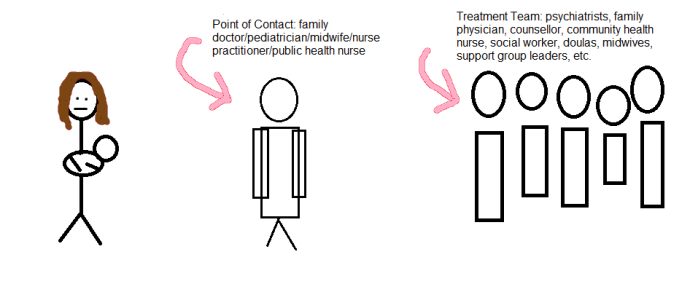
As I sat in that auditorium, surrounded by empathetic professionals and persons, I flashed back to an article I’d read a week and a half earlier.  “The Community Maternal Mental Health Professional” on The Burnout Cafe (click image for link) discusses the gap between women who need help and the services available to them.  While the central point of contact in this graphic from the article lists a woman’s professional caregivers, and a woman certainly does see these people quite frequently both before and after the baby is born, I would argue another layer of contact needs to be added.  If practitioners aren’t well-informed or comfortable dealing with maternal mental health issues, the assessments, diagnoses, and referrals needed will not occur.  Having been down that dark hole myself, I am well-versed in those discussions.  I can help normalize the feelings a woman may be experiencing, yet not want to admit for fear of retribution to her or her child.  I can point her in the direction of practitioners specializing in the exact type of care she so desperately needs.
ppd1

“The Community Maternal Mental Health Professional” as point of contact (via The Burnout Cafe)

With my personal experiences and new-found knowledge via recent trainings, I am a point of contact for mothers.  

My plans may morph and grow as my own life and family does, but the end goal is the same:

Helping Mothers Get the Help They Need.

Standard
anxiety, Depression, Identity, postpartum depression, Recovery, Uncategorized

Recovery Contd.

In an online forum, a mother asked if she was the only one who thought about her experience with postpartum each and every day since she had given birth four years earlier.

I am six years out. While it’s not an everyday occurrence, it often comes to mind. In many ways, it has and continually shapes who I am – as an all-around human, not just certain aspects of motherhood.

Though I wouldn’t recommend it as a means of self-discovery, my postpartum experience taught me a lot about myself. I realized, that while I had been managing it, I’d been suffering from low-level depression and anxiety for years. What I thought was a failure to contain, control, was actually the event horizon of a long-simmering beast’s debut.

So I find it hard when people talk about postpartum recovery. I don’t feel as if I’ve recovered from postpartum depression. I feel like I’ve learned to manage it, but it’s the new normal. While I took an extended hiatus, I’ve returned to my therapist. I never stopped taking my meds. I still have low points that make me wonder if I’ll ever be healed; that make me seek out new treatments and pray for cures.

A cure lies somewhere within the intersection of self-acceptance, medical marvels, and divine intervention. I think it’s impossible that any one will work without the combination of the others.

I need to accept that this may (notice I’m not quite ready yet) be how my chemical makeup operates. That I didn’t fall short on some courage or stick-to-it-ness factor. That I didn’t fail to attract good things through my thoughts. I cannot will myself better with positive thoughts. Though my heart works that way, my mind simply is not wired for that.

Taking medicine to augment your mood is okay, even acceptable. It’s beneficial to your quality of life. It quiets the rage and keeps the nervous energy at bay.

And to fill the gap that always is – there is God. A spiritual dimension to the healing process is essential – and one I was missing for a long time. Unfortunately, this is not a one and done. I must continually seek this solace.

All three spokes of the wheel need continual attention. They all need periodic tweaking and developing. Much to my chagrin, my recovery and learning to live a full life is not a mountain to be scaled and topped with a banner of victory. I have to drag that flag with me wherever I go. As long as it still flies, I guess, there is still hope.

flapping_cloth1

barkergroup.info

Standard
motherhood, postpartum depression, pregnancy

Not PPMADetermined

Postpartum Mood and Anxiety Disorders (PPMADs) rob mothers of so many things, but perhaps the cruelest thing they take is the joy. The joy – which makes the overwhelming job of motherhood worth it – is replaced by fear.

Fear that you’ve made a terrible choice in having a child
Fear that you don’t deserve this child
Fear that someone may take this child from you
Fear that you may do something to hurt this child
Fear that you won’t survive another day without hurting yourself

The fears of the early days will pass – through time, gentle care, therapy, medical intervention. You will be able to envision a bright future for you and your child

Even still, there are some things PPMADs may steal that can never be replaced. The memory of the pain and anguish, the trauma linger on. There is no peace to ever be associated with that time in a mother’s life. So much so, that she will never, ever attempt it again. Women who dreamed of large families stop at one child, not because they are bad mothers or lack the desire, but because their pospartum experience was so bad.

There are the women who achieve pregnancy fully armed with the warning signs and therapeutic tools available to them, should PPMAD strike again, yet are paralyzed by the anxiety that it could happen again.

There are women who must face the scrutiny of others who deem them crazy for even attempting pregnancy after their previous experience. They second-guess their own intuition and self-knowledge and the fact that they’ve come out the other side beat-up, but stronger – all because of the well-meaning souls who give critical advisories for mothers’ own good. Well-meaning souls who have never inhabited the dark spaces of these mothers’ individual hells, who have not fought the daily internal battles it takes to stay out of them, and who don’t realize that every negative comment saps one more drop of the mothers’ resolve.

PPMADs are an insidious band of thieves. They take without provocation, without discrimination, without consideration. They come under cover of dark; they aren’t cloaked because they’re faceless. But with help and support, mothers can choose to face them. And take back what is rightfully theirs: their own vision of motherhood.

Standard
postpartum depression, Recovery

This Ain’t Any Ol’ Con

So I am living the hipster life. Typing on a table so repurposedly wonky my laptop rocks back and forth disconcertingly. In sun-dappled shade as I wait to sip my freshly prepared cafe mocha and eat my just warmed vegetable quiche.

Jennifer Butler Basile

Jennifer Butler Basile

It’s delicious.

All of it.

The flaky crust. The gooey egg. The sugary froth. The warm breeze.

The ability to notice such details as the vaguely distant whoosh of traffic. The inability to safeguard little people.

I can’t.

They’re not here.

I am alone.

Which, even though it was an acupuncture appointment I had this morning, was blessedly just what the doctor ordered.

I’m at the back-end of a weekend packed with emotionally-charged, mentally-draining conference work.

The Postpartum Progress Warrior Mom Conference.

Lest you get the wrong impression, I enjoyed this conference immensely.

I so looked forward to connecting with fellow survivors of postpartum mood and anxiety disorders (commonly lumped together and referred to as postpartum depression). I expected to commiserate and trade war stories. I expected to get amazing fuel and ammo for advocacy – a role into which I thought I’d fully transitioned.

I did not expect to be so completely enveloped by the emotions I thought I’d left behind.

All throughout the first day of workshops, panels, and speakers, I teared up and misted over when particularly poignant points were made. But I was good. While I still danced with depression and angled around anxiety on random occasions of my everyday life, my period of postpartum depression was done.

And then, on the second day of the conference, Annette Cycon of MotherWoman got up to talk. As she described what transpired after an inexplicable bout of rage during her two young daughters’ bath time, my grief bubbled up and out of my body.

“I went into my bedroom and curled into the fetal position on the floor. I held my head, rocked back and forth, and sobbed. I said, ‘It’s either homicide or suicide – and I can’t do either. I love myself too much. And I love them too much.’”

Hearing this raw account, I sobbed. My face contorted into the grimace of one silently choking back tears. My shoulders shook. I experienced this incredibly intimate moment of grief in the midst of a room full of mothers. I felt so incredibly alone and yet dreaded anyone noticing and reaching out to me.

And yet, I wasn’t embarrassed.

There was no need.

I was in a room full of women, mothers who, while their own grief/rage/depression/disappointment/detachment/love/mania/compulsion manifested itself differently, had all been at the bottom of their own deep, dark hole. They were all at various footholds on their way back up and out, or sliding down and scrambling for a hand to hold – to stop them – to stop the pain, the agony – to spark the love they needed to feel for themselves and their children.

I may not have expected to awaken the grief, guilt, shame, and pain I thought I’d left behind – and apparently only buried – but I also didn’t expect to find a tribe of mothers instantly and deeply connected by their shared experience. And that was such a life-giving and validating surprise.

Soon, I will have to leave my empty coffee cup and the flaky crumbs of quiche crust behind. Soon, I will have to stop pretending I am an unencumbered hipster who can write alfresco for hours. Soon, I will collect my children and return home to our ‘normal’ lives, our harried routine, my possibly high levels of anxiety and masked depression.

But there will be hugs around the neck and hearty belly laughs. And there will always, always be my tribe of warrior mamas who’ve got my back.

Standard
postpartum depression

An addendum

In my post Thursday, I discussed the pitfalls of postpartum in dads.  There is a major one I erroneously omitted.

One more thing for postpartum moms to worry about

In all my talk about supporting dads in their postpartum world, I failed to think what such advice/discussion would do to a mom currently suffering from postpartum.  Though I’ve still got plenty of issues to sort out, I am no longer in the deep, dark depths of my postpartum period.  I have traveled far enough beyond it to be able to reflect upon what the experience was like for my husband.  In the midst of it, however, I couldn’t help myself – let alone another human.  I apologized for lashing out; I thanked him for his support; I commiserated when he said he didn’t know what to do.  But beyond that, there was nothing I could do for him.  Nothing except put myself back together.  And that took all my energy.

So all you women and mothers suffering from postpartum mood disorders out there, my last post was not meant to make you feel bad.  It was not meant to give you one more thing to feel shitty about.  To make you think you’ve ruined one more life.

Let me reiterate the point that it takes an entire community to surround and uplift the postpartum tribe.  It should not fall to you to do everything.

Yes, dad needs support, but you don’t have to be the only one to give it to him.  You may not be able to at all.  And that’s okay.

People outside your tight-knit trio need to help put you all back together.

Tripod-of-Life_Holy-Trinity

Standard
postpartum depression

Down in the Valley

When I first heard the idea of postpartum depression in fathers, I thought it was a bunch of hooey. I knew, with the interests I have and the topics I research, I should jump wholeheartedly into the facts of the phenomenon, but I harrumphed at the links and passed them by. Men simply and physiologically could not experience the hormonal onslaught and the horrific physical demands of the perinatal period. I felt that such attention on males would only distract from the already poorly represented female population of sufferers. Could they really have it so bad?

And then I participated in Postpartum Support International‘s webinar on ‘Involving Dads and Partners’.

Dr. Daniel Singley, a psychologist with The Men’s Center for Excellence, opened the webinar with a discussion on relationship issues, stating that one must look at perinatal depression within the arc of a couple’s relationship, as they directly affect each other. Also, a couple’s childbearing years usually coincide with a dip in relationship satisfaction already occurring, an interesting factoid that may explain a lot.

ushaped curve

With the modern expectations of hands-on and collaborative fathering, there has not also come guidelines for how to do that. Fathers are told they must support mom, but they aren’t told how. They must be strong for her, but all without anyone having their back. Gender differences often don’t allow for solicitations for help either. If there is an underlying mental health issue already, such conditions exacerbate it.

Parenting is new to both parties – not just the mother. There is a vast body of knowledge yet untapped in human experience until a parent holds that fragile little being. Insecurities and lack of self-confidence abound in both sexes as they navigate these new waters.

Having only walked in my own flattened out shoes, I dare say women still have the larger burden. We had to push the human out of our bodies. We have to recover from that onslaught while some of us continue to sustain baby with our bodies through breastfeeding. And the huge learning curve of caring for an infant comes with the mantle of harrowing hormones (Feel good hormone, my right raw nipple).

However – Dr. Christina Hibbert makes a good point. In excerpted text from her video, Postpartum Mood Disorders: The Couple’s Experience, she describes how a husband feels he cannot do anything to help the women he loves so much as she suffers. Another husband says ‘it’s as if an alien abducted my wife, returning someone who looked like her and acted like her, but was totally different.’ I showed this part of the webinar to my husband. He paused, nodded thoughtfully, and said, yeah, that’s about right.

This is where looking at postpartum in terms of a spousal relationship is important. As if an individual’s depression weren’t complex enough; as if birthing a child weren’t enough of an event; as if worrying about raising that infant to adulthood safely weren’t overwhelming enough; there is the irrevocable effect the whole evolution has on your relationship. And if it’s a truly loving and compassionate one, watching your partner devolve into depression would certainly take its toll on you.

I was in my own vortex of hell; I couldn’t see anything beyond it. I would hug my husband and thank him for staying with me, other days asking if he’d leave me for all the trouble/misery I’d caused. But I had no idea what his experience was like until I heard these descriptions on this webinar. The pain and grief he experienced. My heart ached anew. For the ways my depression had hurt him and how I was helpless to fix it.

Postpartum – and any other brand of – depression is truly a familial condition. It is not, nor even should be, a solitary journey. Unfortunately, many times the family members are drawn into the negative effects whether they like it or not. But with awareness and support, the weathering of and coming out of can be that much kinder and gentler.

I should not have scoffed at the idea of postpartum depression in dads. Perhaps it is the flawed nature of the term in general. The field is moving toward the broader and more comprehensive term perinatal mood and anxiety disorders (PMAD), which I agree is much clearer and effective. Fathers do not experience the perinatal phase exactly as mothers do, but then, each mother experiences the perinatal phase in a different way.

Everyone involved in the perinatal process needs understanding and openness, warmth and wisdom. Then, perhaps we can all make it up the mountain on the other side of the valley.

Standard
medication, Mental Illness

Stuff We All Get

When I got married, I inherited a staggering amount of pharmaceutical office supplies. Some women marry into wealth. Some women carry a substantial dowry; others, a hope chest full of handmade linens and needlework. I got a cardboard box full of sticky note pads and ball point pens bearing the name of brand-name drugs. A distant cousin on my husband’s paternal side, a salesman for a pharmaceutical company, had a wealth of such products himself, to which I was now a party.

Not one to turn up my nose at anything free, I welcomed this surfeit of stationery. The pen on a lanyard came in handy as I made circuits around my classroom – not only did hanging it about my neck ensure I didn’t lose it, but the big block letters emblazoned along the side. You found an Androgel pen, you say? That’s mine. Unless there was another twenty-something female teacher with stock in Androgel, there was no doubt who the pen’s rightful owner was.

However, this example also illustrates one of the disadvantages of pharmaceutical swag. Your use of said promotional product could be construed as endorsement of said drug.

This wasn’t a problem with the note cube advertising Flonase. Nasal congestion and seasonal allergies don’t carry much of a stigma with them. No one cares if your nose is running or you’re snorting floral scented mist up it. Same with the cute little calculator whose flip-top lid schilled for blood pressure medication. No one will judge me for the inner cleanliness of my arteries.

But I always thought of my audience when I wrote a note on the Wellbutrin pad.

I didn’t want anyone to think that I actually needed an antidepressant; that I was such a frequent flier, I’d earned promotional prizes; that the ‘dealer’ and I were such good buds, I got benefits.

Forget that it doesn’t work that way. It’s not like filling the card of stamps at the grocery store of yore to earn a full set of ceramic dishware. One doesn’t get a sticker for each pill ingested. But I didn’t want anyone to get the wrong idea . . . whatever that meant.

Fast-forward nine years and I’d be fighting my own internal battle with stigma as I debated whether to go on low-level sertraline while I battled postpartum depression. I did. Don’t know which side of stigma won, but I started on the meds I’m still on today.

Today.

The day irony served me a big slap in the face.

The day my physician suggested I add Wellbutrin to my prescription regimen – because sertraline doesn’t seem to be cutting it; because I need a ‘lift’ in the morning to get me going; because while I don’t have ADHD, I need help focusing, prioritizing; because all my labs came back normal and there is no organic reason for my symptoms other than plain old depression and anxiety.

Whoop-ti-do-da-freakin’ DAY.

Four to five years after I started my first antidepressant. Two to three years after I finally (or so I thought) came to terms with ‘succumbing’ to the help of an antidepressant.

Seemingly light years away from that time when I humorously pointed out the name on a sticky-sided square of paper – thinking my worst worry was that people would mistake me for a person who needed medicinal balancing of her brain chemicals.

I have so much more to worry about now.

Standard
postpartum depression

Help Yourself

“If you do become depressed there are several things you can do to help yourself and make the illness as short-lived as possible.”*

I read this in a book preparing women for pregnancy and childbirth. It is meant well. It introduces a section on self-care and avoiding or alleviating depression (including medical help), which goes on to dispel the myth of the ‘perfect mother’, but the tone of this statement rankled me.

Self-advocacy, expectation, and positive outlook do play an important role in mental health, but they only go so far.

If a woman is clinically depressed, no amount of happy thoughts will pull her out. No amount of pampering will soothe her. Strong and mighty though she may be, bent but not broken, she still needs more. Some sort of medical and/or therapeutic intervention.

Statements like this perpetuate the feeling of failure that women suffering from mental illness already feel. That there is something they failed to do, some step they missed or didn’t push hard enough to save themselves. To embrace life and joy.  And the idea that they’ve prolonged their misery by not making it as ‘short-lived as possible’ – argh!

Maybe I’m just cranky because it didn’t work for me. I know I’m reading this not as an objective observer or researcher, but as a severely chipped shoulder. But a lot of the literature I’ve found reads like it’s written by someone who’s too objective, like someone who views depression as a clear-cut, easily addressed condition.

Like someone who’s never been there.

from I’m Pregnant by Lesley Regan, MD; no disrespect to the author, this post represents my own subjective opinion on the topic.

Standard
postpartum depression, Recovery

This is YOU

When you come across a picture of oneself and are impelled to use it as your profile pic, you know you’ve hit a good one.

Scrolling through the images my daughters snapped when they commandeered the family camera, I found one such picture.

One hand on my knee, other on that hip, I am leaning into the camera. My face is the first thing the lens encounters. I am smiling, my laugh lines and crow’s feet in full effect. My eyes alight with joy and love.

People who’d seen the photo commented that it was lovely, adorable, beautiful, terrific. One friend said it made her smile. Another said:

This is YOU, very much alive and ready… Love it

All very wonderful, but it wasn’t until I gave photo cred to my daughter that I realized that was why this picture was so successful. It wasn’t how gorgeous I am or how fashionable my scarf was; it was the love radiating toward my daughter through the lens.

Now, the average parent – or grown child who fully grasps the connection between parent and offspring – might think this explanation is obvious, unnecessary. To me, it’s a huge a-ha moment.

Amidst the anguish and uncertainty that followed me through the postpartum period of her birth, I was afraid she wouldn’t feel loved. I was afraid that soft yet strong, gentle yet fierce protector of a mother would never show through all the layers of dark, depressive, disgusted and disgusting matter hiding it.

Yet, here I am, five years later, beaming at her radiantly. Looking the best I have in awhile and all lit up because of her. If I ever doubted whether my love shone through, now I have photographic evidence.

YOU* Please note that simply smiling will not heal postpartum depression.  I am still shoring certain parts of myself up after five years.  It’s okay if you don’t feel like smiling right now.  There are other ways your baby will know love and there are ways you can get help.  Talk to your physician, your baby’s pediatrician, or sites like postpartumprogress.com

Standard
childbirth, dialogue, help, motherhood, postpartum depression, pregnancy, prevention, Recovery

More to the Story

I spent an hour and a half sitting on the basement floor of my local library the other morning.  I’d found the general Dewey decimal neighborhood I’d wanted and set about meeting the locals.

One good thing about living in a small town on a frigid morning and rushing the library doors as soon as they open is that you have nearly the whole place to yourself.  I was the one who flipped on the banks of fluorescent lights as I descended the stairs.  I sipped from my travel mug of tea as I decided which books would aid me in my research journey.  I read nearly an entire chapter of one that I eventually set back on the shelf – one I’ll certainly return to, but didn’t match the goals of today’s project.

Today’s project is preventing postpartum depression.

Though I checked out nine books, welcoming jokes from the clerks at the front desk as to what kind of wagon I’d need to transport them to the car, none is about postpartum depression.  One is about ‘regular old’ depression.  Others have a few pages, maybe a section specifically about postpartum.  But not one of the towering stack I selected gave an in-depth discussion of postpartum depression.

In the online catalog of our state’s inter-library system, there were some, but still not that many.  And none that looked, on first glance, like they offered the kind of practical information and solace that a woman in the throes of postpartum would want or need.  I know.  It doesn’t take much to put myself back to that hopeless place I experienced myself.

I ended up checking out mostly childbirth preparation books or ‘how-to’ guides to pregnancy, which made my children, upon seeing Mommy read a book with a woman’s round belly on the front, very suspicious.  Two of my girls put in orders for a baby brother.  I asked my eldest if she’d want me to be pregnant, to which she said, no, but if you were I’d want a brother.  Only now do I see the irony in their thinking I needed to read another book about pregnancy after three times around the mountain.

Been there, done that.

But this time, I was trying to read these pregnancy preparation books with new eyes.  Having been through it and having had the experiences I did, what would help me do it differently?  Or more importantly, what support systems would have kept me from plunging into the depths of despair?  And how can I apply those to helping other women?

I was surprised to enjoy Ina May’s Guide to Childbirth (Ina May Gaskin) as much as I did.  I figured that title would be one I skimmed to find anecdotes or info pertaining to postpartum, but I am thoroughly enjoying delving into the personal accounts of unhurried, gradual childbirths.  I am rediscovering the empowering parts of my own labors and deliveries – the first two for their strengths and victories, the last for my eventual triumph over seemingly insurmountable odds.  With that last one as my capstone, I’d forgotten the positive parts of pregnancy and childbirth.  Remembering that gives me something to help women to which to aspire.

The disparity between parts of my own experience and beautiful birth stories brings into sharp focus those areas that can serve as triggers, flashpoints for distress and disorder.  And by beautiful, I do not mean perfect or idyllic.  As Anne Cushman says in The Mindful Way Through Pregnancy, “labor and delivery are wild and messy and animal and angry and bloody and painful.  The transcendent act of giving birth is made up of the earthiest of elements: bodily fluids, a hospital gown stained with blood and excrement, the bruises left on your partner’s arm by the agonized grip of your fingers.” (Piver 16)  All this is normal, to be expected.  That’s not what we need to worry about.  We (women, mothers, humans, physicians, therapists, ob/gyns, midwives) need to help women recognize when there is cause to worry.

So maybe sitting on the floor of my local library and freaking my kids out with pictures of the ocarina found in one of my books will help me figure out how exactly to do that.  As with anything, it’s all about dialogue.  Whether that dialogue comes through books at the library, blog posts, or conversations with doctors, expectant and newborn mothers need to know there’s more to the story.

Standard