Mental Health, Mental Illness

Stand Up For Mental Health: Crazy Good Comic Big Daddy Tazz | Crazy Good Parent

Big thanks to Crazy Good Parent for sharing this clip from Big Daddy Tazz – and the entire ‘Stand Up for Mental Health’ initiative. Get ready to laugh! (Beware – some language)

Stand Up For Mental Health: Crazy Good Comic Big Daddy Tazz | Crazy Good Parent.

Standard
Mental Illness, Perspective

Psychosomatic

Sitting in the driver’s seat of the idling car, waiting for the bus to return my children, I stared at the barren landscape and felt a piercing pull at the point when my left sinus emptied into my throat. It’s just a twinge, I thought. It doesn’t mean I will get sick. If I neti-pot the hell out of it and force fluids, I won’t get sick.

But the pierce persists and I know that as soon as I noticed it, I was done for. Because despite my best preventative measures, my psyche had already talked my body into succumbing to the germs, urging them to multiply and prosper.

When my husband returns from work, we greet by way of hug and I linger there. He kneads (some of) the tension from the inner corners of the upper quadrants of my back. The next morning, the sore throat is worse. Throughout the day, my nose starts running and the body aches begin. I blame him for releasing the toxins into my system, but let him squeeze more out.

Cranky and congested, I don’t go to bed early, thinking, what’s the point. I can’t breathe when I lie down anyway. My husband really knows something is wrong when I arise after the first ring of the alarm – for the same reason I didn’t retire early.

I feel better when I’m forced to socialize at the bus stop and preschool drop-off, but seem even worse when I’m back to my miserable cocoon in the car, sneezing and snorking and cringing. Did I feel better because interacting took my mind off my ailments or off its nefarious plans to infect me further?

My mother has told me repeatedly I’m my own worst enemy – in the most loving, instructive way possible. Apparently, I have not learned the lesson.

How does one shut off the tap of postnasal drip and negative thoughts?

And the song running through my head since that first moment at the bus stop? “Breathe” by The Prodigy. No, the irony does not escape me.

(Warning – video may be more disturbing than the description of my mucus malady)


Standard
Mental Illness, postpartum depression

Into the Depths

It’s become an all-too-familiar image associated with postpartum depression.  A mother, out of her mind due to internal and external stresses, drives her children into a lake.  The reasons vary.  She may think she’s protecting them from an unseen spectre lurking at every turn.  She may be trying to protect them from any harm she might inflict as an unfit mother.  Whatever the motivation, the stories usually stem from some sort of irrational attempt at ‘saving’ the children under her care.

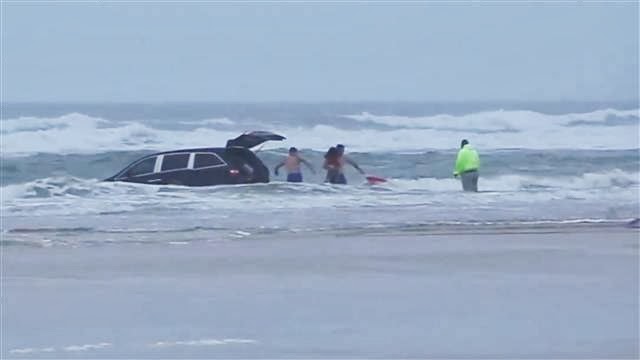
Last week, the body of water was the Atlantic Ocean rather than the ubiquitous lake.  A pregnant South Carolinian woman attempted to drive her minivan and three children into the ocean on Daytona Beach.  Bystanders sprung into action, pulling the children from the van, while the mother, still trying to head into the waves, apparently said, “We’re okay, we’re okay, we’re okay.”  Thankfully, in the end, they all were.

While reports of a diagnosis have not yet been made, I knew instantly this woman’s actions must have stemmed from some sort of perinatal mood disorder.  Of course postpartum was the first thing to pop into my mind, but then I learned she was pregnant.  Not outside the realm, people.  It’s not as if these mood disorders and psychoses obey that post determination like the flip of a switch.  The machinations that power the beast start churning before the baby pops out.

Indeed, this woman’s sister called police requesting a ‘well-being check’, knowing her sister was having difficulty.  The police suspected that as well upon speaking with her, but “conclud[ed] she couldn’t be held under a Florida law that allows for detention of people believed to be impaired by mental illness and who possibly pose a risk of harm.”  They did arrest her after her release from the hospital later that day, however.  With three counts of aggravated child abuse and a charge of attempted murder.

I do not condone the maltreatment of children and most definitely anything that could lead to their deaths.  However, the charges brought against this woman chill me to the bone.  Simply hearing the story – before any facts – I knew she could not be able to exercise right judgment.  Her sister recognized it.  The police officer who interviewed her earlier that day recognized it.  And yet, she is slapped with such a charge?

There are other issues at play.  She came to her sister in Florida to escape a supposedly estranged husband back in South Carolina.  She said she didn’t want him near the children.  The sister said she spoke of demons.  But then she also told police, “she’s … having psychosis or something or postpartum.”  Volusia County Sheriff, Ben Johnson, said “one goal of charging her was to make sure she gets help for any possible mental issues.”

“This is a tragic event. And our goal is to get her into the system so that we can protect the children and take whatever action we need to help her, too,” he said.

I certainly agree that she needs help, help needed so badly she cannot even recognize it.  But is this the way we help those with mental illness?  By charging them criminally?

And what do we tell the children?  The children reportedly told officers, “Mom tried to kill us.”  No child should have to go through such an ordeal.  But I certainly hope all the support staff that come into contact with these children temper their words.  I hope they avoid judgment and stick to the facts: their mother needs help.

Resources (all info and quotes come from the following articles):

http://www.cnn.com/2014/03/08/justice/florida-mother-minivan-ocean/

http://www.cnn.com/2014/03/07/justice/florida-mother-minivan-ocean/


Standard
anxiety, Children, Mental Illness

Vantage Point

An exploding moment.

One that stretches out inexorably like a slow motion sequence in film.

When tragedy occurs at breakneck speed, but your body cannot catch up; cannot speed up to stop it.

My four year-old teetered on the edge of a boulder that stretched in a line of them on the causeway. My mind was already fast-forwarding to the next scene, the one where her battered and broken body lay below or plunged into the icy depths of water beyond.

My voice exploded from my lungs in a staccato screech more piercing than that of the gulls above.

“Michael, the baby, the baby, she’s going to go over the edge, get the baby!”

Stuck to that spot by fear, I didn’t spring forward; I shook my arms, I stamped my feet. I screamed for her father to do it.

He saved her, while reprimanding me for just standing there. If I were going to have such a violent reaction to it, surely I’d do something about it . . .

In the instant replay, she hadn’t been teetering on the edge. She’d been dancing on the top, but not close to falling below. From my vantage point, it looked like she’d surely fall away from me.

From my vantage point.

My nine year-old watched me in the moments that followed. I caught her studying me. Sizing me up. Not like a cruel critic, but as if she might be wondering just what my vantage point was. What would make me screech like holy hell at a threat that no one else perceived. Like she’d just had her first cognizant look at her mother’s mental illness.

I felt shamed. I felt like she’d seen the ugly underbelly that, between my disguises and her naivete, I’d managed to hide until now. That now she had seen the irrational powers that ruled me.

I didn’t know what to say. I didn’t think I should explain it away – and didn’t have the words even if I thought I should. I returned her gaze and pulled her into a hug.

A little while later, I watched her as she stood at the shoreline, hands dug deep into her pockets, jeans tucked expertly into her boots. She is becoming a young woman. Yet, in the wake of the waves crashing upon the shore, she looked so small.

And I thought – is that why we come to the ocean? To be reminded of how small we are? How insignificant in the face of the universe? Comforting to think that our worries are but grains of sand. But suffocating to think of the press of dangers and concerns able to crush us out in one single second.

Which vantage point will my daughter take? Will she recoil from the threat around every corner, refusing to turn and meet it? Or will she refuse to be frozen by fear and tackle her problems head on? Will she see my struggles as problems or failings on my part? Or will she see that I soldiered on in spite of them?

This screenplay is an on-going saga. If only I had the control.

Standard