Living, Mental Health, Mental Illness, Recovery

Many Peaces of Mind

By sharing our stories, we encourage others to do the same.

This was a major theme of the Peace of Mind Storytellers Series I attended yesterday. By breaking the silence surrounding mental illness, we also break the stigma. We allow people to admit and accept the struggle and begin recovery.
wp-1463799297391.jpg

As an anxious person (also mere weeks away from delivering a child), attending a day-long event with hundreds of people I’d never met solo was a little nerve-wracking. But I’d been awarded a free ticket through a generous contest by a local mental health facility, Butler Hospital. I’d been following and loving the organization sponsoring the event, PeaceLove Studios, for several years. And the format of the event, like our state’s own local version of TED Talks, sounded pretty cool. As a writer, I am a little obsessed with stories, after all. Add the mental health aspect and I was hooked.

Once the speakers started rolling out, I realized this was not just like our state’s own local version of TED Talks, it basically was one. The speakers hailed from around the country and world. They ranged from college students to policy-makers and changers to international celebrities. While I hadn’t recognized all the names beforehand, I was impressed by the vitae of these individuals – and even more so by the enthralling stories they shared.

wp-1463799329728.jpgLike Faith Jegede-Cole who said mental health has to do with the health of your soul. Michael Thompson who said the goal is not to focus on just the 1 in 4 who suffers from mental illness, but all 4 – to get the others to listen. Kate Milliken whose own family’s silence over mental illness moved her to create a platform for patients and caregivers living with MS to share their experiences. Amelia Grumbach wishing someone else would take control of her life because she couldn’t/didn’t trust herself to do so. Philip Sheppard, a soul-stirring cellist, urging the attack of any creative endeavor without the fear of creating crap. Simon Majumdar saved by love of food and its serving of soul. The rhythm of Steve Gross’ (left) spoken word carrying the buoyant message of the right attitude affecting everything. Butterscotch following her heart’s desire without compromising for anyone. The mother’s love of A.J. Wilde holding her son, Devin, as he found the key to unlock his autism. Ryan Brunty’s lovable yetis expressing the depression he’d been living with silently beforehand. Stephanie Prechter’s fierce devotion to learning as much as possible to support and treat people like herself and her father who suffer with bipolar disorder. Mark Hedstrom moving Movember into the mental health space. Ross Szabo creating a curriculum so that mental health is not something we look at only when something’s wrong, but taught much like physical health education from kindergarten to grade 12 and beyond.

The wide range of experiences of these speakers broadened my perspective of mental illness and health. One of the speakers said, after all, we all have stuff; we’re all human. There are different brands and flavors and struggles, but one thing we all have in common is trying to walk this world with grace and contentment – at least most of the time.

All of these storytellers did so yesterday with beauty. Through their various creative presentations, they gave swell to that part of the soul that makes one glad to be alive, through the ugly and transcendent, the low and the dizzying highs.

The Peace of Mind Storytellers showed in a grand way what PeaceLove Studios is doing everyday: using expressive arts as a therapeutic device for all individuals languishing, battling, flailing, and/or surviving life with mental illness. What ninety participants got to take part in after the series of speakers. Myself included.

I was transported back to the first PeaceLove workshop I’d attended with a friend a few years ago. While in a different space with different people, the atmosphere was the same: a safe place to create, process, emote, and share. Several participants commented that they didn’t consider themselves artistic, but due to the open-ended nature of the activity and low-pressure environment, they enjoyed creating. Another said that while she hadn’t started with any idea in mind, a plan slowly took shape on her canvas – and that it was symbolic and cohesive. I felt similarly. Exhausted at the end of a long day, I didn’t think I was up for any grand metaphor. But what rose to the surface in that quiet, stream of consciousness state was perhaps exactly what my psyche needed at this time. Indeed, what came out reminded me of my constant struggle for balance. But in that gentle unfolding, it wasn’t frustrating as it usually is, but a quiet reminder that it’s a process, about maintaining peace of mind, not achieving it and moving on.

In the grand and small movements of my day at the Peace of Mind Storytellers Series, the ebb and flow of life was reflected. The entire day was a reflection of life at its best and worst and the journey we all make together. Bound by our stories and in the sharing, we can achieve peace of mind indeed.
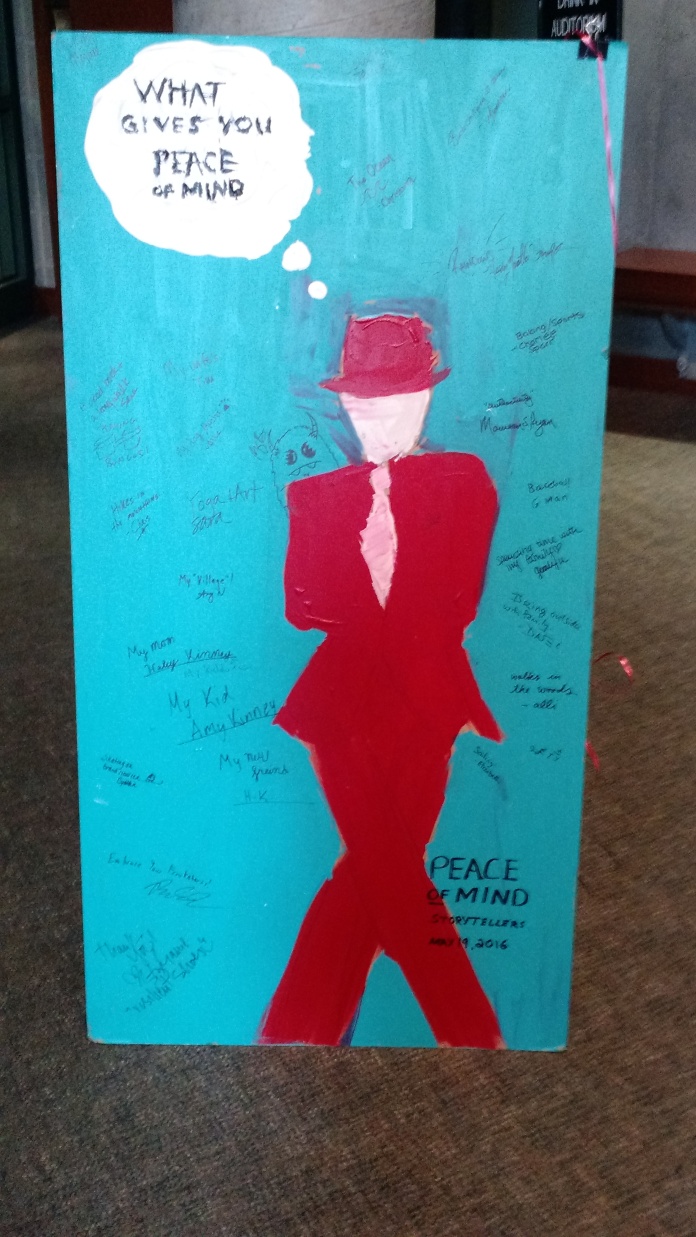
wp-1463799315756.jpg

Painting by Jeffrey Sparr, PeaceLove co-founder

Standard
anxiety, childbirth, Maternal Health Month, May is Mental Health Month, motherhood, postpartum depression, pregnancy

Locked On

They put the baby lo-jack on the umbilical stump.

If I had to choose one phrase illustrating how relaxed my most recent and hopefully last tour of a maternity ward was, that would be it.

It may not seem like much, but to me, it’s a huge deal.

Over six years ago, it was an errant lo-jack slipping off my baby’s slender little ankle that precipitated my fall into postpartum mood and anxiety disorders (PPMAD). Her squirming and that slipping gave my irrational mind the fuel it needed to doubt whether I was taking home the right baby.

I haven’t had that fear this time or denial or doubt, and the nurse only mentioned that additional bit of information as we headed for the elevator, but it capped our visit in the best way possible. As the elevator doors slid shut, I looked at my husband with relief and said if she’d told us nothing else, our tour was worth that one statement.

It’s an odd sensation that washes over one as she walks the floors she knows she’ll next be pacing in pain. To see the calm, the fresh beds, the quiet daylight streaming in the windows. I know the harsh fluorescent lights will glare, the linens no longer be fresh, the quiet replaced with beeps and moans and directions. It’s enough to put anyone on edge – either a woman trying to anticipate something she’s never experienced before or one who knows all too well what to expect.

This fourth tour I’ve taken was the least anxious I’ve ever been, however. It was due in large part to the relaxed community atmosphere of this particular ward. I think I also have finally realized that how ever much I dread labor, there is no way around it, only through it.

The nurse was very low-key, gentle and calming, as she shared information and answered our questions. When I asked about labor positions and modifications due to a weak pubic bone, she explained how the end of the bed came off, a yoga ball could be used, a kneel or squat bar . . . she even said she’d make a note in my chart to request an automatic PT consult after the birth. I wanted to hug and kiss her.

And then she made my day even better when she shared the positioning of the lo-jack. I hadn’t mentioned anything about my postpartum experience last time. I hadn’t mentioned that a tiny locator device could be such a trigger. I hadn’t expressed any concerns about security. Maybe it was just that we were approaching the locked door of the ward as the tour ended, but she told us hospitals have changed procedure to attach the device on the umbilical stump because it can’t fall off.

With that one bit of information, that I hadn’t known I needed to hear or was even a possibility, my mind opened up. The iron grip of anxiety I’d unwittingly been living with lifted – if only enough to let me breathe. To see that this labor and delivery and recovery will be different. There will be no fear concerning the baby.

I am hers, she is mine. Everything will happen as it should.

baby feet

flickrhivemind

Standard
Living, Mental Health, parenting, Recovery, Survival

Not in Vain

Before my third child, I never dropped the JC.

I was no pure linguist, but I did not take the name of the Lord in vain.

In the months and years following her birth, it became a regular part of my vocabulary, satisfyingly venting my rage and frustration at things gone wrong. Stupid things. Teeth not being brushed. Butts not being wiped. Nothing that should unleash rage, but they were the proverbial straws.

I knew its use signaled a loss of center, of control.

Perhaps it was a desperate plea. But it came out sounding like a kid forced to say please and thank you. Totally inappropriate in tone and timbre.

Finally, one Lent, I decided to make a focused effort to stop saying it improperly. Keeping track of my missteps, I counted eight uses during those forty days. A significant reduction. I never did decide what would be an appropriate penance for each of those eight uses, but my non-JC oath habit stuck.

So here I am 32 weeks into pregnancy #4 and I’m being pelted with more stupid little straws.

My six year old has decided this is a fabulous time to assert her independence. Not in a dig-your-heels-in toddler sort of way, but in a snotty teenage you-can’t-make-me sort of way. Holding a stuffie I’d told her to put away at least three times, I stood over her as she sat on the bathroom floor fully dressed and not making any attempts to prepare for bed. I had to fight the urge to bean her over the head with it. After numerous non-oath reminders, I unleashed a torrent of reprimands peppered with choice words (though no JC – does that earn me some credit?).

Having to remove myself from the situation, I stalked in our bedroom, where my husband stood.

“This kid isn’t even born yet and I’m already swearing!”

He laughed. I think he appreciates seeing me get as frustrated as he does sometimes.

But his laughter also signaled to me that perhaps my reaction, while a bit overblown, was natural. I may be hyper-vigilant to signs of rage due to my postpartum experience last time, but that doesn’t mean that every freak-out is a bad sign. It could just be a bad day. Or a bad moment.

Just as uttering Jesus Christ in a proper context is not a bad thing, expressing anger or frustration in an appropriate way is not either. I need to watch the tone of my words and actions to see whether I’m struggling. It may not be a spiral, but a slight dip in the mood of the day.

I know many postpartum women – or anyone who’s suffered a mental health crisis – who see a bad day, a down period, a low point as a relapse. But even if it is, having been where we have and coming back from that place, we are equipped to do so faster, better, and with the proper supports.

We also are entitled to the same bad days our “normal” counterparts have all the time. Not every infraction is a sign of our condition, a harbinger of more to come.

Of course, all of this is easier said than done. Ironically, the organ we must rely on most strongly to convince us of our strength and resiliency is also the one most affected by our illness.

In that case, perhaps a call to the Lord would not be in vain.

Standard
anxiety, Identity, Mental Health, motherhood, parenting, Survival

Without Wee, Within

I am very much inside myself lately.

Thinking about what needs to get done,
Worrying about pain and exhaustion,
Waiting for my next chance to lie down

I weigh this alone time
for its relaxation
vs
opportunity to accomplish,
both sans wee ones

Motherhood has brought me to this state
and yet, it’s all in my head.

I struggle and strive to survive
for them
yet yearn for me

.

power_within

powercube.net

Standard
Depression, Living, Mental Health, Survival

Netflix is Depressing

Netflix is making me depressed.

Ok, I can’t in good conscience blame all of my troubles on on-demand television services, but I can make a good case for their use attributing to my condition.

I’ll be the first to admit that I find cable television seasons highly annoying. You wait an inordinate amount of time for a show to start up again, only to watch it whisk by in five to six weeks. Each episode ends on a ridiculously frustrating cliffhanger, leaving you lunging at the TV for more, an urge you must tamp down for the following week. This manipulative cycle of desire and gratification has got us viewers trapped hook, line, and sinker.

Enter the world of on-demand services.

They don’t solve the week’s wait between new episodes, but glom onto a show just past its prime, and all the episodes are there for the taking. Want to see what happens next? No problem, my addictive friend. Binge away.

Such binges lead to a glorious few days or a week, depending on how long you stretch it out, but leave you – at the end of it – in the ubiquitous showhole. My kids don’t get that commercial. I find it eerily accurate. The fact that I recently learned to knit adds to the effect.


But choose a show so popular, there are scads of episodes, and the showhole never becomes an issue. I’ve recently fallen under the spell of Criminal Minds. I never watched it when it initially aired on network television. I missed that highly popular boat. I discovered it on one of the four over-the-air stations we were left with once we cancelled cable – the only one not airing paid programming or home shopping. However, the marathons I loved so much on Mondays and Tuesdays gave way to other crime shows I enjoyed much less the rest of the week. I searched Hulu to no avail. When we added Netflix a few months later, I was so excited to see all seasons represented. I could watch whenever I wanted and start from square one.

I would settle onto the couch with my pregnant morning snack or lunch or under the afghan when I needed a rest, my BAU friends entertaining me while I vegged. I could rationalize sitting there vegetating as long as the episode continued. Just until this episode finishes, just until they find the unsub, just until they solve the mystery.

However, when motivation is not high to begin with, and I haven’t been sleeping through the night, and I’m growing a child, and whatever low-level mental health issue is ailing me come together and Netflix plays their shows on a constant loop, it’s easy to stay on the couch for the next episode and the next and the next . . .

About half way through the third episode, the show isn’t even that scintillating anymore. It’s the construct and the comfort that leave me there, rooted to the couch, all semblance of productivity drowning in the abyss of my mind and pool of my guilt.

There is definitely a pleasure seeking/reward system at work with any media viewing. We seek solace, relaxation, a treat in our favorite show. But just as that huge bowl of ice cream eventually empties out, so our show ends, leaving us wanting and needing more to fill that reward center. With the overzealous access of on-demand services, it can become very easy to remove oneself from time, place, social connection in search of an elusive endgame – whether it’s escape, entertainment, distraction, avoidance, or happiness.

Holding Netflix responsible for my lack of mojo and self-control is about as ridiculous as suing McDonald’s for getting fat. I need to set up fail-safes and proactive measures to keep me from swirling ever closer to the rim of the showhole. But it’s so easy to drift along on the gentle current of complacency, detachedness . . .

At least I only have ten more seasons to go.

Standard
Mental Health, postpartum depression, prevention, Recovery, Survival

Point of Contact

I entered the world of mental health advocacy kicking and screaming.  Some days, quite literally.

Studying English?  Easy, I loved literature and writing.  Teaching?  A way to purvey that love to another generation while parlaying it into a paycheck.  Motherhood?  An extension of the love my husband and I shared.

Postpartum depression and anxiety?  A most unwelcome and unpleasant recalculation in my life’s journey.

For years, I looked for reasons.  I hadn’t recalibrated my compass, had I?  What had happened to lead to this catastrophic turn of events?

I am not the grand cosmic poomba of all things so I cannot answer those questions with any sort of certainty, but I do know that my struggles awakened a raw, yet steely inner strength I’d never had before.  They fostered an empathy of a whole new level for others’ suffering; for the mantle of motherhood and all its ‘come-withs’.

I had to polish some ragged rock I’d gotten caught up on and dragged along on my journey into at least a burnished gem.  Something positive had to come out of all that suffering.  And perhaps even prevent another woman from travelling the same path.

I started this blog as a way to tell my story, which very few knew.  I thought, with complete disclosure, I might open the dialogue for others.  At least become an ally in an all too commonly silent struggle.  Perhaps I didn’t tackle postpartum directly enough – for many of my discussions and observations were integrated with my life.  However, I still haven’t decided if that was/is a failure, for mental health struggles quickly become an intimate part of one’s life, touching all parts of it.  It also hinted at some version of depression/anxiety becoming part of my ‘new normal’.

And with my ‘new normal’ so different from my old one, I began to develop further plans for burnishing rocks into gems.

I knew what I wanted to do, but with no clinical experience, I had limitations.  I could not mention the word ‘therapeutic’ in any official capacity.  I was petrified that if the programs I had in mind reached the end of my personal experience and empathy, that I wouldn’t be able to help someone in crisis.  

I embarked on a series of webinars offered by Postpartum Support International.  The Social Support Training series, one session every other week, stretched from January to June of last year.  While many of the participants were clinicians in the field of maternal mental health, the course was user-friendly and aimed at individuals interested in starting and supporting groups of mothers in various presentations of mental health.

The Social Support Training was the perfect first step toward a solution.  It offered a wealth of information – statistical and anecdotal, researched and proven – paired with the assurance that social support people are not meant to be clinicians.  They are meant to offer a safe place for mothers to gather and vent, ask questions and talk, discover resources and camaraderie, and just be.

I finished the series a few weeks before I headed to Boston for Postpartum Progress‘ first annual Warrior Mom Conference, the first ever maternal mental health conference for survivors of PMADs.  With my new-found knowledge and training, I looked forward to building on that momentum and connecting with other moms doing the same.  While I did that, I also found parts of me that hadn’t fully healed.  I realized I still had my own work to do and how very complex maternal mental illnesses are.

That fall, my PMAD baby started full-day kindergarten and, though scared as hell, I began formulating plans to kick my ideas into high gear.  I applied for a scholarship offered by Postpartum Progress and the National Council for Behavioral Health to be trained in Mental Health First Aid, which I was awarded a few weeks after discovering I was pregnant with my fourth child.  I faltered, wondering how I would enact my plans with a newborn baby.  But then, they were never my plans anyway.  And now I would have the full-circle experience informing my advocacy.  Up until now, I’d only ever experienced the postpartum piece of mental health; now I could speak to both pre- and postnatal.

I spent two days in New London, Connecticut with two fabulous humans from Child & Family Agency of Southeastern CT learning how to assess and support a person’s mental health status.  Again, the trainers stressed that we were not expected to diagnosis the individuals we come into contact with, but to assess their situation and determine whether they need additional help.  We then must help them feel comfortable and safe until such professional help is acquired.  The trainers helped me gain even more practical ways to help those in need as a civilian, a concerned individual, an advocate.

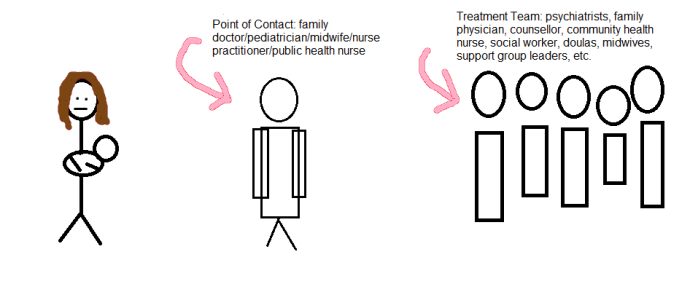
As I sat in that auditorium, surrounded by empathetic professionals and persons, I flashed back to an article I’d read a week and a half earlier.  “The Community Maternal Mental Health Professional” on The Burnout Cafe (click image for link) discusses the gap between women who need help and the services available to them.  While the central point of contact in this graphic from the article lists a woman’s professional caregivers, and a woman certainly does see these people quite frequently both before and after the baby is born, I would argue another layer of contact needs to be added.  If practitioners aren’t well-informed or comfortable dealing with maternal mental health issues, the assessments, diagnoses, and referrals needed will not occur.  Having been down that dark hole myself, I am well-versed in those discussions.  I can help normalize the feelings a woman may be experiencing, yet not want to admit for fear of retribution to her or her child.  I can point her in the direction of practitioners specializing in the exact type of care she so desperately needs.

ppd1

“The Community Maternal Mental Health Professional” as point of contact (via The Burnout Cafe)

With my personal experiences and new-found knowledge via recent trainings, I am a point of contact for mothers.  

My plans may morph and grow as my own life and family does, but the end goal is the same:

Helping Mothers Get the Help They Need.

Standard
anxiety, Depression, Mental Health, Survival

I’ve Been Had

I had to clear out months of clutter in a matter of weeks.

I had to squeeze in cleaning sessions between naps.

I had to let some things go that seemed absolutely essential.

I had to receive guests into an imperfect house.

I had to admit that the next week was lost due to physical and mental recovery.

I had to hope that it was just the exhaustion of overextension and not the harbinger of a downward slide

into

anger

irritability

the dull padding of apathy.

I have to rally the hopeful spirit of the season and strive to be reborn each day.


Standard
Living, Mental Health, Survival

Self-Care: A Cautionary Tale

I didn’t eat breakfast.

I drank caffeine.

I didn’t take my meds.

I stared at the computer screen all day.

I reread a beautiful, but sad book.

I cried hand-clamping tears.

I had a late lunch.

I didn’t get dressed until 4 PM.

I fought with my husband.

I looked things up online by only the light of my phone.

I went to bed too late.

—————————————

I awoke at 5:45 to the crash of thunder,
the wind whirling,
the rain pummeling.
Mother Nature matching my disconcertment.
Trees torn from their roots,
leaves littering the ground –
a mess of downed limbs and debris.
But soon the sun is shining,
the water a glaze of calm.

image

Jennifer Butler Basile

Still, my head is in a vice.
My stomach churns.
There is much recovery to be done.

Standard
Mental Health, Mental Illness

How to Help the Mentally Ill during the Holidays

During a season known for its twinkle lights and tinsel, it’s hard to feel the least bit sparkly when suffering from a mental illness. All the shining happy people floating around us make us feel that much more isolated, removed, and miserable. They all make it look so effortless while we struggle to keep our heads above water on a regular day. The added mayhem of shopping, socializing, and stringing the lights raises the bar to a Himalayan height.

I’ve talked before about how I’ve come to hate putting up our Christmas tree the last few years. Those Christmas crackers? They’ve got nothing on me. My head was about to pop off several times throughout the whole ordeal. This year a few events have transpired that have unwittingly saved me from the debacle so far.

This is only our second year with a real pine tree, which takes more planning than retrieving the cardboard coffin of our since deceased artificial one from the basement. As always the weekends spool away from us toward the holiday at an alarming rate and we haven’t made it to the tree farm. Not to mention, we don’t have tons of extra green of the other kind lying around these days. After two years of failing to decorate that pine tree in direct line of sight from our back door, we finally decided we should chop it down and use it as our indoor Christmas tree. To which the kids balked saying it is too small. They fail to remember the merits of a Charlie Brown Christmas tree or the top third we had to slice off last year due to our overzealous choice. BUT in any event, the ensuing chaos and discord has kept us tree-free for a couple of weeks now.

Which is totally fine by me.

One day when only one of my elves was home from school, I dragged out the bin of wreaths and garlands and hung those up, deposited the empty bin downstairs, and enjoyed the view. Another day, I set up the bin with the nativity and related items. And quit for that day. A third day, I retrieved the mamma-jamma bin longer than I am tall – and which usually makes me want to lay down inside and cry because the kids fling stuff out of it with reckless abandon – and opened it. That’s all. It’s still sitting in the corner, lid askew. The kids pick a few things out here and there, but we haven’t set it all out yet.

And still no sign of a tree.

I know it’s my anxiety and perfectionism and ability to get easily overwhelmed and controlling tendencies that made opening that Christmas box of decorations so hellish. I know I may be missing the point by not letting my girls pull it all out with reckless abandon. But it doesn’t come from some deep-seated desire to be like Martha Stewart. It comes from my tendency to move like a snail and being pushed through the steps heightens my anxiety like the Abdominable Snowman’s toothache. A previously joyous activity becomes hell on a holly branch.

So low and slow is my speed this year.

It seems as if the absence of the tree lets us focus on other beautiful parts of the season, too. Our advent wreath. The nativity. The soft glow of candlelight. Christmas stories and cuddling.

The slow dissemination of decorations from storage bins is not a foolproof solution for all people struggling during the holiday season, though.

How can we all lower our expectations and be at peace with ourselves? How can you keep it low and slow? How can you help your loved ones cope?

Standard
anxiety, Mental Health, motherhood

Mental Intervention

What was I thinking having three kids?

I mean, I love them, but who went and told them they could have their own social lives?

My life has turned into a maelstrom of meetings and play dates, educational outings and activities, birthday parties and sleepovers. Add that to my own [limited] social calendar and my outta-mind anxiety is over the top.

A dear friend once commented that a fellow mother reentered the real world more smoothly and earlier than I, perhaps because she came from a large family and was better equipped to juggle multiple responsibilities at once. She was busting my beans for being incommunicado for most of my child’s infancy, but it stung. Because I was an only child, I sucked at balancing the many demands of life? More so, I think it hurt because it hinted at my inability to cope. In a subconscious effort at self-preservation, I had compartmentalized my life to its limit. The new job of mothering was so all-consuming, I shut out all other demands like the airlock of a submarine to prevent an all-out deluge.

Nine years later, I feel myself pulling back, anticipating catastrophe as life – mine in relation to the swirling schedules around me – ramps up big time. Can I truly not handle all we’ve taken on? Or is my anxiety creating a problem before it’s even – or will – begun/in? I think my struggle is a direct result of my anxiety and not from a need to learn to say no.

It could also be the stubborn mule in me that hates change putting on the brakes. My family no longer exclusively rolls as one unit. The oldest is here, the middle is there, the youngest is home with Daddy while I run errands. Going to the grocery store by myself and buying Christmas gifts without acting like an art smuggler to keep them away from prying eyes is a luxury – but our family life feels so disjointed lately. Times of transition are not my friend.

Another friend once left me a message – somewhere between the two points on today’s timeline – that I couldn’t just stop answering the phone because I was stressed out. It amazed me that she could see me more clearly than I could see myself. When I finally did talk to her, she made me laugh and at least temporarily forget my troubles.

I need some sort of mental intervention now. If only I could enact one myself.

Standard