May is Mental Health Month, Mental Health, postpartum depression

The Brand of Crazy I Am

I guarded my postpartum depression diagnosis like a dirty little secret.

While I felt a certain measure of peace at having a name for the pit I seemed to be peering out of, it didn’t translate to shouting it loud enough to be heard above the rim of that pit.  It didn’t even encourage me to tell my family.

After I nursed the baby and put her down for the night, I’d tuck the other two into bed saying, “Mama’s going to the doctor.”  It was never the therapist, or my LICSW, or someone I need to bare my soul to in order to process what’s going on in my heart and head.

I didn’t want to be one of those people.  The ones who lie on the couch to be psychoanalyzed.  The ones who aren’t normal, who can’t cope, who have problems.

And that was just the ‘me’ stuff.  Slathered on top of that was a thick coating of mommy guilt, seeping down into the crevices and open spaces.  What kind of mother was I if I couldn’t care for my own brood?  Blessed with three gorgeous, healthy children, why couldn’t I be happy?

I didn’t want anyone to see what a failure I was as a mother or how broken I was as a person.

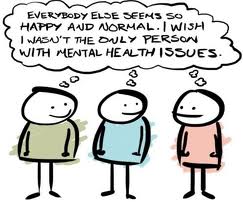
I still have misgivings about sharing TMI on my blog.  I invited all my Facebook friends, many of whom I haven’t seen in years and knew me in former incarnations, from my personal profile to ‘like’ my author page on which I share links to these blog posts.  But did I want these acquaintances to know just what brand of crazy I am?

images

If I’ve learned nothing else during this experience, it’s that having nothing to hide takes away whatever shame there is.  Being completely open is what destroys the stigma.

And as far as postpartum goes, I believe it helps other women get the help they need.  In the surreal realm of new motherhood, it’s easy to feel completely alone.  Start adding feelings not featured on any Hallmark card and there’s no way in hell you’re going to seek someone out to admit to them.  But if you heard just one story, just one little anecdote similar to yours, you might, just might, open your mouth and let yours fly bit by bit.

Standard
anxiety, May is Mental Health Month, Mental Health, motherhood, postpartum depression, Recovery

Don’t Fear the (Ir)rational

As the sun rose hours after the baby’s birth, I was fading fast.  I had slept maybe two hours of the past 24 and didn’t have the strength to eat my breakfast.  The nurse suggested the baby go to the nursery, I drink a pitcher of water, eat, and sleep.  I did and woke up a short while later feeling a bit more human.  When my husband went to retrieve the baby and came back empty-handed, the feeling was short-lived.  “Where’s the baby?” I asked, panic creeping into my voice.

“Oh, her bracelets fell off, they’re just putting on some new ones,” he answered, easy-going as ever, which could’ve been an indication of my overreaction but went unheeded.  I went through every possible combination of events I could think of: were the bracelets in the bassinet, did the nurses take her out of the bassinet, were there any other babies in the nursery?  What I was really getting at was: how will we know this is our baby?  My husband, thinking with a rational mind, told me it was fine; they were giving her new bracelets to match ours and were checking the serial number on her Baby Lo-Jack, the nickname for the security device affixed to all babies in the hospital.  Still, I balked.

I worried for months, a year after.  I had moments of clarity: an expression on her face as she gazed up at me, identical to her oldest sister when she was an infant; her tiny hands patting me on the back as she wrapped me in a hug; shadows of family members in baby photos.  But always, when I allowed it to seep through, that dark thought,

‘Did I bring home the right baby?’

I was afraid that if I loved her too much someone would come to take her away from me.  The licensed social worker I had started seeing suggested I felt that way because things – the pregnancy, labor, delivery, and recovery – hadn’t gone according to my plans.

It wasn’t until we sped down the highway one day months later that the truth caught up with me.  As I saw the family resemblance written all over my baby’s face, I realized that I hadn’t thought she was mine because I still hadn’t accepted the fact that I was having a third child.  I hadn’t sanctioned it.  It hadn’t gone according to plan.  I was still grasping for some sort of control that I hadn’t felt since being plunged into the chaos of three children awash with my own anxiety.  Did I not see the resemblance because I didn’t want to see it?

Yes and no.  Or yes, but not totally.  It wasn’t my wounded psyche that was totally to blame.  As my therapist pointed out, irrational fears are another symptom of postpartum depression.  I more than filled that box on the survey.  It was a strange split, though.  Rationally, I knew she was mine and accepted her with the unconditional love of a mother.  In the stark predawn hours of loneliness or moments of love bordering on too intense, my irrational self would pull back, fraught with worry and dread.

My husband irresolutely assured me she was ours.  “What do I need to do to prove it to you?” he asked.  “Do you want to get blood tests done?”  “She’s ours, Jen, I know it.”  “I was right there beside you when she was born.”  To which I responded, sometimes verbally – and later as the argument wore out, silently – “But that was before she went to the nursery and lost her bracelets.”

I couldn’t shut off the stream of irrational thought and worry – even though I knew there were holes all over my argument.  I felt silly voicing my concerns, but wanted other people to tell me how much she looked like her sisters or me or my husband.  I needed validation that the ‘voices’ in my head were wrong.  I couldn’t defeat them myself.

And I didn’t.  With love and support from my husband, my fabulous social worker, lifestyle changes, the passage of time, and eventually medication, the irrational worry stopped.  It became definable, ‘boxable’, and I shut it away.  I don’t think it’ll come back, but I think I’ll always remember how real and frightening it was.

Standard
May is Mental Health Month, Mental Health, motherhood, parenting, postpartum depression

The Perfect Storm

hurricane

When my husband and I learned of the imminent arrival of our third child, we were in shock.  Yes, we knew how things worked.  Yes, we’d always considered, even expected, a third child.  No, we were not ready for it right then.  After our second was born, we said we’d definitely want to wait until she was older than our first had been before we welcomed number three, which was just over two and a half.    The best laid plans . . .

Our second was eighteen months old when we found out I was pregnant.  In the weeks that followed, we walked around in a stupor.  As I went about my daily activities caring for the kids, I would find myself staring into space, lost in thoughts of third car seats, reconfiguring furniture in our already small house, finances, schedules.  The phone would ring – my husband calling from work – and we would stare into space together, our shock suspended in the telephone lines.  We knew we wanted this child and loved it already, but were totally caught off-guard by its timing.

It was also a difficult time in my extended family.  My uncle was battling a terminal brain tumor.  My announcement to my mother was made by way of my explanation for not visiting the ICU.  He died a few days later.  Four months later, my cousin was killed in a motorcycle accident.  My grandmother’s devastation was complete.  My mother’s own grief was wrapped up in worry for her mother.

Somehow, the days wound on, the months passing.  Caring for two children while carrying my third was starting to take its physical toll.  The usual aches and pains of pregnancy were amplified.  My left hip and pelvis were giving me more pain than ever.  As my due date approached, I felt extreme pressure, a heaviness, different than impending labor.  Having nothing to compare it to, I just assumed it was my body’s worn-out response to doing this a third time.

In the delivery room, my midwife asked me if there’d be a fourth if we had another girl.  “I hope not,” I’d said.  By the time I was pushing, I was sure there wouldn’t be.  Even after two natural births, I’d never experienced anything like it.  I actually uttered the words that infuriate me when I hear them in television portrayals of labor: “I can’t do this.”  But somehow I did.  And the nurses placed a perfect little girl in my arms.

I’d like to say all the shock and worry evaporated as soon as I saw her face.  She was gorgeous, I loved her, but I almost felt like a stranger observing the scene from afar.  I still hadn’t wrapped my head around the idea of starting over again with a third child.  And I wouldn’t get a chance to right away.  In the hours and days following her birth, a new challenge presented itself: getting out of bed.

When the nurse came to get me the next morning, she asked if it was the first time I’d been out of bed.  “No,” I answered, nonplussed, until I saw her face as she watched me move.  My walk was more of a shuffle, getting in and out of bed was slower than glacial melt.  Finally, after many such episodes throughout the day, she said, “Maybe we should send you for an x-ray to make sure you didn’t break anything.”  Break anything?  You’re not supposed to break anything when you have a baby – except your water.  Now she was making me nervous.

An x-ray confirmed her suspicions – and my pain.  I had a slight case of diastasis symphysis pubis.  Thank God it was slight because it meant the ligaments in my pubic bone had separated.  And as slight as it was, it was excruciating.

Once the adrenaline wore off and the soreness settled in, I couldn’t roll over in bed without crying.  It took me 45 minutes to get out of bed early one morning when I didn’t wake my husband or call the nurse.  My father brought me the old karate belt I’d left at their house to lash my legs together as I rotated them off the bed to come up to sitting.  Hip adduction was simply impossible.

My husband had taken two weeks’ vacation to help with the baby.  He didn’t know that, in addition, he’d be doing everything for the other kids, washing and folding clothes, preparing food, and helping me to and from the car like a little old lady.  The helplessness that can afflict a new mother was magnified ten-fold by my handicap.

I told my mother-in-law, “I’m finding it hard not to feel sorry for myself.”

She said, “I don’t blame you.”

Her answer surprised me.  Were things really that bad that I should be feeling sorry for myself?

Apparently so.  I worked my way into some sort of routine with a newborn who fed at no particular time, a preschooler who had to be in school at a precise time, and a toddler who took off her shoes and socks whenever she felt like it.  Weekly visits to a physical therapist worked me through a regimen that gave me a tenuous, yet workable, physicality.  And yet, four months after the baby’s birth, I still couldn’t cope.

I would reach my breaking point over hair elastics stretched to theirs over the top of a dining room chair.  God help the poor soul who dumped out the basket of toys I just filled.  My two oldest would jump when I started screaming at the top of my lungs out of seemingly nowhere over seemingly nothing.  I felt like a pot about to boil over and I was trying desperately to keep the lid on tight.  It was a particularly grueling drop-off at preschool one morning that crystallized everything.

Sleet was just turning to snow as we pulled into the parking lot.  I strapped the baby into the baby carrier on the front of me and moved around to the other side of the car.  My toddler had already taken off the hat and mittens I’d fought to get on her at the house.  I reached into the back seat where the preschooler was seated to depress the red button on her harness, instructing her to unclip the top part while I redressed the toddler’s extremities.

“I can’t, Mommy,” came the plaintive cry from the back seat as she stared out the window at the passing kids.  I instructed her to focus on what she was doing and try again.  This conversation repeated itself over and over like an audio loop, her despair and my frustration escalating each time.  Finally, I lunged into the car, swearing like a sailor, the baby bobbing in her carrier like a cork on the ocean, undoing the strap and telling her to get out of the car.

Then I stopped.  I scanned the parking lot around us for parents going to and from their cars.  Had anyone heard me?  Had they seen this terrible little episode?  Shouldn’t I have known I was getting out of control before it was too late?  Once my oldest was safely in the classroom and the rest of us safely home, I dissolved into tears recounting the story to my husband on the phone.

“I need help,” I said.

A few weeks later, I started a new kind of therapy.  I met weekly with a licensed social worker to discuss and treat what finally had a name: postpartum depression.

At the end of my first visit, I said to her, “So, do I have postpartum?”  In classic counselor speak, she replied, “Would you like me to say you have postpartum?”  I laughed and she joined me.  “I can go through the indicators if you’d like,” she said.  One by one, she ticked off every single one of my circumstances: unexpected pregnancy, death of a loved one(s), stress, difficult delivery, physical trauma, demands of caring for other children, anxiety.  “Does that make you feel better?” she asked.  Oddly enough, it did.  For the first time in months, I felt light leaving her office.  I wasn’t a failure and I wasn’t crazy.

This perfect storm was not forecast, but at least now I had some sort of outlook for the future.

Standard
May is Mental Health Month, Mental Health, postpartum depression

Depression did not define me and the same is true for you. | Boundaries of the Soul

There comes a time when whatever is ailing you affects your quality of life so much that you go searching for answers.  For me, it was finding the Edinburgh Postnatal Depression Scale online.  Always one to minimize symptoms and having a surprisingly high threshold for pain (per my midwife) which perhaps translates to the emotional kind as well, I didn’t know how accurately I answered the questions.  But the fact that I sought it out was the first step in getting help.

Dr. Nicholas Jenner (see link below) wrote this incredibly helpful piece that I found too late to “diagnose” myself, but in reviewing his symptoms three and a half years into my own journey, I see how spot-on they are.  In fact, they made me smack my head in a “Gee, ya think?” sort of way.  Shit, is that what happened?

Maybe his article will reach you at a point somewhere before that one!

Depression did not define me and the same is true for you. | Boundaries of the Soul.

Standard
May is Mental Health Month, Mental Health

May is Mental Health Month

Is there a reason that any 31 (or 30 or 28) days of the year should be any more important than the 334 (or 335 or 337) others to celebrate and promote a certain cause?  No.

Does a catchy phrase, vibrant color, or ribbon bring more attention to said cause?  Yes.

There are certain causes that should be mainstream knowledge, part of the collective consciousness of our society, but are not.  That, I suppose, is where car magnets, PSAs on cereal boxes, and fundraisers come in.  And that is why I’m challenging myself this month to raise awareness about a silently insidious disease, disorder, condition.

Mental Health.

Just as autism’s umbrella has opened wide to shelter a great number of conditions, so has mental health become an amoeba wriggling its hulking mass into more and more areas.

And it’s the amoeba in the corner of the room that no one is talking about.

I came across the blog, A Canvas of the Minds, a few months ago.  They have many thought-provoking posts written by a talented cross-section of writers.  Their initiative, Blogging for Mental Health 2013, is a brilliant idea.  blogformentalhealth20131I so wanted to join in the challenge and proudly post their badge on my blog, but I felt I didn’t quite fit the mold.  Their network is of blogs dedicated to discussing mental health issues.  Mine is about chopping potatoes and motherhood.  The way I navigate daily life and motherhood is shaped by the state of my mental health, but that would not be the main focus of each and every entry.

But I want to salute them and their initiative.  And I encourage you to join them in their quest to make mental health something people are not afraid to talk about.  Worrying about how other people see us should not be one more challenge we need to face as we struggle to make life livable.


Standard