anxiety, Living

Cucumbers, Tomatoes, and Too Much Shit to Do

That odd sense of weightlessness, of floating adrift; the feeling that something important, some thought or memory, appointment or task, is there, but hovering somewhere on the periphery, just out of grasp.  Is there something I forgot to do, or should be doing right now?  Some pertinent task that needs to be done or the world as I know it will burst apart from the center outwards?

That was my feeling as I wandered around my garden this evening.

Yes, I needed to put those tomato and cucumber plants I’d bought in the ground before they withered up and died.  Yes, I needed to pull the damned crabgrass out of the ground before it choked all the plants that were supposed to be there.

But wasn’t there something else I should be doing?  Something on that mile-long to-do list I’d been working off for the last two weeks or so?

The end goal in my house lately has been to get said house up on the market.  I had two weeks to do all the things I’d let slide over the last few years, the things that don’t have a fighting chance of ending up on the priority list when you have small children.  Scraping the tiny stray hairs off the bottom of the medicine cabinet.  Ridding the wood in the dining room of dried milk droplets once and for all.  Magic eraser-ing the bejeezus out of my living room walls.

The phone rang, books went unread, writing went undone.

And after one last marathon night stretching into the wee hours of the next morning, my husband and I somehow had the house ready for the real estate agent to take photographs and post the listing.  I took that afternoon and evening to revel in my newfound freedom.  Yeah, the basement could still stand some purging, the garage some cleaning, but for now, we’d earned a respite.

Until the next day.  So used to being on the treadmill (or hamster wheel is more like it), my anxious mind felt like there was something I was missing.  For days on end, everywhere I looked, everything I touched, begged to be fixed, cleaned, put away.  It felt dangerous to shut that off.  Though I know I couldn’t operate at that level much longer.  The systems were breaking down.  Exhaustion – mentally and physically.  Blood-shot eyes.  Cranky.  Irritable.  Snappy.  Emotional (or is that just every time I see the ‘for sale’ sign out front?).

And I suppose that’s the point.  When I get to the point where I feel like I’m at the center of a system – objects, ideas, responsibilities swirling around me in a swiftly moving orbit – it’s time to step back before the whole thing collapses in on itself.  Or I end up in the nuthouse with a nervous breakdown.  Which reminds me of another thing that would help me keep perspective, too.  So what if I miss one of those things that seems supremely important?  Would the world end?  Would I end up checking out?  No and no.  The world doesn’t revolve around me and I can’t possibly control it all.

But I can help those tomato and cucumber plants from kicking the bucket – and if the squirrels don’t get a hold of them, end up with some tasty produce at the end of it.  Digging in the dirt always grounds me (no pun intended).  There’s something soothing about the quiet, the repetitive nature of digging, weeding, deadheading.

Maybe if I’m that present in all I do, I won’t see the ghosts of to-do lists past floating in my periphery.

Standard
anxiety, Living

What is Home?

What is home?

A place to eat? Sleep? Bathe? Shelter from the elements?

An outward manifestation of our personal aesthetic, pleasing to the senses, and exuding a sense of comfort?

A gathering place for those we hold dear to us, to be in each other’s presence and enjoy each other’s company?

Yes, yes, yes, yes, and yes.

But what is it, really?

With the three-semester exception of living in a dorm room Monday-Friday at a college twenty minutes away, I lived in my childhood home until I returned from my honeymoon. Deliriously happy in my marriage, my nights were fraught with depressive tossing and turning as I tried to reconcile this new dwelling with my pre-existing ideas of home. And over the last eleven years, there have been times when I awaken from a very deep or sick-induced slumber and forget for a moment that when I open my eyes I will not see the pale lilac wall of my youth.

Nevertheless, this ‘new’ home has truly become home. My husband and I have built the foundation of our family here. From dinners on the living room floor to detritus thrown from a high chair. From office to nursery to toddler’s room to nursery again. From relaxing soaks in the tub to all-out splash fests. From a quiet haven to a bustling hub of activity.

And now the question that begs to be asked: Have we become too much for this home? Has our family outgrown this lovely little space? How much is enough? This home serves the basic functions of a family (i.e. eat, sleep, bathe, shelter), but we’re busting at the seams. It’s become a battle of space to breathe vs. burgeoning piles of crap. How much can you edit before you affect the quality of life? How much do we really need?

For the last several years, I’ve had a quote tucked into the glass door of the hutch in my dining room, always visible to remind me to contemplate it from time to time.

“It is not wrong to want to live better; what is wrong is a style of life which is presumed to be better when it is directed towards ‘having’ rather than ‘being’, and which wants to have more, not in order to be more but in order to spend life in enjoyments as an end in itself. It is therefore necessary to create life-styles in which the quest for truth, beauty, goodness and communion with others for the sake of common growth are the factors which determine consumer choices, savings and investments.”
– John Paul II

Will a new, more streamlined, spacious place help us to foster connections and communion with others (including the immediate members of our family)? Does the desire for a new home come from a desire for beauty or the want for bigger and better? Am I trying to make life easier or keep up the proverbial Joneses?

I’m hoping the very fact that I’m questioning means I’m making conscious, valid decisions. Perhaps I’m having misgivings because the idea of redefining home again is so scary to me. My thoughts swirling and anxieties mounting, my husband offered me some sage advice I almost missed. The worry in and of itself was almost comforting, because not knowing where we were going or what we should do, that endless loop of thoughts felt almost productive in the face of uncertainty. But I forced myself to look at him when he said the following words, ones I knew I couldn’t miss, “Home is wherever you and I and the kids are.”

And isn’t that the very best answer to so many questions.


Standard
Living, Writing

Oblivion is Bliss

Sometimes I wish I were oblivious.

Years ago, as my husband and I enjoyed a sumptuous dinner and breathtaking view of the Pacific Ocean we were paying entirely too much for, the couple at the table next to us broke out into a quite heated and quite loud conversation.  She had used a French term to describe something and he’d corrected her pronunciation, irritating her and derailing her whole story and subsequently the whole meal – for all within earshot.  Except my husband.  He had no idea what I was talking about when I mentioned it.  While I stewed about their inconsiderate behavior toward all those gathered in this hushed dining room, he told me to ignore it and enjoy our nice food and each other’s company.

He was right.  I, however, could not acquiesce.  Not because I’m nosy.  Not because I can’t mind my own Ps and Qs.  Not because I feel like an authority on proper etiquette.  Because I chose two of the worst professions for one who wishes to be oblivious – even if only for some of the time.

Years in the classroom as an English teacher developed both my ears and the eyes in the back of my head.  Multitasking is an understatement.  I needed to address a large group, scan for questions, read body language, catch the note being passed at the back of the class, hear the tiny whisper above the rustle of papers.  I had to ‘put my roller skates on’ as one of my colleagues used to say and move about the room facilitating group work, attending to one group while still monitoring the sounds of work and/or inactivity from others’.  I had to be the fly on the wall, the all-seeing eye.  Front and center and everywhere.  Attendant to all even while listening to one.

All of which does not make for a pleasant dining experience when one cannot tune out.  Or even a trip to the mall.  One time, I had to bite my tongue in order not to scold some kids down from a raised barrier around a flowing fountain.

Then I took on writing.  Early on in this venture, I heard Jack Gantos speak, saying that to be a writer, one has to notice everything, even if only for a little bit each day.  I saw stories at the bus stop, on the sides of trucks, in snippets of conversation.  Most of them stayed observations, never switching to story, but boy, did I notice.  Now I’ve fine-tuned my observational skills and cull what I know I can truly use.  But that’s not to say I don’t still hear it all – like last night.

My writers’ group convened at a cozy booth on the upper level of a restaurant surprisingly boisterous for a Wednesday night.  Next to us was a booth twice our size and packed to the gills.  The group was mixed so I had trouble imagining what might have brought them together, but the tone and volume of their conversations suggested celebration.  My group layered our conversation in amongst the din and started our critiques.  All was fine until our talks wound to a close and theirs up to a fevered pitch, perhaps in direct relation to their intake of wine as the night wore on.

I heard them lamenting MCA’s death, which I did, too, when I heard (not on a personal level, but for the loss of a hugely talented contributor to the music world), but they said how it freaked them out because he was the first of that generation to die of natural causes.  Last I checked cancer was not a natural cause of death.  And these people were too young to consider themselves part of his generation.

The fragment that most got me, though, was when a woman who, by my estimation, is at least ten years younger than I am waxed philosophical on her decision to dye her hair.  At first, she said, she wanted the grey to add to her esteem, her perceived wisdom.  But as more and more grew in, she decided it was making her look too old.  I’d venture to guess she had ten grey hairs hidden beneath that black dye.  I wanted to call across the bench seat, you want to see greys?  I’ll show you greys – and with no hair dye to cover them up.

Maybe I’m bitter because I went grey at an early age (which may have been her case, but I toughed it out, chica, and didn’t use it as an accessory to my image first).  Maybe I’m pissed off by clueless people.  Maybe I just wanted them to be quiet.

Maybe I just wish I could tune out all external stimuli.  That would help with a whole lot more than dinner conversation, now wouldn’t it?  It’s not something that’s easily turned off, though.  Sometimes, I really do think oblivion would be nice.

Standard
Living, Recovery

Wine before Beer

Once upon a time, I wore straw hats and strappy tank tops while I tasted wine alfresco.  I sampled champagne paired with complementary bites of savory food.  I dined with my husband for as long as it took to finish that amazing bottle of wine just shipped from California.

Now I drink beer from the bottle.

The shift started somewhere during my second pregnancy.  The mere whiff of a freshly opened bottle of beer would set me to salivating.  I thought for sure I was having a boy since beer is not the drink that comes to mind when picturing a ladies’ tea.  Plus, I never drank it.  I would’ve fit right in with a bunch of teetotalling ladies in college.  I didn’t really enjoy the taste of any alcohol.

But, as they say, it’s an acquired taste.  A glass of wine with dinner here, some fruity drink there.  By the time I came home from my honeymoon in Napa, I was well versed in obnoxious adjectives like full-bodied, oakey, and well-rounded bouquet.  Eventually I branched out to ‘heartier’ reds.  And by then I was ready for lagers, ales, and now, even the occasional stout.

It only makes sense, really.  If someone were to tell me on my wedding day what was coming down the pike in the next three, five, seven years, there would’ve been no way I could’ve handled it.  Three babies?  Who one by one spirited away a little bit more of my independence?  No more travel?  No more carefree weekends?  No more Monday-night-kill-the-bottle dinners?  Agonizing self-doubt?  Guilt?  Depression?

I started out with the light, fruity stuff; the bright, refreshing tastes of youth.  My tastes changed as the years went by, the experiences deepened.  Spicy zins for when things got dicey.  Bitter hops when the shit hit the fan.  Luckily, I never hit the hard stuff.

I’m not a fine bottle of wine, getting better with age.  I identify more with the wizened old man sipping his beer at the end of the bar, the lines on his face telling the story of where he’s been.  I know my life is not refined as it may have once been.  Lately, it’s been hardscrabble more often than not.  But I might be okay with that.  Now I can handle what life throws at me, more than I may have been able to at the start of this journey.  I can enjoy the acidic bite following a sip of ale.  And I can more readily appreciate the sweet in its stark contrast.


Standard
anxiety, Living, Poetry

I am a bruise

I am a bruise

A soft spot on your skin that it hurts to look at

A navy hoodie with black sweats toasty warm from the dryer

An ache so familiar it’s almost comfortable

That vulnerable appendage inviting confrontation

from door jambs and jolly bitches,

pointy corners and conscientious offenders

Apply pressure until I turn green and purple,

puce and chartreuse

A mere shade of who I am

Sore and tender,

when will I be at ease in my own skin?

Standard
anxiety, Living, motherhood, postpartum depression

No Use Crying Over Spilt Whatever

Pinch, pinch, pull.

If my daughter’s preschool teacher can inspire twenty-five four year-olds to use this technique to open their pint-size pouches of fruit snacks, you’d think I’d be able to employ it to open a bag of pasta.

Not so.

Employing said technique, I managed to send dozens of uncooked Ditali skittering across the counter.  Surprisingly enough I caught myself before a torrent of curses loosed from my mouth, which is usually what would happen.  I pressed my body up against the impending avalanche and managed to keep all but a few Ditali from dropping.  I gathered the rest up by the fistful, after seeking out a few strays, and threw them into the boiling pot, shepherding the lost sheep to lead them to the slaughter.  And the overused idiom came to mind.

There really is no use crying over spilt whatever.

If I had flipped out (as I said I’m wont to do), what purpose would it have served?  I’d give my two year-old a few more choice words to add to her repertoire of words bound to be repeated when least desired?  I’d pump my blood pressure up a few points?  I’d push even more pasta over the precipice with my spastic gesticulations?  Really, there’s nothing positive that ‘crying’ would have added to the situation.  I’d still be a few Ditali short of a pound.

Not unlike the time I decided to bake Christmas cookies with all three kids.  Though the ‘baby’ was fifteen months old and I should’ve been ‘recovered’ from postpartum depression, I still got stressed very easily, had very little patience, and hated anything that made my job harder.  In this case: candy sprinkles.  Each time a candy-coated ball hit the floor, my rip-shit meter went up another notch.  Then Bella picked up the bottle, gave it a good shake, and the whole flippin’ lid flew off, blanketing the floor in a layer of rainbow-hued ball bearings.  I felt the wave of anger swell up inside me, but like some out-of-body experience, I stopped it before it crested.  Somehow, it occurred to me that it didn’t matter.  Let them throw candy around like confetti, for goodness sake – couldn’t get any worse now, could it?

This is not to say I’m happy when things like this happen.  Very often, you will find me cursing when I find myself under the dining room table on my hands and knees in the middle of dinner mopping up spilt milk.  And stuff like this is just one more thing threatening to push me over the edge in my already heightened state of stress.

I try to be Zen.  I try to employ my relaxation response.  I apologize to Jesus for taking His name in vain – again (something I never did until I had the third kid, by the way).  But like there’ll always be stressors, I’ll always be striving to keep it on the down low.  Just like I’ll be finding those flippin’ candy sprinkles under the stove each time I pull it out for the rest of my life.

Standard
Legacy, Living

(Im)material Possessions

I sat staring at the porcelain platter in my hands for far too long.  I did not need another platter.  The delicate design painted onto its surface was not my style.  Yet, it was beautiful, the fine crackled lines a roadmap across its surface.  And flipping the plate over, I saw to where the roadmap led.  Ireland.

My great-aunt and uncle traveled to Ireland numerous times.  My great-uncle was consumed by a great need to discover our family’s roots, perhaps because his grandfather, whose name he shared, was the first to make the trek from Ireland to the United States.  Unfortunately, he was not able to glean much information about him or other relatives of the same line.  Thirty years after his death, I’m hitting many of the same walls.  And nearly as consumed by that desire – though not in possession of a purse deep enough to do much about it save research from home.

So when I came across this beautiful platter made in Ireland, perhaps acquired on one their many trips, it was not just a plate, but a tangible link to my heritage.  For not only have I never been to the homeland, but our family has no heirlooms from it.  In mere moments, I formed an odd attachment to this piece of pottery because it’s really all I’ve got.

Then I realize, even that is more than my ancestors had.

Between the potato famine, extreme exportation of their own food stores, and their diaspora, the Irish came to America with virtually nothing.  Reading “97 Orchard: An Edible History of Five Immigrant Families in One New York Tenement” by Jane Ziegelman, I learn that extended even to their culinary traditions.

“No other immigrant arrived in the United States with a culinary tradition as skeletal as the Irish.  By the time of the Great Famine, three centuries of the landlord system had stripped it down to a single carbohydrate and a handful of condiments.  Where Germans and Italians and Jews worked hard to perpetuate native food ways, the Irish peasant had little to preserve.  Other immigrant groups used their native foods to establish a collective identity in the New World.  Not so the Irish . . . they turned to religion, music, drama, and dance, among other cultural forms, to assert their identity and connect themselves with the past and each other.” (Ziegelman 59)

After the life they’d lived, they looked to things other than the material to sustain them.

The heirlooms my ancestors have left me are immaterial – in their composition, not their importance.  They are stories, struggles.  I know within my bones the legacy of my people.  I’m calling on the lyrical muse of their lives when I write.  When I laugh in the face of adversity so that I may not cry, I’m utilizing the gifts of their survival.

I still haven’t decided whether I’ll keep the platter.  I’m still haunted by the phantoms of the past, but now I know their spirit lives on.


Standard
anxiety, Living, Writing

Back to the Future

When I was a kid, particularly a teenager, the only time I would clean my room was when I had a report to do. Might seem like faulty logic, but the crippling thought of sitting down and starting a report actually made cleaning my room look like a fun endeavor. I had to clear off the desk before I could sit at it to write, no? And Mom had been after to me to clean for some time now. It needed to be done!

By the time it was apparent I could not put off said report-writing any longer, I would become a conglomeration of the many phrases my mother often used to describe me: running around like a chicken with its head cut off, burning the candle at both ends, pulling through in the eleventh hour. And while it was undoubtedly stressful and quite a haphazard way of doing things, I would always finish the report – and usually quite well. I’d get some inspiration at the last minute and write like a fiend until I’d proven my point – much to my mother’s chagrin. While she did not want to see me fail in school, she frowned upon my methods. Clean room or no, I think I made her more nervous than I did myself.

Procrastination and spontaneous ‘Hail Mary’s have always been my way. Being out of college for over a decade now (ugh – how did that happen?), the phenomenon hasn’t been as apparent, but it still exists. Knowing I have a week until my daughter’s birthday party, I’ll putz around the house all week and stay up until 2 AM the night before scrubbing toilets and baking cakes (not at the same time). Well aware that the parade that runs close to our house happens the second Saturday of June every year, I’ll be planting containers with patriotic-colored flowers at dusk the night before. I’ve just shifted the focus from class work to housework. Though maybe if I had more papers to write, my house would be cleaner – ha!

But I am writer. As a writer not under contract, I use self-imposed deadlines to keep me active and productive. I follow my writers’ group guidelines of submitting a week before our meeting. I post to my blog at least once a week, every Thursday. Except for weeks like this. I’ve fallen off the wagon, people. And because, as far as I can tell, most cases of procrastination are born of crippling ideas of perfectionism, I am paying for it. Oh, the guilt.

I’m in the middle of revising my young adult novel. I’ve heard a lot of writers say they love the revision process, struggling through the draft process just to get to it. As someone who loves to wait till the last minute and work off an epiphany and has problems with spatial relations (chapter reorganization, wha?), it’s trying to say the least. So instead of figuring out how to fix the problem in the chapters I was due to submit to my group, I went into cleaning mode. Luckily, I had the perfect excuse for rationalization. My friend was coming over with her baby and he needed a clean floor to frolic on, no?

We had a lovely visit, and spirits buoyed by my ordered surroundings, I even strapped myself to the computer after they left and fixed the problem (I think – we’ll see how next week’s meeting goes!). But, like a game of dominoes, my cleaning pushed the writing tile back a day, which pushed the blog tile back. Hence, today’s post should have been yesterday’s.

But no sense living in the past with its failed promises and rumpled to-do lists. I may relive my bad behavior patterns from time to time, but it’s a waste of time to punish myself for them. Trying to change them bit by bit would be good, but being aware of them is a start, right? I also need to acknowledge what such behaviors say about me. I do work best under pressure. And while it’s starting to make me as crazy as it used to make my mother, it still does offer a certain level of success. And all of us really are just stuck between past and future. I guess it works to operate within some combination of the two.

Standard
Living, motherhood, Recovery

The Butt of the Joke

What is it about the fabric on the butt of a bathing suit?  Is the fabric such that it always sags?  Or is it just the mass amount needed to cover my ass?  Maybe it just gets tired and worn out as time goes by – not unlike the skin on my body.

I had youth on my side with the first pregnancy.  After # 2, my breasts resembled tennis balls in tube socks.  And # 3?  After that one, I visited every specialist under the sun.

Pelvis malfunction and a left hip always slipping out?  Physical Therapist

Lower back and left buttock numb?  Chiropractor

Developing bunions (found by way of visit for ingrown toenail)? Podiatrist

My husband, knowing it would no doubt get my goat (which it most certainly did), joked that he was going to trade me in for a newer model.  Nevertheless, through exercises, adjustments, and orthotics, I regained mobility.  But just as absence makes the heart grow fonder, so did I forget how much continued maintenance and exercise matters.  Gradually, my routine lessened, then, went by the wayside.

Two years later, I have a near-constant stitch where my left hamstring meets my butt.  The place where my abs weakened and spread now yawns open hungrily.  I have saddlebags where once there were all straight lines and angles.

Now, I’ve heard of how ladies in years past, like those found in Rubens’ paintings, were valued for their curves and wide hips, signifying their life-giving capabilities.  And I do enjoy a certain comfort with my body more now than at any other point in my life.  Once upon a time, I was extremely shy about my body, even though I had a ‘cute little figure’.  Now that I’ve seen it morph and grow and sag, I realize I should’ve flaunted it when I had the chance.  But after bearing it all to give birth and publicly breastfeeding, I enjoy a ‘take me as I am’ attitude and a pride akin to battle scars, I suppose.  Plus, there’s only so much stretch before an elastic won’t snap back into place.  Just like accepting what your body is capable of on a given day of yoga, I accept that there are certain realities about my current form I must accept.  It is what it is.

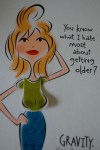
It’s also a source of great amusement – because as I tell myself so often – laugh so that you may not cry.  And it’s something to share with my friends as we grow older together.  Just the other day, I received this card in the mail from my dear friend.

Maybe with the increasing effects of gravity over the years, I’ll at least stay grounded  ☺

Standard
Intimacy, Living, parenting

The Perils of NFP

I awoke this morning with a thermometer in my eye.  My two and a half year-old, having recently mastered the art of crib climbing (as in, out of), came stealthily to my bedside and announced her presence by handing me my thermometer, point-first, in the eye.

“Thank you, honey,” I murmured as I deftly plucked it out of her little hand and out of range of my eye.

Rousing myself to face any day is hard enough – exhaustion keeping me down, thoughts of the daily grind keeping me from getting up.  A poke in the eye by a metal-tipped prod adds injury to the insult.

Every morning for more than a decade, I’ve taken my temperature before rising, marking it down on a chart as part of the Creighton Model of Natural Family Planning.  I’ve also noted other symptoms of my cycle, such as the start and duration of my period, any pain, etc.  For the most part, it’s been no problem.  For all the reasons that matter, I’m glad my husband and I have chosen this method to order the reproductive part of our lives.

Then there is the drawer of my bedside table, spewing charts from months past, always a pen, the thermometer.  One more thing to add to my morning routine – the taking of the temperature; and one more thing to do before bed – recording the temperature (because I usually don’t have – or take – the time to do it in the morning).

And the restraint it takes to successfully practice Natural Family Planning.  There are certain days in my cycle that we must abstain from sex if we wish to postpone or prevent pregnancy.  Then, there are days when it ‘might’ be safe.  That’s when the third ring of our circus (see last post) found her way into the world.  My husband may never get lucky during that range of days again!  Unless I/we decide to throw caution to the wind.

But, then, that’s the point of Natural Family Planning – and perhaps what makes it hardest for even the most God-fearing humans to practice.  Relinquishing control.

I may not have been ready for a baby at that time, and yet, I cannot imagine my life without her love in it.  And the personal struggles that I dealt with during my pregnancy and postpartum with her, have wrought changes in me that never would have happened had I waited until a time I deemed the right one.  The self-control and mutual respect that my husband and I had at the start of our marriage have blossomed into a stronger partnership as we follow this method.

With the ebb and flow of my body’s natural cycles, God has a chance to interject His will into our usually tightly structured plans.  There certainly is no peril in that.

Me getting over my control-freak tendencies – and avoiding blinding by impalement – that’s another story.  At least I can find a new spot for my thermometer – because I’m thinking the crib climbing is just the beginning.

Standard