
mother vs self, Write to Heal

Don’t Foist Me In

In the beginning of the last module, I alluded to outside expectations and stereotypes that inform our mothering. We could base an entire month’s work (or more) on exploring this construct – and likely will in the future – but let’s touch on it this week.


Return to your reflections of what it means to ‘mother’ and ‘mom’. Going through your lists or descriptions, consider which items are ones you feel are essential and ones you feel you should do. Pick two color highlighters or markers. Designate one MUST and one SHOULD. Color code your lists.

Laying both together again, do you see a patchwork or an overwhelming wash of one color?

Reflect on where the shoulds and musts originated. Do they have their source in you? Others?


Even when we focus on what unequivocally must be done in our role of mothering, we likely would be able to shave multiple items off that list. Undoubtedly some of what we’ve labeled as unequivocal has grown from a seed planted by someone else.

If we look closely at what absolutely, undoubtedly must be done, we must ask ourselves:

  • does it need to be done now?
  • what purpose does this serve?
  • what is the motivation behind this act?
  • what would happen if I/we don’t do this?
  • how does this make me feel?

If you feel a sense of gratification or warmth or love, the task or action likely is a must in your realm of motherhood. If it fulfills a basic need for your child or family, it is a must.

If it makes you tense, feel less, anxious, angry, resentful – there is a good chance the task or action originated with someone else.

Often, we don’t even notice when outsized expectations and ways of being are foisted upon us.

I would argue that the deceptive nature of ‘foist’ is not lost in terms of the unrealistic and damaging expectations upon women today who enter into motherhood. I would argue that the unconscious socialization of women entering into the machine of motherhood makes them an unwilling party. Not unwilling in terms of bearing and raising children – but it terms of the mindfuck of perfect motherhood to which they are unwillingly subject.


And by whom?

It’s time to do a deep dive into what we hold dear as mothers and what has been forced upon us, inherited from others, internalized in guilt, and unrealistically expected.

I can’t tell you how to tackle this.

A list? A t-chart with what and whom on either side? A stream of consciousness outpouring of your greatest fears and insecurities? A manifesto of your worth and sacred spirit?

Perhaps this will take several sittings to unearth what has embedded itself subliminally in you.

Perhaps it will raise feelings you can digest only a small amount at a time.

Perhaps you will finish victorious, reclaiming a personal and powerful motherhood in which you can truly find joy.

It may be all of the above.
Standard
mother vs self, Write to Heal

Instinctually You

“How it feels to be a parent and how it feels to do the quotidian and often arduous task of parenting are two very separate things.”

– Jennifer Senior

During the last module, perhaps you were confronted with some unpleasant truths about motherhood. I hope you were able to find at least some pleasurable parts of ‘mom’ing if not mothering. Bear in mind that we also do not mother in a vacuum. There are expectations and stereotypes around and over us that inform our own mothering – even if we do not subscribe to them.

With this week’s module, I’d like to see if we can’t step outside of those pressures and focus on our own experience and intuition.


For the next little while, forget the labels of mother and mom.

Think of the relationship between you and your child(ren). Not whether it is good or bad or indifferent. How the two of you actually relate to one another. One to one.

Relive or reimagine a recent interaction if it helps. A bedtime routine. Doodling on a blank placemat.

What unconscious acts did you do? How did you anticipate your child’s needs? How did you encourage and enforce your child’s authentic self? How did you create and feel connection?

Answer these questions to get you started – or simply recognize and record your own instincts below.

Perhaps the scene wasn’t idyllic. In what ways did your instincts help you defuse the situation? How were you able to redirect your child? Or build a framework for a future positive outcome?

If not, how will your instincts adjust for a future similar encounter?


If we trust in our innate ability to care for our child, we will fall into the relaxed, passive, naturally occurring beauty and resonance of being a mother/mom. Naturally ourselves, we empower our children to be naturally themselves.

What naturally occurring parts of yourself enhance your way of being with your child?

What do you bring to the table? The essence of you . . .

Standard
mother vs self, Write to Heal

A Rose By Any Other Name

Within the framework of balance, we last reflected upon the meaning of ‘mother’.

With the graphic below, I want you to now define ‘mom’ – within the letters, in the swirls of sand and sea.

Lay your definitions of ‘mother’ from last time and ‘mom’ today side by side.

Do they overlap? Do two distinct meanings appear? Reflect on where they convene and converge.


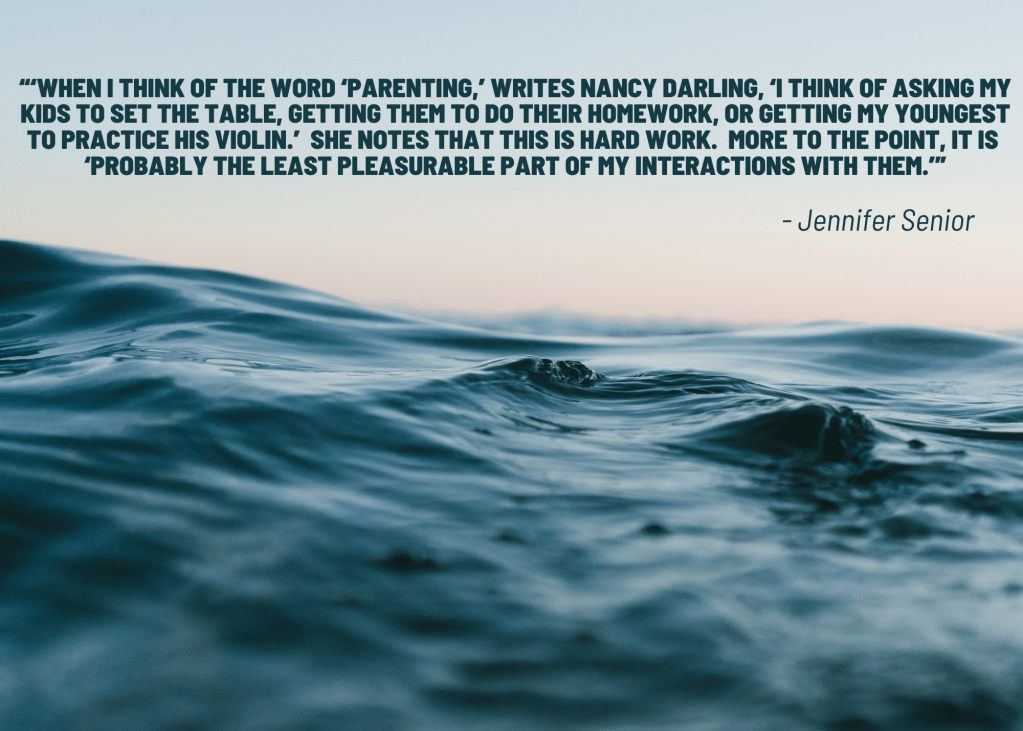
When Nancy Darling, the developmental psychologist quoted last time, reflected on parenting, she recalled hard work, “the least pleasurable part of my interactions with them.” When asked to reflect upon what does give her pleasure, she responded thus:

How different these descriptions are than what may first come to mind when defining motherhood. Jennifer Senior and Darling stress the distinction between passivity and action. Senior states, “mothering and fathering aren’t just things we do. Being a mother or being a father is who we are.”


Revisit your definitions of ‘mother’ and ‘mom’.

Last time, I asked you to circle the least pleasurable parts of motherhood. Review these circled items. How would you categorize them? Are they chores? Are they sticking points with your child (or partner)? Are they merely actions needed to get through the day?

Now, underline the other items on your list(s). What is this other category? The passive? Just being and watching your kids be kids? Or are they a different sort of action?

You may see your list(s) split into action/inaction, enjoyable/unpleasant, etc.

Is the split down the line of mother vs mom – or do the lists merge and blur?

Upon inspection and reflection of your lists, take some time to free-write the feelings this brings up. This stays in your notebook for you. Be honest with yourself and your feelings about being a mother, a mom, or anything in between.

Standard
Perspective

How’s Your Gratitude Practice Going?

Every year I aim for the perfect pumpkin purchasing day.

Sufficient time to carve for the school pumpkin glow; close enough that it won’t look too creepy on the front step for Halloween. Getting one to last till Thanksgiving, forget it.

This year, the pumpkins disappeared the day after Halloween. From the commercial calendar, that is.

When the huge cardboard pallets full of robust harvest orbs were rolled out for Christmas decor, I knew I’d have to go local and go seasonal to buy a pumpkin for Thanksgiving.

I actually needed one for my Girl Scout to carve at her meeting on November 1, but for several years now I’ve harbored the desire to plunk a big ol’ pumpkin at the center of the Thanksgiving table and ask everyone to record that for which she is thankful. While I did find one at a roadside stand where the proprietor asked me if I wanted it for my chickens while he fashioned memorial greenery baskets for the holidays, my daughter’s leader scored the last of the windfall at a local farm – and let me have one while the girls carved.

Even while the spirits pushed against the veil, I didn’t want to fashion a jack-o-lantern. I decided to go simple, not even cut through the flesh, and maybe, just maybe, have a gratitude-themed pumpkin come Thanksgiving.

I should’ve taken a before picture.

It was glorious. Perfectly etched letters, a simple graphic theme writ large.

It didn’t look quite this bad on the actual holiday, but bad enough that I didn’t dare set it on the dining table. I didn’t even introduce the idea of carving our thanks

When I stepped out the afternoon of Small Business Saturday and saw it slumped there, I thought, whoa, that’s a sad metaphor for gratitude.

Are our ‘thanks’ muscles shriveling up and dying? Molding over and shrinking at the edges? Attracting bugs and starting to smell?

I never even got the candle set up inside before my ‘thanks’ started rotting.

There may be a deeper metaphor of keeping it sealed up (not cutting the pumpkin) and therefore looking better, longer – but, then, aren’t we meant to lay our insides out – in vulnerability, in service to others, in authenticity . . . ?

What’s the sweet spot between plump and crisp and putrid and crushed?

Standard
mother vs self, Write to Heal

Qu’est-ce que c’est?

As we saw with last month’s theme, achieving balance is often about moving between two poles.

Life-giving/

Procedural

Want/Need

Action/

Inaction

The poles may not be in direct opposition, but often, we feel discomfort if we stay too far to one end.

Keep this in mind as we move through this month’s modules.


Une

Consider printing out the graphic below for the next exercise or turn to a new page in your notebook.

Within and around the block letters of ‘mother’ or under your own heading, write down the meaning of this word. Words and phrases you associate with it. Actions or ways of being that define it. What it means to you.

When you think you’ve written all your ideas down, leave your page for a bit – an afternoon, a day. Revisit it once that time has elapsed and add anything else that came to mind.


Deux

With your notes and ideas from the above exercise in hand, read what Nancy Darling, a developmental psychologist, said about parenting.

Do you have similar examples or ideas in your definition of ‘mother’?

Circle all the items on your list you would qualify as the ‘least pleasurable’ parts of motherhood.

Is your list or writing made up entirely of ‘hard work’?

What’s left?

Reflect on this for a bit. Write down your thoughts and feelings about this part of mothering.


Trois

In a quiet reflective state, ingest the following quote from John Lanchester’s memoir, Family Romance.

Place your ‘mother’ reflection in front of you.

In light of what you see as mothering, consider the following:

  • duty
  • care
  • hard work
  • want to do/have to do
  • dislike
  • doing the right thing

Write down whatever comes into your head. Let your ideas and feelings flow from your mind to your pen unencumbered. No thoughts, ideas, feelings are right, wrong, or permanent. Take stock of your relationship to mothering in this moment. Give yourself a fair amount of time to sit with this.

Perhaps you will need another sit-down with this later in the week.

Standard
Mental Health

Question, Persuade, Refer: A Path to Prevention

Last month, I had the opportunity to attend a suicide prevention training at my community hospital. I’d heard about it through their email newsletter and jumped at the chance to complete the training I’d had on my radar for at least a year. Finding MHFA training so beneficial, the extension of care specifically to those experiencing suicidality was something I was very interested in.

When I saw that some of the participants were apparently hospital staff extending their own professional knowledge, I was even more appreciative that they opened the class to the community – and that was before I met the instructor.

Dr. Robert Harrison had a long and dedicated career at Westerly Hospital as an Emergency Room physician – and that was after his service to the country in the United States Navy.

Now, he serves as director of the Washington County Zero Suicide Program.

As impressive a vitae as that, it was Dr. Harrison’s extensive knowledge of and empathy for people suffering from depression and slipping into the despair that can lead to death that was even more so.

He shared the staggering statistics of the mental health crisis of which our nation is currently in the grip.

Facts such as:
  • The suicide rate rose 33% from 2004 to 2021
  • Total deaths by suicide in 2021 were 48,183
  • Suicide is the 11th cause of death in the US; 3rd leading cause for 15-24 year-olds

The sobering facts of suicide, the stories of suffering could have gone on all evening, but Dr. Harrison shifted the focus during the second half of the presentation – to one of HOPE.

QPR, the steps of this process we could use to help those we suspect are suffering, is intended to provide hope through positive action.

By QUESTIONing, we can deduce whether a person is contemplating ending their life.

We can then PERSUADE them to get help, to find a hopeful solution to what seems like an ‘insoluble problem’.

Finally, we REFER them to professional help, either by taking them directly, making arrangements with them, or giving them referral info and getting a ‘good faith commitment’ that they will not complete or attempt suicide.

Having practical tools to apply in what seems like an unfixable situation is empowering. Depression IS terrifying. But to know that there are ways to stave off or circumvent its lying advances and urgings is the epitome of HOPE.

As striking as this revelatory information is, knowing that there are empathetic people who walk this earth and populate our hospital halls is even more amazing. The nuance and care with which Dr. Harrison shared his experience and information was moving; the witness he bore to pain and suffering and support of people who care was affecting.

In a mental health atmosphere where citizens don’t want to discuss the uncomfortable, practitioners aren’t armed with the skills to stave off suffering, and systems don’t support access or affordability – this conversation at Westerly Hospital one evening in October is one I won’t soon forget.

Yes, it served the professional development of my skills; it fortified the tools and resources in my fight for mental wellness – but it also filled my reserves of hope to overflowing.

That can be an uncommon occurrence in this work.

But it’s at the very root of what we do.

All anyone wants in this life is HOPE.

QPR helps us walk the path together.

Standard
pikiwizard
motherhood, Poetry

Unseen Web

We imbue our mothering with the ghost of our other children

The empty embrace of the one we just sent away
causes us to cling ever tightly to the one in front of us

The overflowing vessel of a love we never got to pour
floods the existence of the next to come into being

It is never only about the child in question

Our actions are the answer to all 
the worries
       hopes 
       fears 
       attachments 
       neurosis and 
       emotional stability within us.

It is a web
we can only see 
when the sun 
alights
on the tips
of frozen blades
of grass

Standard