motherhood

Love or Logistics?

I remember my grandmother being none too impressed with the idea of baby registries.

Asking for specific gifts? Telling people what to buy? We’ve all raised children; we know what a baby needs.

I tried to explain them from a logistical standpoint.

It’s to prevent duplicate gifts. People can buy gift cards or certificates to apply toward larger items. Or you can buy gifts to match the nursery theme.

She understood all these arguments, but she did have a point. Still, I registered.

I spent the excruciating better part of a Saturday at the local baby superstore, one which my husband still laments never being able to get back; one which I still remind him proved he was a sore sport. We took a break at one point, resting in two of the array of gliders on display. Stretching out on the coordinating ottomans, he said how much his feet hurt. Your feet hurt? I am carrying around a nearly full-term human!

My sister-in-law recounts a similarly disappointing experience. She, too, entered the store full of excitement and anticipation, ready to get all the things her little one might need. One look at the wall of bottles and nipples sucked that right out of her.

There’s different flows? I didn’t know there were different flows! How do I know which one to get? How am I supposed to know which my baby will like?

She ended up walking out of the store, the lunch date with my brother-in-law a much better prospect.

I’ve come to revisit this harrowing phase of a woman’s life – the waiting period before one’s first child – because I attended a baby shower this past weekend. I hadn’t realized how long it had been since I’d attended one. I hadn’t realized how much psychic distance I’d achieved from that point in my life.

Scrolling through the mother-to-be’s online registry, I pondered all the minutae we stockpile for one fragile little being. Watching the mother-to-be open myriad boxes and bags, I marveled at the physical objects we amass in preparation for their care. I thought about the stupid decisions we make beforehand – because we have nothing on which to base them. We don’t know whether our baby will like to be bounced or rocked. We don’t know whether they’ll take a pacifier or spit it out. We don’t know whether they’ll take to nursing like a vacuum or suck down formula like it’s going out of style. Yet, we let marketing gurus and product developers make these decisions for us; tell us what our baby will need before we’ve even met them.

I was thinking how wonderful it would be if we instead showered the mother with practical wisdom. Looking back, having been what I’ve been through, I think, would it not be more beneficial to surround the mother with support rather than things? Not to offer harping advice or to scare with harrowing tales, but share our experiences and struggles; to let the mother air her concerns and ask questions.

Is not the combined experience of all the mothers in that room much more valuable than the material trappings?

Modern society may have streamlined gift-giving with the registry process, but it also omitted something special. The human element. The generational wisdom and tradition. The magic and wonder of growing and birthing and caring for a baby. That one little trick your mother learned from her mother that will stop a crying baby better than any toy or tool can do.

Mothers need other mothers more than they need anything else. Love and support, the nest of family and friends. All things that no amount of logistics can provide.
circle

Standard
Weekend Write-Off

if you want to see a whale

Focus – to the exclusion of everything else.

Being able to tune out any distractions or discouragements apart from the final goal can be accomplishment gold. But if it also means missing out on beautiful sights or moments along the way, the brilliant glow can become a burnished pallor.

This is the risk the main character takes in Julie Fogliano and Erin E. Stead’s picture book, if you want to see a whale.

On his journey to see the whale, the young boy, with his dog and a bird as companions, passes roses and pirate ships, pelicans and inch worms. He ignores them:

because roses don’t want you watching whales
or waiting for
or wondering about
things that are not pink
and things that are not sweet
and things that are not roses.

If the boy did not ignore the roses, he might have missed the whale that he finally finds on the last page. But he misses the turtle amidst the clouds, a comfy and cozy nap, the lighthouse atop the headland shaped like a whale.

Yet even with all this sacrifice, the boy still almost misses the whale. On the second to last page, he is so busy staring into the sea, he doesn’t see the whale pass right below his rowboat. Ultimately, it is the whale who breaks the surface and peers into the boy’s face.

While preparation and staying the course are essential to achieving goals, there is a certain element of chance that factors into the final result. And if we exclude all way points and detours, a failure at the termination point will be that much more crushing.

I suspect that Fogliano and Stead meant for this story to be a triumphant tale of setting one’s mind to something and seeing it through. And it is. There is a lot to be said for persistence and patience; for courage and consistency.

There is also the flip-side.

It makes me sad to see all the missed opportunities along the way for this young boy. It makes my soul ache for my own missed opportunities throughout any given day. The simple pleasures, invaluable gifts of the here and now. When goal-setting becomes tunnel-vision, mindfulness cannot occur.

If you want to see a whale, it’s pretty amazing. Just don’t miss out on what the waves wash up on the way.

Just one of the gorgeous illustrations.

Just one of the gorgeous illustrations.

Standard
Writing

Write On

I am sitting at my desk for the first time in a long time. At least to sit and write. I’ve sat a few times to check email or Facebook, but haven’t sat here in a long time for its meaning and purpose.

As I sorted piles of dirty clothes by color in preparation for laundering last night, I saw the top of my writing cabinet rolled back just enough to reveal the rocks I’ve placed there as talismans. The ones chosen for memories: one thrown by a dear friend barely missing my head, one from a bright, beautiful day at the beach, others for their touch and feel. All within smelling distance of dirty laundry. All untouched, robbed of their potential for healing or inspiration.

During these last few cold months, I’ve set up camp by the wood stove. A stack of books on my daughter’s miniature rocking chair on one side, a stool with a mug of tea on the other, computer in lap, feet on ottoman, aimed at the stove. Not bad, I must say.

But – if I sat at my desk on my ergonomic chair, I might not exacerbate that crick in my neck. I might not strain the shoulders I tweaked in frenzied shoveling yesterday. I might not draw the ire of said daughter for thieving her miniature rocking chair. I might stick to the task at hand. And – AND – I might be inspired by the lovely things around me.

Since it’s been awhile, things other than my work have inevitably piled up on my desk. My daughter’s outgrown ducky slippers. A pair of fleece pajamas I’ve yet to exchange for the right size. My middle daughter’s class portrait grasped from her little sister’s tight fist at just the last second. There’s a colored pencil that doesn’t belong to me. A bathing suit I still haven’t decided if I want to return. There’s the goody bag from my friend’s burgeoning business of skin care products I’ve yet to put away – but this is a lovely procrastination; for the smell of sea foam has provided the most uplifting aromatherapy.

While putting off and getting away from routines or rituals can be detrimental, it can also give the chance to come back with new eyes. Had I sat here every writing session, every week of every month, perhaps I wouldn’t appreciate the little corner I’ve carved out for myself. Perhaps I wouldn’t remember to hold that solid hunk of earth in my hand, wrap my fingers around but one chunk of the infinite space around us.

Does that mean I will sit here each time I write now and be incredibly prolific? Probably not. But the space is readied. For now, the mind is readied. My spirit is ready.

Standard
postpartum depression, Recovery

This is YOU

When you come across a picture of oneself and are impelled to use it as your profile pic, you know you’ve hit a good one.

Scrolling through the images my daughters snapped when they commandeered the family camera, I found one such picture.

One hand on my knee, other on that hip, I am leaning into the camera. My face is the first thing the lens encounters. I am smiling, my laugh lines and crow’s feet in full effect. My eyes alight with joy and love.

People who’d seen the photo commented that it was lovely, adorable, beautiful, terrific. One friend said it made her smile. Another said:

This is YOU, very much alive and ready… Love it

All very wonderful, but it wasn’t until I gave photo cred to my daughter that I realized that was why this picture was so successful. It wasn’t how gorgeous I am or how fashionable my scarf was; it was the love radiating toward my daughter through the lens.

Now, the average parent – or grown child who fully grasps the connection between parent and offspring – might think this explanation is obvious, unnecessary. To me, it’s a huge a-ha moment.

Amidst the anguish and uncertainty that followed me through the postpartum period of her birth, I was afraid she wouldn’t feel loved. I was afraid that soft yet strong, gentle yet fierce protector of a mother would never show through all the layers of dark, depressive, disgusted and disgusting matter hiding it.

Yet, here I am, five years later, beaming at her radiantly. Looking the best I have in awhile and all lit up because of her. If I ever doubted whether my love shone through, now I have photographic evidence.

YOU* Please note that simply smiling will not heal postpartum depression.  I am still shoring certain parts of myself up after five years.  It’s okay if you don’t feel like smiling right now.  There are other ways your baby will know love and there are ways you can get help.  Talk to your physician, your baby’s pediatrician, or sites like postpartumprogress.com

Standard
anxiety

Off the Grid

The irony of

one post about the beauty of staring into the fire

and the next

about not staring but rushing around willy-nilly

does not escape me.

Of life-giving warmth

giving meditative bliss and salve

being ignored for

frantic prepping and sapping of adrenaline that may be needed in actual emergency.

I get it.

My analytic mind senses the conundrum.

My overly expectant self wallows in the defeat of two house-bound days devoid of relaxation.

Though my electrical panel never lost power, I did.

The ability to worry is the only sort of control I have.

Standard
anxiety

Free to Fall

I think waiting for the power to go out is worse than dealing with its absence.

Flush the toilet one more time, hurry to put the last load of laundry in the dryer, fill the sink with soapy rinse water. Charge the computer, the tablet, the cellphone. Stack the wood, stoke the fire, boil one more pot for tea.

This blizzard is the perfect microcosm for my anxious world.

The worrying is worse than the event.

The scenarios the brain can come up with cause more pain than living through the eventuality.

The waiting, the waiting – for the other shoe to drop, the limb to fall, the powerline to go slack.

My mind is spinning faster than the vortex of wintry wind outside.

I am not thinking of the warm cocoon my house provides, the heat radiating from the wood stove that didn’t exist during the last such storm, the canned and dry goods in the pantry.

I am on edge. I am a raw nerve. I am living in fear of the worst outcome not happening – for if it did, I’d be free of the worry.

Jennifer Butler Basile

Jennifer Butler Basile

Standard
Living, Poetry

As I Once

In the parking lot of a Burger King on the Canadian border

On the bluestone terrace of a bed and breakfast in Vermont

By the cobwebbed window of a general store in the Redwoods

A quiet side street, a rushing river, an elegant table for two:
These are the places I go without going anywhere.

The places I’ve been in past lives,

The places I’d go if unencumbered

by lack of freedom and finances,

responsibility and restrictive routines.

But one blip on the timeline,
they come back to me

as I once went to them.

Standard
Living

Catch a Fire

I can see why the discovery of fire was such a watershed moment in the history of mankind.

Not only for its life-giving (or preserving) qualities – warmth, cooked meat, and protection from becoming raw meat are all good things – but for its mesmerizing abilities.

In the past few years, having moved to the country, built a fire pit, and acquired a wood stove, I’ve spent a lot of time staring into flames. There is a certain magic to the seemingly alive tongues of fire; the dance, the movement, the consumption of material, the production of charcoal, the transformation to ash.

It also teaches a lot of life lessons.

Building and maintaining a fire takes a lot of work. Steady attention. Checking in. One cannot get distracted or fully immersed in some other project. Until it’s rip-roaring, your job is the fire. You must focus. You must settle into that state of mind that allows you to do the task at hand and nothing else. It’s quite freeing, actually. Poking, prodding, turning, and nudging – worries, urges, outstanding obligations fall away in the tedious, tactile action.

As does the guilt that usually accompanies the exclusion of other tasks. While only focusing on one, this task is keeping your family, your house warm. It is providing a comfort, a safe haven – it’s even saving on fuel costs 😉

Maintaining a fire teaches other lessons as well that aren’t as easy or pleasurable to learn.

Like patience.

Sometimes you don’t need to throw another log on the fire; sometimes you need to shut the door and watch the roiling smoke. Watch until it produces enough heat on its own. Watch until the flames burst forth seemingly spontaneously – only they don’t. There’s lots of quiet build-up and warming-up that lead to it – all without your interference.

The agonizing part is knowing when these moments of holding back are needed. Will you lose the fire altogether if you mistake its need? Or will you squander the heat by opening the door and fiddling with it too much?

This give-and-take, this mental questioning seems like the opposite of the mindless joy in minding a fire I described above. But only if you let it be. Through practice, through trial and error, such decisions will come instinctually. And focusing on the fire is always better than obsessing over the machinations of your own life.

Sitting by the fire, the warmest, coziest spot in the house with a cup of tea, has become my favorite spot to be, thing to do (or not do) on these cold winter days. The voice in the back of my mind tries to tell me I’ve fallen into a pattern of leisure that is not good. But a louder, happier part of me thanks those prehistoric peoples who discovered the wisdom of the flames and learned from it.

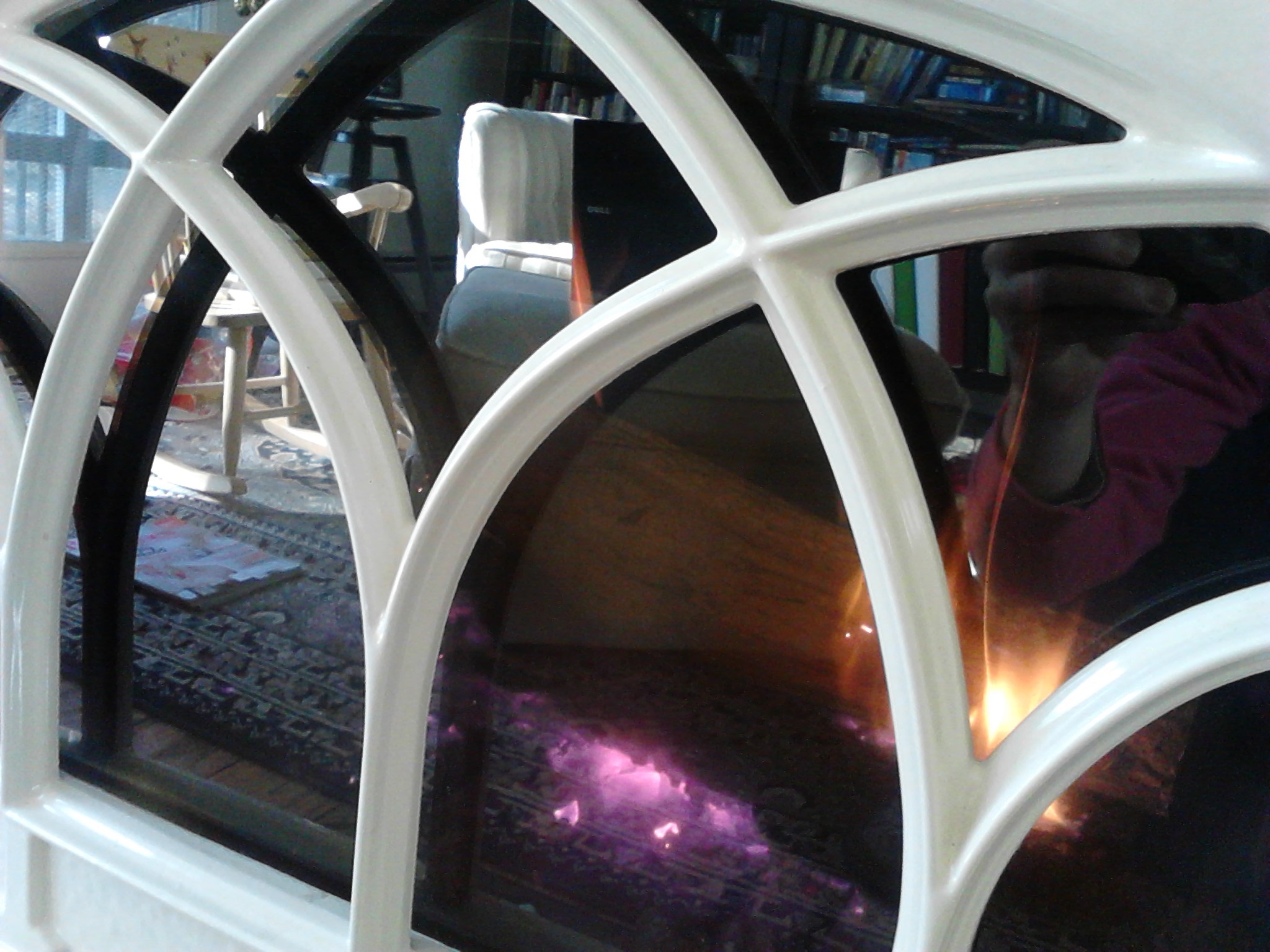
Reflecting on fire

                Reflections of fire (Jennifer Butler Basile)

Standard