Living, Poetry

Inert AM

A pair of disapproving elderly librarians
judging my three-time renewal of books

But I got special permission from the head librarian

A fleece-clad stranger cuddled in,
stealing blankets and real estate

But she’s asleep, so we’re asleep

The intermittent voices of a tin-can radio man
interrupted by the ever-increasing beeps of the alarm clock

Up and at the absurd

sick_in_bed_sfw

Standard
Mental Illness

Unhushable

Suicide is often something spoken of in whispers.  The ‘unexpected death’ in an obituary.  The shadowy family secret.

Until something so very public happens, we cannot ignore the pain and problem for comfort’s sake.

suicide

Click image for news story of Placentia, CA teacher found in her classroom

As a devout Catholic, I grew up with a peripheral feeling of shame surrounding suicide.  Scorning God-given life was a sin.  Only He could determine the beginning and end of your time on earth.  But, then, individuals who consider suicide aren’t in their right minds, are they?  Only someone completely given over to despair and illness would consider such as an option.

I think we, as a society, forget that.  The public interpretation of my faith’s stance on suicide squeezed out that important part.  People of God and faith support fellow humans to become whole – not condemn them if they are not.

Excellent discussion of Catholicism’s stance on suicide.

Unfortunately, the general public doesn’t always feel that way.  Make the mistake of reading the commentary on articles about publicized suicides and ignorance shows its ugly face.  People lambasted this teacher for her selfishness; didn’t she think what finding her would do to her students?  Obviously not.  Couldn’t she have done it at home?

I agree that I would not want my children to discover their dead teacher in their classroom.  But to think that one place is better than another to hang oneself?  To think this teacher selfish for doing it?  Suicide is not an easy, thoughtless decision.  It is often a last resort after much anguished mental and emotional battle.

Honestly, I think this hatred and judgment comes from fear.  People don’t want to be pulled from their artificial bubble of safety.  If you have issues, fine, but keep them to yourself.  Keep your mess confined to your own home, world – don’t let it infect mine.

Suicide is not contagious.  Mental illness is not contagious.  Hate, fear-mongering, and ignorant attitudes are.

How many public hangings do we need to see before we as a society develop compassion and understanding?

Standard
Living

Everything I Needed to Know About Life, I Learned in Troop Camp Training

This past weekend, I went on a camping excursion.

I live in New England. There is snow on the ground. Lots of snow. And ice. The air temperature is frigid.

And yet, I signed up to sleep overnight at a Girl Scout facility so I would be qualified to lead a group of girls on an overnight camping trip. Yes, there were no Girl Scouts involved. And yes, I voluntarily chose this wintry weekend.

I attended with the leader of our troop. She was planning on going already, and I agreed that this session would be best since we’d be in a lodge for actual sleeping, rather than the platform tents used during warmer months.

What we failed to take into account was that in order to learn the things needed to go camping outside, we’d actually have to go outside to do them – regardless of the snow banks and bitter cold. We would not, alas, be sleeping in the heated bunk room all weekend.

Thanks to my leader for this photo!

Thanks to my leader for this photo!

We hiked, we sawed wood for the fire, we cooked breakfast on inverted tin cans.

By the time bedtime Saturday night rolled around, I felt like a caterpillar about to burst out of its cocoon. I couldn’t wait to peel off the eight waistbands of the many layers pushing into my middle. My feet sighed with relief as I wiggled my naked toes in the bottom of my sleeping bag.

Either the cold coddled my brain or I was getting used to this ‘roughing it’, because I actually lamented when the leader told us it was too cold to go outside to whittle cooking sticks. I wanted to set bearings with my compass on tree limbs burdened with snow. And my insulated snow pants precluded the need for the heater in the car on my way home.

I dove into the wood pile with gusto when I arrived home. I trudged through the snow without hesitation. No snow drift too high or approaching storm would stop me from collecting wood; I was insulated to within a half inch of movement.

I unpacked my vagabond stove and coiled cooking sticks with ambivalence – thanking God I didn’t have to use them to make dinner that night and wishing I could. I remembered jokes I’d shared with the eight other women I’d camped with, but let them roll no farther than the tip of my tongue because ‘you had to be there’. I snapped at my children when they asked for help or needed to be told to do something after running on the smoothly oiled machines of patrols and kaper charts all weekend.

The irony of choosing to rough it in our privileged society did not elude me – when there are societies who have no choice but to use such survival methods to last the day and we complain of the inconvenience of doing them for fun. Why wouldn’t we stay home with our running water and electric ovens; why scorn the luxuries of modern society?

Because running a dishwasher doesn’t make you feel like a superhero. Popping a casserole in the oven doesn’t make you feel like a survivalist. Removing the convenience and accessible ease of everyday tasks helps us realize not only how lucky we have it, but also our own resourcefulness, resilience, and ingenuity. We realize strengths and abilities we never knew we had. We aren’t so afraid of losing power or running water anymore. We have options. We are not completely reliant upon services and systems provided by other people.

That is not to say, however, that we don’t need other people. The success of our weekend lay in the expertise and assistance of our leaders; the teamwork and willingness of our compatriots. Work is lighter and more productive when coordinated and collaborative.

By the end of the weekend, I felt like a cross between MacGyver and Grizzly Adams. I could fashion a stove with a pair of tin snips. I could close a jackknife without slicing off three fingers. And I could almost tie a bowline knot.

Granted, taking twelve girls on such an excursion might produce an entirely different set of results. But that’s a risk worth taking because camp provides so many lessons.

Standard
Literacy, Technology

Goodbye Flip Phone, Hello Moto

The technology in our house is undergoing a transformation.

My husband, who works for a communications company, has always had his finger on the pulse of new: new product, newest update, latest gadgets. I, however, knowing he’s doing enough worrying about it for the two of us, have gotten progressively further out of the loop with each subsequent year past college. With the exception of my blog and attendant accounts, I haven’t added any new technology ammo to my arsenal.

When my husband was issued an iPhone for his job, I inherited his personal ruggedized flip phone. It did the job. It stored important numbers. It texted – after you hit the same alpha-numeric button a kajillion times for one character. It took grainy photos. I actually impressed my husband with the amount of functionality I squeezed out of that embarrassingly outdated piece of equipment.

Only, its days were numbered.

He sent me a text one day that read, “I love you ??” I countered with, “What, you don’t know?” He explained it was supposed to be some cute emoji blowing me a kiss, but our antiquated tech couldn’t decipher it. I still thought it was rather suspect. He thought it was one more reason to get a new phone.

Then, due to restructuring at work, his iPhone would no longer be standard issue. He began shopping for two brand-spanking new smartphones for us. He told me I’d like them so much better. I vacillated between not caring and not wanting one.

I liked the ability to go incommunicado when I left the house. I enjoyed not having Hal summoning me throughout the day and night. I liked not having a technological tether.

And then he forced me to set it up and play with it.

My head nearly exploded the first time I swiped down and a list of updates from all my social media accounts appeared on one screen. I could comment on my blog in real-time. I could find out who that new follower on Twitter was instantaneously. I could add new events to my calendar without deleting two others because the memory was full. Hell, I could even ask Moto what song was playing on the closing credits of the movie that just ended.

The ability to synch and stream and search does make life a lot easier. In a world where everyone else is ‘smart’, it does give me an edge – or at least a fighting chance. It will help me build my platform and online presence with a sense of immediacy that taking a photo with my flip phone, emailing it to myself, and posting it five hours later simply can’t.

There are, however, drawbacks.

To write this, is the first time I’ve opened my laptop in five days. Sure, swiping my smartphone can make me a Twitter phenom, but it ain’t gonna get any writing done.

There are other ways it could hurt my writing, too. Grammar. Syntax. Spelling. Holy God. I already feel myself getting dumber. When I have to stuff my fat thumbs onto those tiny little virtual squares, the least amount of tapping is optimal, but my grammar dander is up big time. I don’t think I’ve tapped a complete sentence yet. With texting, this isn’t as much of an issue, but when you can access email as well, there is a significant drop in quality of communications. I feel like I need to prostrate myself in front of my junior high English teachers.

Smartphones also rob us of another basic language skill: alphabetical order. When my husband imported some contacts for me, I wondered why they were alphabetized by first name or prefix (ie Uncle Josephat). I was going to lambaste him for his shoddy abc order, when I realized new additions filed the same way. When I questioned him on the reason for this, he agreed it was strange, but that didn’t stop me from a lengthy diatribe on how this little feature was killing the skill-set of the next generation. (Yes, tech gurus, I understand you’ve studied the metrics of keystrokes and all that crap, but you’re killing our linguistic scaffolds!)

Last, but certainly not least, smartphones rob us of life. Designed to save precious moments, they steal many others from us. I, myself, in short order became a rampant offender – of that crime of staring into the tiny screen rather than the expanse in front of me. Of running to the notification beep like Pavlov’s drooling dog. In our desire of being up-to-the-minute, in-the-know, we don’t do any of the living ourselves. How stupidly sad.

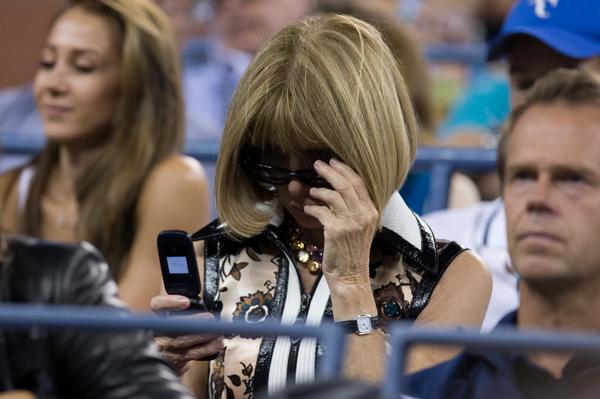
In an ironic twist of fate, as I prepared to flip my phone shut for the last time, this news broke:
anna wintnor

Anna Wintour and her flip phone

Proof that if you hold onto something long enough, it will come back around again.  Maybe I shouldn’t have been so hasty to kick my flip phone to the curb.  But then, I never would’ve known my flip phone was still in vogue if it hadn’t trended on my husband’s smartphone.

Standard
postpartum depression

Help Yourself

“If you do become depressed there are several things you can do to help yourself and make the illness as short-lived as possible.”*

I read this in a book preparing women for pregnancy and childbirth. It is meant well. It introduces a section on self-care and avoiding or alleviating depression (including medical help), which goes on to dispel the myth of the ‘perfect mother’, but the tone of this statement rankled me.

Self-advocacy, expectation, and positive outlook do play an important role in mental health, but they only go so far.

If a woman is clinically depressed, no amount of happy thoughts will pull her out. No amount of pampering will soothe her. Strong and mighty though she may be, bent but not broken, she still needs more. Some sort of medical and/or therapeutic intervention.

Statements like this perpetuate the feeling of failure that women suffering from mental illness already feel. That there is something they failed to do, some step they missed or didn’t push hard enough to save themselves. To embrace life and joy.  And the idea that they’ve prolonged their misery by not making it as ‘short-lived as possible’ – argh!

Maybe I’m just cranky because it didn’t work for me. I know I’m reading this not as an objective observer or researcher, but as a severely chipped shoulder. But a lot of the literature I’ve found reads like it’s written by someone who’s too objective, like someone who views depression as a clear-cut, easily addressed condition.

Like someone who’s never been there.

from I’m Pregnant by Lesley Regan, MD; no disrespect to the author, this post represents my own subjective opinion on the topic.

Standard
Weekend Write-Off, Writing

The Higher Power of Lucky

“Lucky stole her technique of keeping going from the anonymous twelve-step people, whose slogan is ‘One Day at a Time.’ If you think of undoing a big habit day after day for the entire rest of your life, you can’t bear it because it’s too overwhelming and hard, so you give up. But if you think only of getting through this one day, and don’t worry about later, you can do it. Lucky used the ‘One Day at a Time’ idea by putting one foot in front of the other without thinking about what would happen later. She knew she could do one step and then another step and then another step and then another step as long as she thought ‘One Step at a Time.’”

Life advice from a young adult novel. How profound.lucky

So profound is ten year-old Lucky’s voice in Susan Patron’s The Higher Power of Lucky, that I almost didn’t believe it – except that she speaks with such authority. She also has been through an inordinate amount of struggle and strife for a child her age, which has given her wisdom while toughening her up.

The title, ethereal cover with illustrations by Matt Phelan, and book jacket summary drew me to this book. I’m always looking for quality literature for young people, but all that package material spoke to the adult in me who is still searching. If a ten year-old could find her higher power, then surely I could. As with anyone’s search – no matter what age she is – Lucky’s is filled with twists and turns, mysterious signs, with the only real answer being a feeling. But it sometimes is the simplest ideas, like the passage above, that get us through. And listening to and allowing our feelings to come through – as Lucky ultimately did with Brigitte – often is the ultimate goal.

The prose in The Higher Power of Lucky is stark, but gorgeous; as raw and beautiful as the desert setting of Hard Pan. It is in the quiet moments of Lucky’s days, the tone of which reminds me very much of Missing May by Cynthia Rylant, that such images sneak up on the reader. After Lucky, Miles, and HMS Beagle – who is not a beagle – finish their ramshackle dinner outside:

“The feel of the air, soft and nearly still, was something you usually wouldn’t even notice. But now, after the dust storm, it felt like a kindness, a special thoughtful anonymous gift.”

Susan Patron has given readers such a gift: a quiet, thoughtful piece of literature that reminds us that focusing on what’s right in front of us can reveal our higher power more readily than any grand adventure.

Standard
motherhood

For Those About to Rock . . . Motherhood

To all the mothers hooking their arms under the handles of infant carriers, hitching them onto their hips, grabbing the gallons of juice needed for preschool snack time with one hand, and their toddlers with the other – I salute you.

To all the mommas with babies strapped to their fronts, rocking yogic squats while they wrangle suddenly top-heavy toddlers into snow pants – I salute you.

To the mothers who drive up to the bus stop as the bus pulls away –
To the mothers who drop f-bombs because they’re so frustrated –
To the mothers drenched in sweat and limp as a dishrag by 8:37 AM –

I salute you.

I don’t ask whether you need help because I think you can’t handle it. I ask because I know you can, but even the slightest way to make these machinations easier is a blessing. I ask because, seeing you, I have flashbacks to those hellish mornings; because I’m so grateful that level of hell is done – that I’ve moved on to a slightly lesser one. I ask because I never would have asked someone else for help.

You rock, all you mothers. You’re doing it. I salute you. I’m also here for you.

‘Cause we all need to let out a primal scream – or war cry – from time to time . . .

Standard