Art, Identity, Writing

Six Degrees of Memoir

Six words.

Choose them carefully because that’s all you have to tell your life story.

Should be easy, right? Anyone can complete a story that’s only six words long.

But can it encapsulate an entire life? Can it fully relate the defining moment in someone’s life? With only six words, you have to precisely concise.

Or is it even possible to pin down a life in six words, several characters?

That was the conundrum I faced with ‘My Six Word Memoir’, a calling for and exhibition of this unique artistic narrative at the Jewish Alliance of Greater Rhode Island.
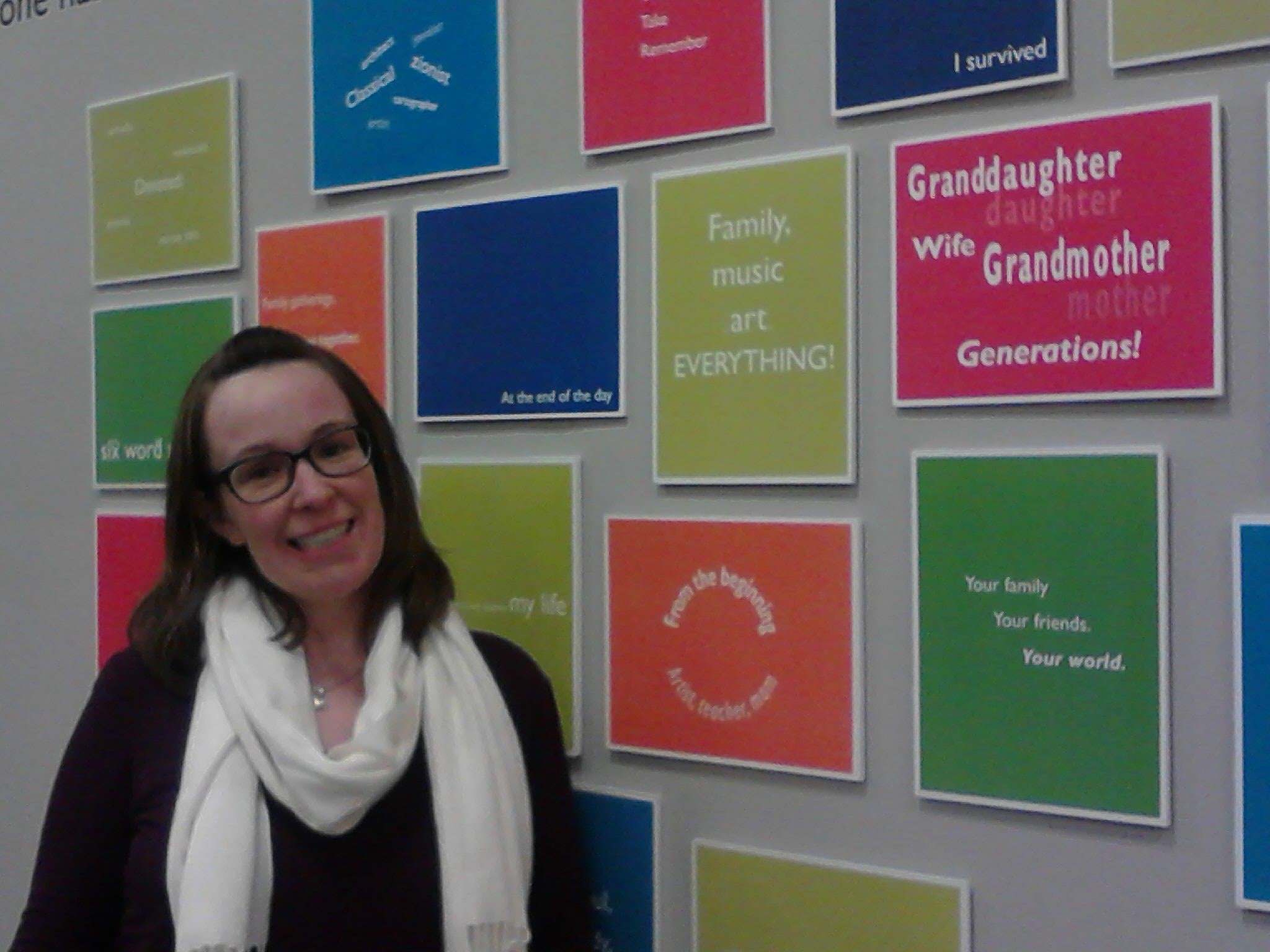
D by wall

A dear friend connected with the organization encouraged me to participate in the project, an offshoot of Larry Smith’s Six-Word Memoir challenge. The Jewish Alliance challenged the “community to rethink the notion of writer and memoir and offer a simple platform to share the short, sharp story of your life.”
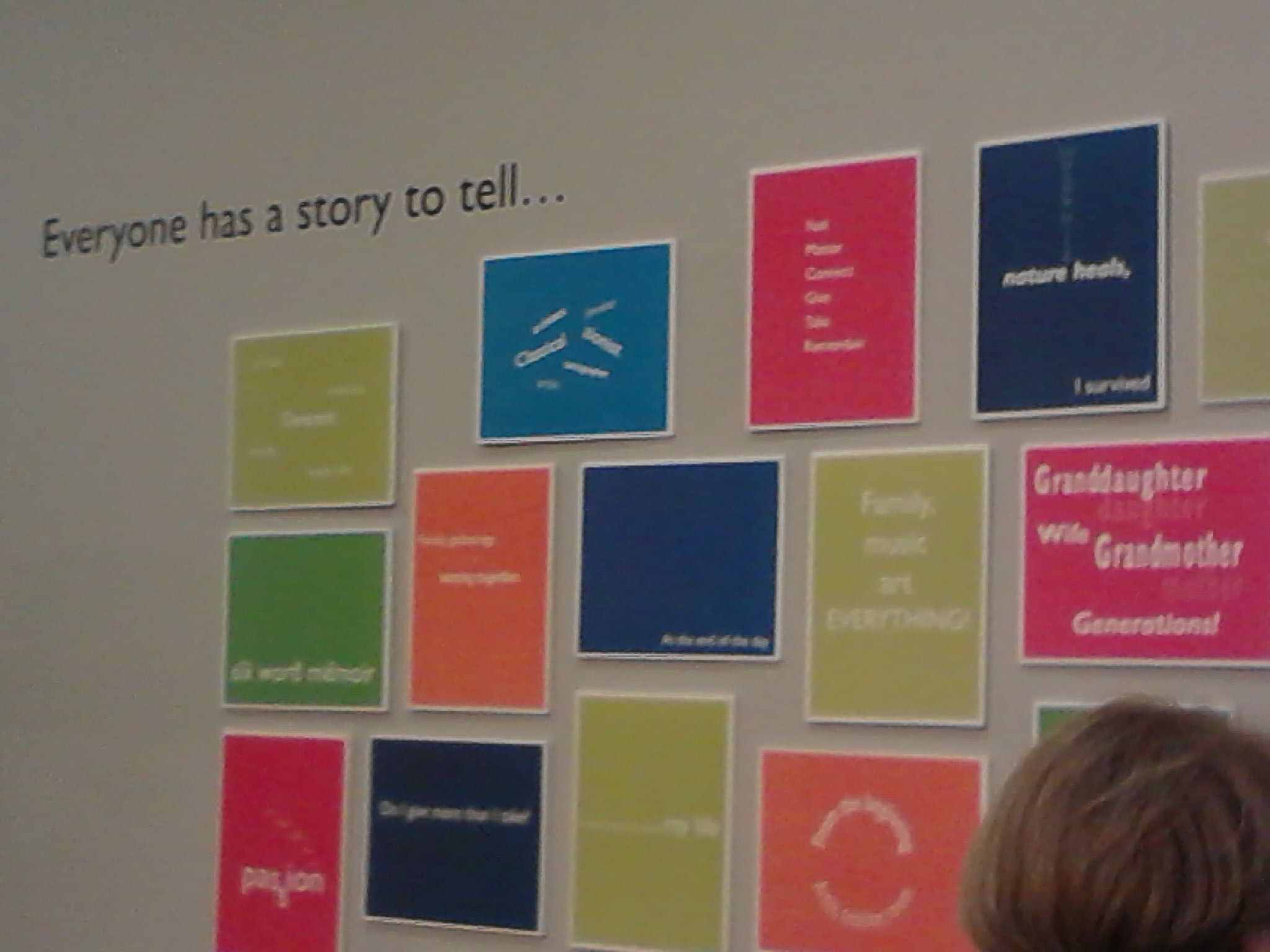
everyone has The opening night of the exhibit, my friend and I circulated amongst  on-lookers and other writers. Some writers gave themselves away  with the click of a camera by their memoir. Others pointed theirs out  sheepishly when I commented on them. One of the organizers  admitted “[her] six words are always changing,” which segued nicely  into a conversation with another participant about the difficulty of choosing just one story. We discussed the distinction between a story and the story. Would bits and pieces of our lives represent it as fully or richly as an agoniziplace to tellngly selected six-word summary? Or more so? Someone had asked her whether her memoir was too simple. She’d countered with, ‘But is it?

Perspective is everything.

What seemed like a simple exercise in writing opened up many philosophical  and existential conversations – personally, as I sat at my keyboard, and  collectively, once I joined the audience at the art gallery. I realized that what  I put on my ‘canvas’ was not what others brought to it from their own  experiences. And what I read in theirs wasn’t necessarily what they  intended. Another case of artist vs. art critic. Writer vs. reader response.  Intent vs. interpretation.

Who can say that any one of the versions is wrong? Who can say that any one of us is finished writing the story of his or her life? It is the meditation and conversation that comes with that truly defines us.

mine

* A special thank you to the Jewish Alliance of Greater Rhode Island for offering this project and showcasing it in such a palatable way in Gallery (401).gallery 401

Standard
Art, Writing

Process of Procrastination

This is how I spent the better part of my afternoon yesterday.

Photo by Jennifer Butler Basile

Actually, it’s how I spent the better part of the last few years. Or should have.

If you are the one person who happens to notice the bottom corner of my blog, where I post which book is currently on my bedside table, you might have been wondering what the hell was taking me so long to read The Process of Sculpture by Anthony Padovano. I’ve actually been reading it longer than I’ve been advertising it.

This highly informative tome of the processes of sculpture was loaned to me by an artist generous of her time and talent – and trust. My aunt took me to meet her friend, Sarah Blair, years ago, at the origin point of the trajectory I’m still on to write the young adult novel of Dmitri, the seventeen year old who desires to eschew the family tradition of plastering for sculpture. This sculptor was the subject of my very first interview as an author. I felt so official, doing research, for my novel. She happily answered all my questions, showed me her work, and sent me out the door with a text she’d studied in art school.

I wonder if she knew how long it would be before her book came home?

The book sat, pregnant with possibility and inspiration, in my rolling writing office at my old house, and on the writing desk I’d graduated to after we moved. It held the scratching and scribblings of my interview notes and beginnings of detailed notes on its contents. It waited when I’d lost forward motion on the project. It taunted when I picked the project back up and had no excuse not to crack its cover. It inspired me with its epiphanies that could be applied to sculpture and life. It lulled me to sleep at night. It awoke new insights into Dmitri and his story.

After mining its surfeit of information, I blessedly, rejoicedly finished it!

And yet, I couldn’t take it off my bedside table. I had yet to transcribe the nuggets marked by myriad sticky tags, rippling their rainbow tongues at me from the edges of the pages. I should be moved on to the next book. I should be typing a new title into the little corner of my blog. Alas, I had unfinished business.

After days of putting off the seemingly tedious task of transcribing quotes and notes about the practical and procedural side of sculpture, I sat down and realized Anthony Padovano spoke about a lot more than just sculpture. He spoke of artistic process. He spoke of life philosophy. Of beauty. Of meaning. Of right and wrong. Of finding one’s voice and when and when not one should use it. Of how to use it.

Yes, he and Sarah Blair taught me what Dmitri needs to know as a sculptor, what I might find him doing on any day in his studio, but also about the artistic process all around me. Of the importance of art and the valuing of it, in our world. How it shapes and defines our lives.

The book’s rainbow tongues had transformed into technicolor teeth on my computer, as I filled the edges of the screen with each completed point. Light from the windows behind transfused even the opaque white parts of the tags with a brilliance. Soft, gentle, but brilliant. The sense of accomplishment I felt upon closing that book with a solid thunk was brilliant. A job well-done. Finally.

Now I can write my book, armed to the technicolor teeth with sculpturing knowledge and a better understanding of what makes Dmitri tick. I could, in theory, build an armature with materials from the hardware store and mix my own plaster with which to mold it into life. I definitely can return Sarah’s book to her in good conscience and thank her wholeheartedly for sharing the process and molding the shape of my book.

Standard
Writing

I’m in Love – Again

You fall in love and you can’t get enough of your heart’s desire.  Every waking moment is spent thinking of, studying, obsessing over, and drinking in all that he or she is.  He or she loves every bit of you in return and all is right with the world where birds chirp and the sun shines everyday.

And then the shine wears off.

Suddenly, endearing quirks become irritating.  Spending so much time together becomes smothering.  Familiarity may eventually breed contempt, but at the very least it keeps you from recognizing what it was that made him or her special in the first place.  You can’t really even see the person at all.

Now before you think I’ve lost sight of our relationship, this is not about my husband and me.

This is about the cast of characters, particularly a young man named Dmitri, in my young adult novel.

I had sensed the growing frustration between us.  I tried doing things differently to liven up the doldrums into which we’d wandered.  I gave him space.  None of this worked.  In fact, the extra space felt surprisingly refreshing.  Too freeing.  I didn’t know if I’d ever want to return to the constraints of our relationship.  Though I didn’t know how to fix it, I always felt guilty when he came to mind because of our unresolved issues.

Then one day, I opened a book.  The voice on the page, the way the girl told her story reminded me of my Dmitri.  I thought, if only Dmitri could be freed like that to tell his story.  I opened my laptop and Dmitri spoke to me in ways he never had.

I’ve spent the last four days cavorting with him.  In a blissful sort of oblivion, we’ve reunited, he reaffirming all I ever loved about him.  I can’t catch my breath.  I’m positively vibrating with excitement.  When I’m forced to perform one of my daily obligations, I can’t wait until I can return to him.

So sorry I haven’t posted lately – I’ve been falling head over heels in love – again.

Standard
Weekend Write-Off, Writing

Symbolically Speaking

“Symbols arise from the instant and continuous deterioration of sensation in the memory since first experience.”

 –  in Henry’s notebooks from Perfection by Julie Metz

God, I hope this isn’t true in relation to writing.  In creating symbols and their –isms, does each time I hit that note weaken the power of the initial memory or feeling it elicits?

Writers use symbols to illustrate themes, ideas, emotions.  Illustrate is a key word here.  ‘Show, don’t tell’ is a mantra that haunts us all in our sleep.  We cannot describe said feeling without talking down to or boring our reader.  But if we can hit them where it hurts, draw out that venom from a similar hurt they’ve experienced, yes, that is what makes writing powerful and universal.

Raindrops, an unexpected phone call or delivery, a plump bud about to burst, a family business with one remaining heir.

But where do we cross the line between evocative and cliché?

A repetition, a refrain, an oral tradition, cautionary tales – there are threads that weave us all together in the collective consciousness of all time.  There are reasons for patterns.

But if we bang that drum one too many times, do we risk ‘the instant and continuous deterioration’ Metz mentions above?

Or is it not what we do, but the way that we do it?

The goal is to fine-tune our words, choose them like each brushstroke of a painting.  If we create a unique experience in each scene, regardless of its resemblance to an aura that once surrounded our readers, we will gain connection, a relativity with a resounding freshness.

It’s no small task.  But there’s also pretty good research backing us up.  There’s a reason symbols resonate throughout the millennia.  Through story, there is some thread of our DNA.  Whether it’s deteriorated throughout the years, some small part of it remains and vibrates within us when we read it.

Standard
Weekend Write-Off, Writing

Beg, Borrow, or Steal

What is not up for dibs for a writer?


The conversations, the witty remark, the anecdote.


The errant animal who roamed not your village.


The marbles you did not collect.


The talking-to you should have given.


How much is artistic license and how much is misrepresentation?


Anything marked as fiction can be deemed coincidental.


There is also the power of taking something pedestrian and elevating it,

making the commonplace extraordinary, making what should have been become alive.


If it’s all for the sake of art, anything goes.

Isn’t that what Cole Porter would say?


Image from Mary DeMuth

Image from Mary DeMuth


Standard
Identity, Living, May is Mental Health Month, Mental Health

Maybe

At the beginning of May, I set out on a mental health mission.  May being Mental Health Month, I wanted to dedicate a daily post to a condition of, treatment for, and/or living with mental illness.  While my life is influenced by my own struggle with depression, and all of my posts are therefore colored by it, I wanted these series of posts to address mental illness and health dead on.  And with the exception of one day, I did it!  And learned some interesting things in the process.

What a month of blogging about mental illness and health will teach you:

  • Focusing on your depression and what it does to you everyday makes you even more depressed
  • I may have exhausted not only myself, but also those around me.
  • Daily blogging (I had previously blogged approximately two times a week) made this ‘stay-at-home mom’ feel like I had a purpose, a vocation, a “real” job.  I had set that schedule for myself and had to stick to it.  I made writing – something I truly enjoy – a priority.
  • Daily blogging made my house look like a pit.  Making my writing a priority pushed nearly everything else to the wayside.
  • I need to work on time management 😉
  • If you write it, they will come – eventually
  • There are a lot of super-supportive people who write incredibly thoughtful comments.
  • ‘I feel your pain’, though overused, is not a pile of horseshit.  It is extremely powerful to connect with someone who has, indeed, felt your pain.
  • That I over-catastrophize (yes, I may be making up words again).  I missed one day in my blog-a-day-a-month challenge and a bushel basket of chopped potatoes did not come crashing down upon my head.
  • That given the chance to slack, I will.  June 1 rolled around and I let the rest of life come rushing back in.
  • That, sometimes to a fault, I engage both sides of an argument, an issue, etc.  I’m forever writing that big pro/con list in the sky, which may make me come across as wishy-washy, fickle, not knowing my @## from my elbow (compare the two previous points!)
  • That achieving balance is to continually adjust on the tightrope of life.  Urgh.
  • That telling your deepest, darkest fears and foibles makes you incredibly vulnerable – or at least feeling that way.
  • That people like to know they’re not the only one feeling that way.
  • That one month of posts is not enough to explore all there is to know about mental health and illness.
  • That although I started the month of May thinking these posts would be a departure from my usual in that they directly addressed mental health and illness, there really is no separating out depression from everyday life.  It’s the constant mantle on our shoulders, sometimes blowing lightly in the wind, sometimes soaking wet with rain.

So, now it’s back to operation ‘normal’, whatever the hell that is.  I did miss writing about my crazy adventures and travails as a mom.  I did miss writing something “positive” or life affirming (I tried during May, but felt like most of it was heavy).  I’ll be glad to write something that doesn’t make you think I loathe my children and the life I lead.  But I guess I won’t be giving up writing about mental health and illness; that is woven into the fiber of my being for better or worse.  Maybe I’m finally learning to live with that.

Standard
Writing

Somewhere Out There

I write best when in my car.

No, I’m not one of those people you see mouth agape going eighty miles an hour applying mascara.  I’m not reading the map spread across my dashboard as I try to maintain lane (disregard the fact that ergonomic dashboards and GPS have made this point moot).  I’m not even trying to eat a sloppy sandwich as I steer with my elbows.

I have both hands securely planted on the wheel, watching both the speed- and tachometer, the radio adjusted to a safe level so as not to cause distraction.  My youngest daughter is safely secured in her five-point harness in the backseat.  My eyes are on the road and what the traffic ahead of me is doing.

Some part of my mind, however, is in the hills lit by sunlight on the horizon.  The clouds sweeping across the crest of the hill.  That part of my mind is parsing words and phrases, building them up and fine-tuning them.

the roadInto poetry.

Into a thousand different perfect prompts for this blog.

Into the character quirk I’ve been needing for Dmitri.

Into metaphors and images, symbols and signs –

all of which leave me when I sit down hours or days later at the keyboard.

There are times it’s happened in the ether just before sleep.  When the body has relaxed just enough to quell the mind’s obsessing, but not it’s creative processes.  Perfectly formed paragraphs gather and congregate.  Teasing me to remember them, knowing I won’t fight the exhaustion to lift a pen and record them in the notebook on my bedside table.

In the morning, the memory of them remains but not the perfect manuscript.

A voice to text application would probably help.  But I have such a nostalgia for and dedication to hand- and typewritten words.  I’m searching for a place to display the ancient Underwood typewriter my father’s holding for me now.  It would feel disingenuous somehow to speak my words into thin air and have them magically transform to text.  Maybe I’m a glutton for punishment.  Maybe I just hate to hear a playback of my recorded voice.

I’m hopelessly devoted to forming the perfect mental manuscript and promptly forgetting it when my hands touch the keyboard.  If only mental memory would transfer to sense memory in this one instance.  Just another form of writers’ block, I suppose.  Or another rationalization for not writing what I’m supposed to be.  It’s much easier to lament the perfect lost words than write the imperfect permanent ones.

So I’ll take leave of you now.  Perhaps to go for a drive.  Perhaps to build on the momentum I finally reengaged in my book yesterday.  Or maybe to go stare out the window and dream of the perfect words floating somewhere out there.

Standard
Literacy, Writing

Blank

Words haunt me in my dreams, in my waking hours

They carve themselves in my grey matter

They pull my hands in loops and lines

The click of keys, the satisfying clunk of return

Bits and pieces of phrases and lyrics

Familiar yet fleeting

Disparate yet part of my collective consciousness

Inspiring love, eliciting hate

Droughts or a copious spate

A blank screen, a taunting cursor

Time to sit, reflect, create

A swirling maelstrom in my brain

I cannot settle on a name

Standard
Living, Writing

Oblivion is Bliss

Sometimes I wish I were oblivious.

Years ago, as my husband and I enjoyed a sumptuous dinner and breathtaking view of the Pacific Ocean we were paying entirely too much for, the couple at the table next to us broke out into a quite heated and quite loud conversation.  She had used a French term to describe something and he’d corrected her pronunciation, irritating her and derailing her whole story and subsequently the whole meal – for all within earshot.  Except my husband.  He had no idea what I was talking about when I mentioned it.  While I stewed about their inconsiderate behavior toward all those gathered in this hushed dining room, he told me to ignore it and enjoy our nice food and each other’s company.

He was right.  I, however, could not acquiesce.  Not because I’m nosy.  Not because I can’t mind my own Ps and Qs.  Not because I feel like an authority on proper etiquette.  Because I chose two of the worst professions for one who wishes to be oblivious – even if only for some of the time.

Years in the classroom as an English teacher developed both my ears and the eyes in the back of my head.  Multitasking is an understatement.  I needed to address a large group, scan for questions, read body language, catch the note being passed at the back of the class, hear the tiny whisper above the rustle of papers.  I had to ‘put my roller skates on’ as one of my colleagues used to say and move about the room facilitating group work, attending to one group while still monitoring the sounds of work and/or inactivity from others’.  I had to be the fly on the wall, the all-seeing eye.  Front and center and everywhere.  Attendant to all even while listening to one.

All of which does not make for a pleasant dining experience when one cannot tune out.  Or even a trip to the mall.  One time, I had to bite my tongue in order not to scold some kids down from a raised barrier around a flowing fountain.

Then I took on writing.  Early on in this venture, I heard Jack Gantos speak, saying that to be a writer, one has to notice everything, even if only for a little bit each day.  I saw stories at the bus stop, on the sides of trucks, in snippets of conversation.  Most of them stayed observations, never switching to story, but boy, did I notice.  Now I’ve fine-tuned my observational skills and cull what I know I can truly use.  But that’s not to say I don’t still hear it all – like last night.

My writers’ group convened at a cozy booth on the upper level of a restaurant surprisingly boisterous for a Wednesday night.  Next to us was a booth twice our size and packed to the gills.  The group was mixed so I had trouble imagining what might have brought them together, but the tone and volume of their conversations suggested celebration.  My group layered our conversation in amongst the din and started our critiques.  All was fine until our talks wound to a close and theirs up to a fevered pitch, perhaps in direct relation to their intake of wine as the night wore on.

I heard them lamenting MCA’s death, which I did, too, when I heard (not on a personal level, but for the loss of a hugely talented contributor to the music world), but they said how it freaked them out because he was the first of that generation to die of natural causes.  Last I checked cancer was not a natural cause of death.  And these people were too young to consider themselves part of his generation.

The fragment that most got me, though, was when a woman who, by my estimation, is at least ten years younger than I am waxed philosophical on her decision to dye her hair.  At first, she said, she wanted the grey to add to her esteem, her perceived wisdom.  But as more and more grew in, she decided it was making her look too old.  I’d venture to guess she had ten grey hairs hidden beneath that black dye.  I wanted to call across the bench seat, you want to see greys?  I’ll show you greys – and with no hair dye to cover them up.

Maybe I’m bitter because I went grey at an early age (which may have been her case, but I toughed it out, chica, and didn’t use it as an accessory to my image first).  Maybe I’m pissed off by clueless people.  Maybe I just wanted them to be quiet.

Maybe I just wish I could tune out all external stimuli.  That would help with a whole lot more than dinner conversation, now wouldn’t it?  It’s not something that’s easily turned off, though.  Sometimes, I really do think oblivion would be nice.

Standard
anxiety, Living, Writing

Back to the Future

When I was a kid, particularly a teenager, the only time I would clean my room was when I had a report to do. Might seem like faulty logic, but the crippling thought of sitting down and starting a report actually made cleaning my room look like a fun endeavor. I had to clear off the desk before I could sit at it to write, no? And Mom had been after to me to clean for some time now. It needed to be done!

By the time it was apparent I could not put off said report-writing any longer, I would become a conglomeration of the many phrases my mother often used to describe me: running around like a chicken with its head cut off, burning the candle at both ends, pulling through in the eleventh hour. And while it was undoubtedly stressful and quite a haphazard way of doing things, I would always finish the report – and usually quite well. I’d get some inspiration at the last minute and write like a fiend until I’d proven my point – much to my mother’s chagrin. While she did not want to see me fail in school, she frowned upon my methods. Clean room or no, I think I made her more nervous than I did myself.

Procrastination and spontaneous ‘Hail Mary’s have always been my way. Being out of college for over a decade now (ugh – how did that happen?), the phenomenon hasn’t been as apparent, but it still exists. Knowing I have a week until my daughter’s birthday party, I’ll putz around the house all week and stay up until 2 AM the night before scrubbing toilets and baking cakes (not at the same time). Well aware that the parade that runs close to our house happens the second Saturday of June every year, I’ll be planting containers with patriotic-colored flowers at dusk the night before. I’ve just shifted the focus from class work to housework. Though maybe if I had more papers to write, my house would be cleaner – ha!

But I am writer. As a writer not under contract, I use self-imposed deadlines to keep me active and productive. I follow my writers’ group guidelines of submitting a week before our meeting. I post to my blog at least once a week, every Thursday. Except for weeks like this. I’ve fallen off the wagon, people. And because, as far as I can tell, most cases of procrastination are born of crippling ideas of perfectionism, I am paying for it. Oh, the guilt.

I’m in the middle of revising my young adult novel. I’ve heard a lot of writers say they love the revision process, struggling through the draft process just to get to it. As someone who loves to wait till the last minute and work off an epiphany and has problems with spatial relations (chapter reorganization, wha?), it’s trying to say the least. So instead of figuring out how to fix the problem in the chapters I was due to submit to my group, I went into cleaning mode. Luckily, I had the perfect excuse for rationalization. My friend was coming over with her baby and he needed a clean floor to frolic on, no?

We had a lovely visit, and spirits buoyed by my ordered surroundings, I even strapped myself to the computer after they left and fixed the problem (I think – we’ll see how next week’s meeting goes!). But, like a game of dominoes, my cleaning pushed the writing tile back a day, which pushed the blog tile back. Hence, today’s post should have been yesterday’s.

But no sense living in the past with its failed promises and rumpled to-do lists. I may relive my bad behavior patterns from time to time, but it’s a waste of time to punish myself for them. Trying to change them bit by bit would be good, but being aware of them is a start, right? I also need to acknowledge what such behaviors say about me. I do work best under pressure. And while it’s starting to make me as crazy as it used to make my mother, it still does offer a certain level of success. And all of us really are just stuck between past and future. I guess it works to operate within some combination of the two.

Standard