My grandmother was a connoisseur of the written word.
She devoured it voraciously.
Oftentimes, seeing her car in the library parking lot, I would find her among the stacks or bump into her in the lobby, fist full of the next adventure to be had.
As my own love of writing deepened in high school, she began to share what she deemed stellar examples of its use. A clipping of newspaper, a strong Op Ed, a well-executed essay.
She’d come of age in the glory days of the Providence Journal, her own brother disappearing into its whole block of a building for work each day. It was a stalwart of journalism and professional writing.
Naturally, then, I came to appreciate those writers and articles she’d send. With my parents referencing Ken Weber’s hiking guide nearly every weekend, I became interested in the sparse yet beautifully evocative language of his nature columns. I fancied myself ‘the next Ken Weber’ as I detailed my own rambles. And as an adult, I discovered more of my own writers.
G. Wayne Miller was a name I was accustomed to seeing in the by-lines of the Journal. When he did an ongoing series about mental health in 2014, I followed closely. How encouraging to see a close-up view of the many facets of mental illness and its treatment in our state. When he retired from the Journal in 2022, I was glad for his accomplishment; sad for the loss of such thoughtful coverage.
Through the wonders of LinkedIn, I stayed abreast of his work with Ocean State Stories (housed within Salve Regina University’s Pell Center). Imagine my surprise and delight when he reached out to me recently to be the subject of one of the Q&A features on their site.
When your writing comes of age with a steady diet of talented writers, fed to you by loved ones, part of the literary fabric of Rhode Island – and then one reaches out to you . . . it’s as if fairy dust has burst from the folds of clipped newsprint.
Thank you, Wayne, for taking the time to read my work and offering the space for me to share it. Your care and attention to mental health already impressed me. Your encouragement of fellow writers means perhaps even more.
An ancient symbol of Hinduism, Adi Shakti, represents the sacred feminine. Her four symbolic weapons represent primal creative feminine power. The numerous weapons reflect the balance each individual female must make between woman and mother.
Not only is this a potent reminder of the balance women have always had to seek, but the innate and sacred power within us.
In fact, I’m all but convinced that women are so strong that Satan tried to set us up for inferiority for all eternity. When he chose Eve as the recipient of his tempting invitation in the garden, which he knew would enact the chain of events leading to (hu)man’s fall from grace, he did so with the full intent that the full blame would fall on her. She ate the forbidden fruit. She offered it to Adam. She instigated the break from God’s will. Never mind that he set her up. Thousands of years later Eve still bears the blame.
Childbirth was apparently meant to be painful, but the intensity ratcheting up a result of Eve’s transgression. Does this increase in pain (ie bad, negative) also lessen or taint the power of childbirth? At least in the eyes of male biblical scholars who punish the evil woman with it.
[I do find it interesting that Mary, the mother of Jesus, has been referred to as the ‘new Eve’, undoing the advent of sin ushered in by the first woman by bringing the life of her child – God’s child – into the world. Not to get too theological, but it does encourage me that perhaps the patriarchal tide will be spiritually stemmed – which many would find completely surprising coming from the Catholic Church!]
Another indicator of women’s strength is the fact that patriarchy pits us against each other. In our previous module, Propped up by Patriarchy, we started to explore this idea. That, in order to play by patriarchy’s rules, to achieve success in that paradigm, we often must out-play or cast out our female ‘competitors’.
A major reason Sarah McLachlan founded Lilith Fair was to fight the idea of record labels and promoters who often said, “but we already have a girl.”
It is the paradigm of patriarchy that there’s limited room for females in that space. At least a most favored or powerful one.
This idea is present in fairy tales even.
Snow White.
Historically, the Queen is an evil, hated character. But, “in the patriarchal Kingdom of the text these women inhabit the Queen’s life can be literally imperiled by her daughter’s beauty.” (The Madwoman in the Attic, Gilbert and Gubar) Is the Queen simply responding to the threat of her own demise? How devastating that her own power and vitality can’t exist alongside that of her burgeoning daughter.
It is not the men who create the ideal stereotype who endanger these women, mothers – at least not overtly. They’ve set the board for women to knock each other down.
In an article by Angie Hunt cited in the first module (Misguided Archetype), Kelly Oddenweller says “In some cases, [the ideal moms] are mothers who embody what our culture believes is a good mom and yet among mothers, they are treating each other very negatively.”
It is not that we live to tear others down; such attacks or negative attitudes come from insecurity. Fear of ‘looking bad’ or being less than fuels such animosity. And no woman I’ve known longs to be perfect or drive themselves into lunacy achieving insane standards.
No woman created the ideal mother.
Men, society encourage this to keep us from achieving our true power.
If we look back to Adi Shakti . . .
“Many of you will feel you don’t have the space or energy to pick up this sword, to recapture the true meaning of health, peace, and happiness. I argue that you don’t have the space or energy not to.”
Has society made you or your ways of being feel weak? How so?
Reflect on these instances, either one or one at a time.
What about these moments actually showed strength? Flip the paradigm and find the authenticity of your personal way of doing in that instance.
Where do you take up your sword?
Do you feel the upside down quality of the paradigm and try to operate outside of it? How so?
If you haven’t yet or can’t think of a time you did, find one now that, going forward, you can flip to your advantage. Write on how you’ll do things differently in that instance.
Do you carve out time and space for you as a woman? Does doing so feel like a fight?
What is your relationship to the shield?
Do you revel in protecting and caring? Is it an honor? Or a burden? Sit with this in writing for a few minutes.
Do you find it challenging yet rewarding? Or do you feel it is thrust upon you (at least this version of it) by the misshapen paradigm?
Reflect on ways you can wield the shield to best protect your version of motherhood.
As a child, I’d spent hundreds of hours playing The Game of Life. According to Hasbro, you begin life as a phallic pink or blue peg (a fitting introduction to the patriarchy).
When I saw the first trailer for Tully a few months ago, I was excited. A full-length feature film that portrayed the real story of new motherhood? The heartache, the frustration, the despair? I was ready to book my mom’s night out right then.
What Tully is not about – or only part of the picture
But something stayed my hand from hitting the share button. Even in a thirty second promo, her night nurse seemed too good to be true. How could she possibly say the right thing at the exact right time every single time? And do it all with the Zen voice of a life coach? Or not even. Like a lover trying to woo Charlize Theron’s character, Marlo. I wasn’t sure what, but something was off.
A few days later, a fellow maternal mental health advocate sounded the alarm. Read Graeme Seabrook’s take here. More problems arose as the days went on, though. Apparently, Tully is not just a flawed character; she does not exist at all. She is entirely a creation of Marlo’s mind. No wonder she was too good to be true.
In the film, Marlo apparently does receive a diagnosis of postpartum depression. The plot does admit that her behavior and experience are not ‘normal’. She does suffer from a condition of mental illness – except postpartum depression is not what it is. Marlo suffers from postpartum psychosis.
Postpartum depression is characterized by feelings of anger, irritability, guilt, shame, hopelessness, and sadness, but delusions, strange beliefs and hallucinations are symptoms more in line with a diagnosis of postpartum psychosis, as are cases of infanticide, according to Postpartum Support International (PSI).
The fact that the extreme separate reality Marlo has created is attributed to postpartum depression is dangerous. If we take this film at face value, which many viewers will if they have no experience with maternal mental health, two things may happen. One, women who do not have hallucinations will not seek help because they don’t feel they’re that bad. Two, women who do not have hallucinations but suffer from debilitating depression (or anxiety or OCD) will be seen as mothers who will harm their children. Women are already afraid to seek out the help they so desperately need when suffering from maternal mental health issues. If they also have to fear being deemed unfit to care for their children, they will even less likely to obtain and benefit from treatment.
Society already sees every mother with postpartum depression as one with those who desperately drown their children. As recently as this January, police were called to a California emergency room when a mother requested help for postpartum mental health concerns. There is enough stigma to fight without movies like Tully perpetuating myths and muddying the water advocates fight daily to clear.
A star-powered film in mainstream cinema has tremendous potential to slay such myths and spread awareness. What a squandered opportunity. Many mental health advocates are asking, why didn’t they ask us? If only Jason Reitman or Diablo Cody had consulted professionals and organizations for the full picture. But honestly, I don’t think the Hollywood players working on this film are concerned with the women who will come to this movie looking for a funny cathartic look at their real life, but instead get sneak-attack triggered by the surprise turn of events. They are more concerned with plot; with a compelling, unexpected story. They are dealing with fictional characters, after all. Except that they have failed to take into account the devastating effect their largest imaginary character will have on their very real viewers.
Even writers of fiction must research their topic, their time period. Even in fiction, world-building must be believable. Egregious errors ruin the integrity of the world, the characters, the entire experience. Not only did those responsible for Tully fail sufferers and survivors of maternal mental illness, but the standards of good writing as well.
From the moment this film was named, it took power away from mothers – the very first being Marlo. It’s not her story. It becomes the story of her illness. Maternal mental illness does overshadow the mother in its darkest depths. But it does not define the woman. The most compelling part of the story should be the journey out of those depths. A mother’s eventual triumph, not her despair. Tully totally misses that.
Another great discussion of the film from Motherly here
A perfectionist prolongs her reentry, waiting for the perfect post, story, sentiment; making her grand reentry so untenably grand, it may never happen. Or be such a tremendous let-down, it truly disappoints.
A dweller in the present seizes the few minutes’ pocket of silence to write like her life depends upon it; easing back into life with the monotony of a moment, a microcosm of her world, the gentle ebb and flow of everyday.
If the procrastinator gets a hold of either of these two, nothing will ever be written again. Too many of the dweller’s moments will pass, needing explanation, analysis. Explanation and analysis swoop in upon the perfectionist like the ugly albatross.
As the sun warms my legs and slowly melts the snow outside, I sit at the center of a circle drawn by these three.
If a human being closes her eyes hard enough and for long enough, she can remember pretty well everything that has made her happy. The fragrance of her mother’s skin at the age of five and how they fled giggling into a porch to get out of a sudden downpour. The cold tip of her father’s nose against her cheek. The consolation of the rough part of a soft toy that she has refused to let them wash. The sound of waves stealing in over rocks during their last seaside holiday. Applause in a theater. Her sister’s hair, afterwards, carelessly waving in the breeze as they’re walking down the street.
And apart from that? When has she been happy? A few moments. The jangling of keys in the door. The beating of Kent’s heart against the palms of her hands while he lay sleeping. Children’s laughter. The feel of the wind on her balcony. Fragrant tulips. True love.
The first kiss.
A few moments. A human being, any human being at all, has so perishingly few chances to stay right there, to let go of time and fall into the moment. And to love someone without measure. Explode with passion.
A few times when we are children, maybe, for those of us who are allowed to be. But after that, how many breaths are we allowed to take beyond the confines of ourselves? How many pure emotions make us cheer out loud, without a sense of shame? How many chances do we get to be blessed by amnesia?
All passion is childish. It’s banal and naive. It’s nothing we learn; it’s instinctive, and so it overwhelms us. Overturns us. It bears us away in a flood. All other emotions belong to the earth, but passions inhabits the universe.
That is the reason why passion is worth something, not for what it gives us but for what it demands that we risk. Our dignity. The puzzlement of others and their condescending, shaking heads.
“[Writing is] like driving a car at night: you never see further than your headlights, but you can make the whole trip that way.”
– E.L. Doctorow
A few summers ago, I sat in a writing workshop with the inimitable Kelly Easton that unexpectedly turned into a therapy session – perhaps most unexpectedly for her.
We’d been given an exercise to write a scene from our work in progress from the point of view of a secondary character rather than our protagonist. I love Ant. He’s so fun to write. His humorous and outrageous comments flow from a place that’s cheesy and cathartic at the same time. So he was my target voice.
When I read back my piece to Kelly and the others for feedback, she said she loved the energy and spontaneity of the beginning, but that lessened as it went on. It was, she said, as if I didn’t trust his voice, myself; that rather than letting the story go where it would, I clicked on that control switch, molding the plot to the overall plan I had in mind. That I was afraid to relinquish control.
The critique hit me like a ton of bricks. Not because she was wrong. Not because I can’t take criticism (at least from a trusted source 😉 ). But because Kelly’s critique applied to my entire life – not just my work in progress.
How often do we follow some preordained plan rather than functioning within and through the essence of our being? How often do we tick off the to-dos to achieve a goal rather than burning and glowing with the initial desire for it? How often do we rein ourselves in rather than galloping exuberantly forward?
For what?
Unless we’re acting recklessly, we will not crash. There’s a fair distance between joy and mania. Why are we so afraid to inhabit our joy? Are we afraid to feel it in advance of our perceived loss of it?
What’s the worst that could have happened in my story? Anthony would’ve surprised me? Would’ve taken the plot in a new and exciting direction? The writer me could’ve certainly looped him back around to my original story – or marvelled at an even-better blossoming of the plot.
The same applies to life. Long ago, a wise friend reminded me that when your dreams haven’t come true or prayers answered, perhaps it is because God has something even better in store for you. We need not see further than our headlights illuminate. Stubborn human nature makes us want to, but it’s not necessary to survival and success – and certainly not to our happiness.
“And when she took hold of his lower arm, thick as her thigh, and tickled him until that sulky boy’s face opened up in a smile, it was like a plaster cast cracking around a piece of jewelry, and when this happened it was as if something started singing inside Sonja. And they belonged only to her, those moments.”

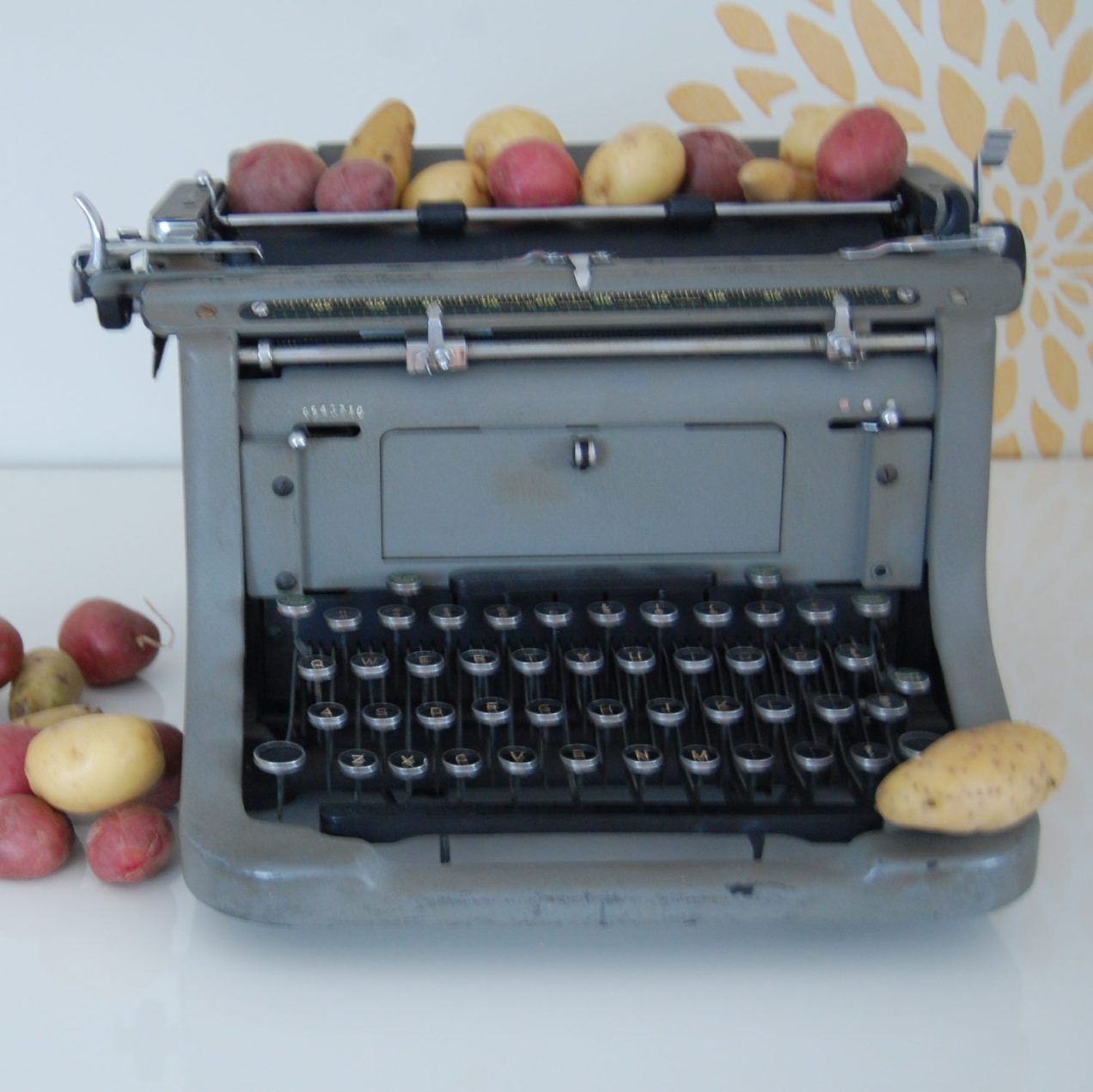






 Chopping Potatoes