
Subscribe to access Mother vs. Self series
Read more of this month’s theme, The Way:

Read more of this month’s theme, The Way:
Read more of this month’s when you subscribe today.
Get this and the rest of this month’s theme:
Be a part of the Mother vs. Self virtual workshops!
Read this and more of Mother vs Self

In the beginning of the last module, I alluded to outside expectations and stereotypes that inform our mothering. We could base an entire month’s work (or more) on exploring this construct – and likely will in the future – but let’s touch on it this week.


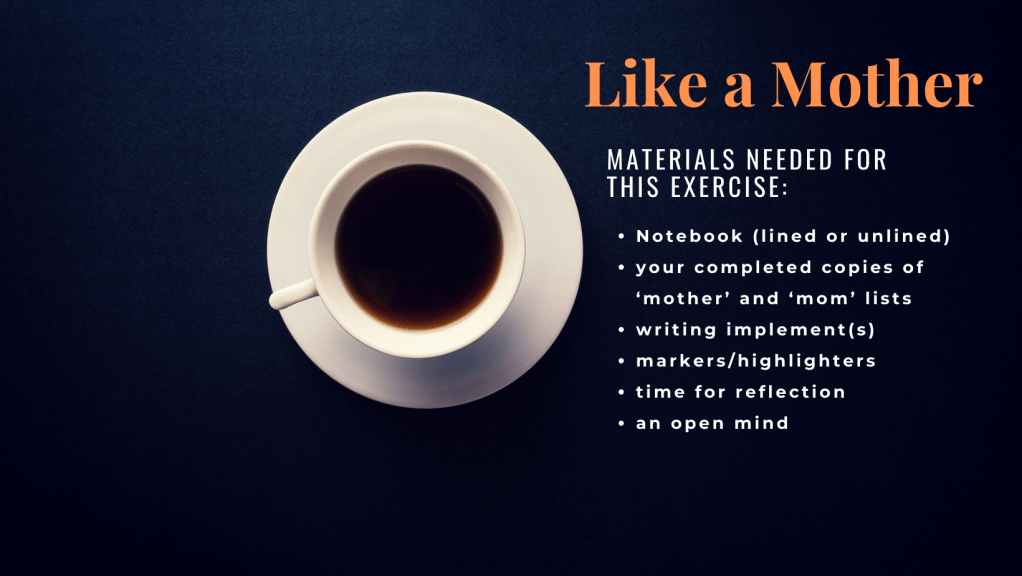
Return to your reflections of what it means to ‘mother’ and ‘mom’. Going through your lists or descriptions, consider which items are ones you feel are essential and ones you feel you should do. Pick two color highlighters or markers. Designate one MUST and one SHOULD. Color code your lists.
Laying both together again, do you see a patchwork or an overwhelming wash of one color?
Reflect on where the shoulds and musts originated. Do they have their source in you? Others?
Even when we focus on what unequivocally must be done in our role of mothering, we likely would be able to shave multiple items off that list. Undoubtedly some of what we’ve labeled as unequivocal has grown from a seed planted by someone else.
If we look closely at what absolutely, undoubtedly must be done, we must ask ourselves:
If you feel a sense of gratification or warmth or love, the task or action likely is a must in your realm of motherhood. If it fulfills a basic need for your child or family, it is a must.
If it makes you tense, feel less, anxious, angry, resentful – there is a good chance the task or action originated with someone else.

Often, we don’t even notice when outsized expectations and ways of being are foisted upon us.

I would argue that the deceptive nature of ‘foist’ is not lost in terms of the unrealistic and damaging expectations upon women today who enter into motherhood. I would argue that the unconscious socialization of women entering into the machine of motherhood makes them an unwilling party. Not unwilling in terms of bearing and raising children – but it terms of the mindfuck of perfect motherhood to which they are unwillingly subject.

It’s time to do a deep dive into what we hold dear as mothers and what has been forced upon us, inherited from others, internalized in guilt, and unrealistically expected.
I can’t tell you how to tackle this.
A list? A t-chart with what and whom on either side? A stream of consciousness outpouring of your greatest fears and insecurities? A manifesto of your worth and sacred spirit?
Perhaps this will take several sittings to unearth what has embedded itself subliminally in you.
Perhaps it will raise feelings you can digest only a small amount at a time.
Perhaps you will finish victorious, reclaiming a personal and powerful motherhood in which you can truly find joy.
It may be all of the above.

A small kelly green hardbound book with a gold embossed border and square locking mechanism.
Even then, in the dire days of second grade, I failed to fill in the daily pages.
Perhaps the slot at the top of each page to fill in the date was where my ongoing cycle of expectation/failure/guilt got its perfectionist start. If only there were simply blank pages with no open forward slashes for month/day/year, maybe then I would’ve been free to record my thoughts as I wished, order them as needed.
But it was only this summer that it took me two entire days to write one entry in my journal. Now the pages were wide open, but my days were not. The stream of thoughts were interrupted when sports practice actually ended on time one evening and completed in fits and starts when swim lessons turned into extended splashing in the shallows. As parents beckoned with outstretched towels, I began to stir from my chair. But my little leapfrog still happily skidded her hands across the surface of the water even as her classmates began to leave. And her older sisters were likely still snoozing. So why not let her play a while longer and finish my thoughts?
Staying seated in that chair strained every productive perfect bone in my body.
Will another mom see me with my head down and judge me as putting my child in danger? (I looked up every few words and rose from time to time to make eye contact with her) Should I go home and check on her sisters? (I’d texted and only one had risen and started to think about breakfast) What laundry/dishes/errands need to be completed next? (The list was never-ending and would still be there when I got home)
Why did letting my child extend her playtime in the outdoors feel like a bad choice?
Because, in this instance, it meant that I got to fill the lines on my pages and my cup. Because in a daily schedule/vocation/lifestyle (ie motherhood) that society orders as self-less, it seems self-ish to take a few minutes for oneself. On a perpetual treadmill, it seems wasteful to sit and stare into space.
But just as it did my daughter well to soak up some sunshine and wonder in the lapping water, it did me well to off-load some thoughts and feelings onto the page, synthesize others, and start with a clean slate.
In that instant I couldn’t change the tempo of my life, I couldn’t create time, but I chose to step out it. I chose to do something that would allow a refreshed me to step back in.
And we all have that choice.
Whether we draw, doodle, sketch; list, pen lengthy diatribes, or long poems; write letters to someone with whom we’re angry, our younger or future self; discover truths buried deep in our hearts or a simply profound recognition – journalling is whatever we make of it and accessible to us all.
All it takes is a piece of paper, something to write with, and a willingness to be open.


Become a paid subscriber to get access to the rest of this post and other exclusive content.

Become a paid subscriber to get access to the rest of this post and other exclusive content.

 Chopping Potatoes