

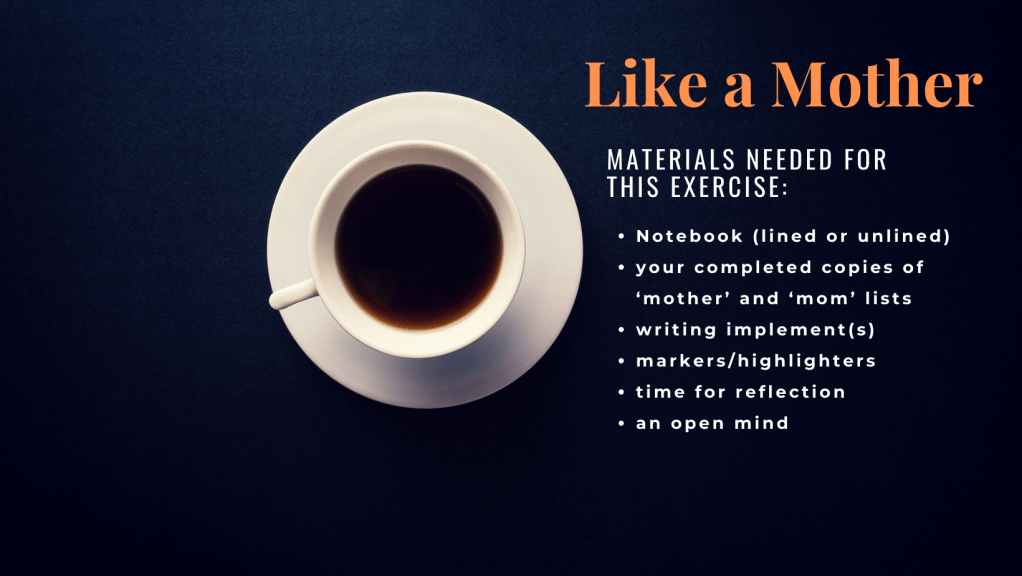
In the beginning of the last module, I alluded to outside expectations and stereotypes that inform our mothering. We could base an entire month’s work (or more) on exploring this construct – and likely will in the future – but let’s touch on it this week.


Return to your reflections of what it means to ‘mother’ and ‘mom’. Going through your lists or descriptions, consider which items are ones you feel are essential and ones you feel you should do. Pick two color highlighters or markers. Designate one MUST and one SHOULD. Color code your lists.
Laying both together again, do you see a patchwork or an overwhelming wash of one color?
Reflect on where the shoulds and musts originated. Do they have their source in you? Others?
Even when we focus on what unequivocally must be done in our role of mothering, we likely would be able to shave multiple items off that list. Undoubtedly some of what we’ve labeled as unequivocal has grown from a seed planted by someone else.
If we look closely at what absolutely, undoubtedly must be done, we must ask ourselves:
- does it need to be done now?
- what purpose does this serve?
- what is the motivation behind this act?
- what would happen if I/we don’t do this?
- how does this make me feel?
If you feel a sense of gratification or warmth or love, the task or action likely is a must in your realm of motherhood. If it fulfills a basic need for your child or family, it is a must.
If it makes you tense, feel less, anxious, angry, resentful – there is a good chance the task or action originated with someone else.

Often, we don’t even notice when outsized expectations and ways of being are foisted upon us.

I would argue that the deceptive nature of ‘foist’ is not lost in terms of the unrealistic and damaging expectations upon women today who enter into motherhood. I would argue that the unconscious socialization of women entering into the machine of motherhood makes them an unwilling party. Not unwilling in terms of bearing and raising children – but it terms of the mindfuck of perfect motherhood to which they are unwillingly subject.

And by whom?
It’s time to do a deep dive into what we hold dear as mothers and what has been forced upon us, inherited from others, internalized in guilt, and unrealistically expected.
I can’t tell you how to tackle this.
A list? A t-chart with what and whom on either side? A stream of consciousness outpouring of your greatest fears and insecurities? A manifesto of your worth and sacred spirit?
Perhaps this will take several sittings to unearth what has embedded itself subliminally in you.
Perhaps it will raise feelings you can digest only a small amount at a time.
Perhaps you will finish victorious, reclaiming a personal and powerful motherhood in which you can truly find joy.
It may be all of the above.
 Chopping Potatoes