Claudio-Duart-Designer pixabay canva
Living, Mental Health, Survival

Five Years On

I’d like to blame my current malaise on COVID.

Not the having of the virus, though two times was punishment enough. (I know, it certainly could have been worse. Believe me, I know.)

And while the pandemic and attendant lockdown messed with my time-space continuum royally, it started in the months before.

When I let myself get so low, I had a near-panic attack just going to the doctor’s office to ask for meds.

When I got so low, I let my mind trick me into thinking needing meds was a moral failure on my part.

When I stumbled around in a fog so thick, I didn’t realize how bad it had gotten.

And then as I climbed out, I felt the need to tell the story.

I knew I needed to explain how I’d gotten there – for the mental health narrative and for my own mental health.

But the story was so huge. The path so steep and craggy, I knew not where to begin or how.

And the more time passes, the harder a thing is to tell. Details forgotten, edges dulled.

And then the world stopped.

We were all in survival mode. Myself acutely.

I thank God for the fortuitous timing of that first appointment.

For if I hadn’t started meds when I did –

thrown into ‘homeschooling’ and online learning and personal loss from afar. . .

But after months of bizarre, those details began to be forgotten and those edges dulled.

And this was life.

We were expected to pick up the baton and keep time

when time was wonky, hearts were broken, and psyches scarred.

Five years on

I’ve picked up bad habits, sloth and sipping alcohol.

Smack-dab in the middle of perimenopause

and the slog of midlife.

What started as peeling back the layers of over-exhaustion and exertion

flipped the other way into inert.

Achieving perfection and avoiding failure by not attempting at all

has settled into paralysis.

And now, what is life, but this fragile thing that can be taken and wrenched dry in mere months.

When the acute sorrow is gone and you’re left with nothing but the days

and another load of groceries to unpack.

Five years on

and I still can’t tell you how I got here.

But I have begun.

Standard
Poetry

Personal Effects II

I wrote a poem about loss.

No one died, but all around me there was empty space with the possibility.

When we worry, when the unknowns build into an ugly catastrophe

it’s easy to be overwhelmed by the gravity of it all.

In the stark cavity created by the spidery black legs of a thinly padded plastic chair and the expanse of institutional white tile below

sat the plastic bag

holding the physical items that tied personality to my baby

The ones she doffed for an anonymous starched gown

that dwarfed her inside

all of the unknown

While I sat staring at the obscenely transparent plastic holding but a small part of her.

Standard
Poetry

Personal Effects

There is nothing so sad as a clear plastic hospital bag.

Kite-string thin threaded through plastic puckers

pulling at the corners, ripping at the seams

The material trappings of this world lumped at the bottom

Empty expanse of cellophane spread out for the world to see

Contained for safe keeping

Inconsequential in the aftermath

Who cares for scrunchies and soft socks

When the immaterial has left this mortal coil

Standard
Weekend Write-Off, Writing

Loss in Children’s Literature

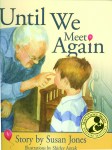
The first book caught my eye from its display, the title singing to my soul, The Poet’s Dog, a novel by Patricia MacLachlan.  The second, I found flipping through the bins of picture books, its title, Until We Meet Again (Susan Jones), speaking to my family’s recent season of loss.  Little did I know how thematically intertwined they both were.

Both titles speak to children bearing and moving through the loss of a loved one.imgres

The Poet’s Dog is more novella than novel and told in sparse prose.  But it is told from the point of view of Teddy, the poet Sylvan’s dog.  And Teddy, while wise and loquacious for a dog, is dealing with the stark life left him by Sylvan’s death.  There is a beauty and simplicity to the unfolding of this tale and the healing that takes place.  Teddy, in saving two siblings from a raging storm, is himself saved by their companionship.  The siblings, Nickel and Flora, and readers don’t find out what exactly happened to Sylvan until halfway through the book, which is really quite wonderful in terms of grief.  Teddy, like so many experiencing loss, comes to a slow realization of the gravity of the absence of his loved one; even slower, comes the ability to share the painful parts of that loss.  He opens up as he comes to terms with it – and it is through the gentle love and presence of the now dear young friends.

untilwemeet-448x600Until We Meet Again, a picture book by Susan Jones, illustrated by Shirley Antak, is told from the perspective of an adorable little boy, made so both by Antak’s rendering and the amazing way he transcends death’s grip on his beloved grandfather.  The opening sequence shows the deep bond and ritual of this grandfather/grandson relationship.  The boy obviously adores the strong influence of his grandfather.  When he first gets news of his grandfather’s eventual demise, he is unsettled, of course, but this midsection of the book sets the stage for the last, when the boy becomes the strong influence.  He initiates and continues all of their special traditions, validating his grandfather, cementing their unending bond, and gathering his own strength for life without him.
Both these titles tackle a topic that is usually met with the awkward shrug of a smile, the stammering silence of not knowing what to say.  The subject matter is the stuff we try to shield our kids from, not books we willingly hand them.  But as with any tough topic, the children dealing with death need them right now.

Ironically, I chose not to share them with my children right now.  Perhaps I am being naive in thinking I can protect them from the direct blow of death for just a bit longer, but they’ve yet to be at a funeral.  They blessedly haven’t felt the stinging sorrow of a daily hole in their lives.  The deaths dealt to our family recently have been on their periphery.  But to know I have such gentle and poignant resources in literature should I need them – I’m glad the literary universe conspired to bring them both to me in the same lending cycle.


Standard
Legacy, Living

Light and Dark

As the joy of the holidays subsided, the dark days of winter took hold.  Truly, the last few days of 2016 brought death to a close and disconcerting distance.  It stepped in and stayed until as recently as last week.  And still, it lingers.

I’d pulled my black leather pumps from their shelf high in the closet.  I’d arched my inner soles into their uncomfortable embrace.  I’d released my tired, swollen toes from their pinch at the end of the day.  But I’d yet to return them to their box; death would not let me store them away for the next black dress event.

There was another, and another.

A year of new life was marred by the loss of three precious ones.

Death is always waiting in the wings – but I’m comforted by the thought that their spirits fly in the wind that catches our breath and reminds us we’re alive.

img_20161231_173059532_top

Standard
Maternal Health Month, Maternal Health Month 2014, may is maternal mental health month, Recovery

Return to Zero

Stigma.  Silence.  Simply impossible to say the right thing.

All of these surround the topic of neonatal death, miscarriage, and stillbirth.

Tonight, a film determines to shatter all that.

Return to Zero tells the story of a couple expecting their first child, whom they are devastated to discover has died before he could even be born.  It is the first feature film to tackle the uncomfortable and uncovered story of this type of tragedy.

Perhaps no one wants to watch a film with such a difficult plot, but certainly no parent wants to find themselves playing the starring role.  Just as we all find comfort and empowerment in reading our story on the page, finding our face on the screen, this film should prove powerful – and hopefully therapeutic – for parents who have been silenced by the horrific events of stillbirth.

Standard
Maternal Health Month, Maternal Health Month 2014, may is maternal mental health month, Weekend Write-Off

Stranger than Fiction


You just can’t make this stuff up.


We’ve all heard people say this. We may have even heard some pretty good instances of the phenomenon. Read Kelly Kittel’s Breathe: A Memoir of Motherhood, Grief, and Family Conflict, however, and you’ll find perhaps the best exemplar of it ever.

Kittel’s story starts much like many other love stories: with the birth of a precious baby boy. We learn to know and love Noah, Kittel’s fourth child, right along with her. Amidst the love and adoration, though, there is an undercurrent of tension. Relations with extended family increasingly interfere with the Kittels’ close knit circle of immediate family, creating conditions ripe for catastrophe.

A tragic accident involving Noah is unfortunately and unbelievably only the first tragedy to befall Kelly and her family. In her quest for “an oversized house and a plastic car overflowing with round-headed pink and blue babies while [she] navigated [her] way through the Game of Life,” Kittel experienced miscarriages and an unnecessary stillbirth, unsupportive and argumentative family members.

Through personal anguish and legal battles, spiritual searches and encounters with nature, Kittel somehow arrives victorious on the other end, relishing each and every moment with her family of five living children and the spirit of those in heaven. Even with all its loss, Breathe is always – on every page, in every word – a life-affirming story.

I was fortunate enough to have read Breathe in its entirety before publication. Shortly after Kelly joined our writers’ group, she began sharing excerpts of her story, until we’d read, critiqued, and discussed the whole thing. We stroked the cover of her first proof when she passed it around the circle one night (it really is velvety soft!). We cheered her on upon its release on May 14, the birthday of her dear son, Jonah, his one and only day upon the earth.

Kelly Kittel wrote this story for those precious sons robbed of the oft-neglected privilege of breathing. But she also offers a poignant story of survival – her own. And in doing so, she most certainly will help countless mothers and women do the same.

Breathe-Cover


Standard