Living

Catch a Fire

I can see why the discovery of fire was such a watershed moment in the history of mankind.

Not only for its life-giving (or preserving) qualities – warmth, cooked meat, and protection from becoming raw meat are all good things – but for its mesmerizing abilities.

In the past few years, having moved to the country, built a fire pit, and acquired a wood stove, I’ve spent a lot of time staring into flames. There is a certain magic to the seemingly alive tongues of fire; the dance, the movement, the consumption of material, the production of charcoal, the transformation to ash.

It also teaches a lot of life lessons.

Building and maintaining a fire takes a lot of work. Steady attention. Checking in. One cannot get distracted or fully immersed in some other project. Until it’s rip-roaring, your job is the fire. You must focus. You must settle into that state of mind that allows you to do the task at hand and nothing else. It’s quite freeing, actually. Poking, prodding, turning, and nudging – worries, urges, outstanding obligations fall away in the tedious, tactile action.

As does the guilt that usually accompanies the exclusion of other tasks. While only focusing on one, this task is keeping your family, your house warm. It is providing a comfort, a safe haven – it’s even saving on fuel costs 😉

Maintaining a fire teaches other lessons as well that aren’t as easy or pleasurable to learn.

Like patience.

Sometimes you don’t need to throw another log on the fire; sometimes you need to shut the door and watch the roiling smoke. Watch until it produces enough heat on its own. Watch until the flames burst forth seemingly spontaneously – only they don’t. There’s lots of quiet build-up and warming-up that lead to it – all without your interference.

The agonizing part is knowing when these moments of holding back are needed. Will you lose the fire altogether if you mistake its need? Or will you squander the heat by opening the door and fiddling with it too much?

This give-and-take, this mental questioning seems like the opposite of the mindless joy in minding a fire I described above. But only if you let it be. Through practice, through trial and error, such decisions will come instinctually. And focusing on the fire is always better than obsessing over the machinations of your own life.

Sitting by the fire, the warmest, coziest spot in the house with a cup of tea, has become my favorite spot to be, thing to do (or not do) on these cold winter days. The voice in the back of my mind tries to tell me I’ve fallen into a pattern of leisure that is not good. But a louder, happier part of me thanks those prehistoric peoples who discovered the wisdom of the flames and learned from it.
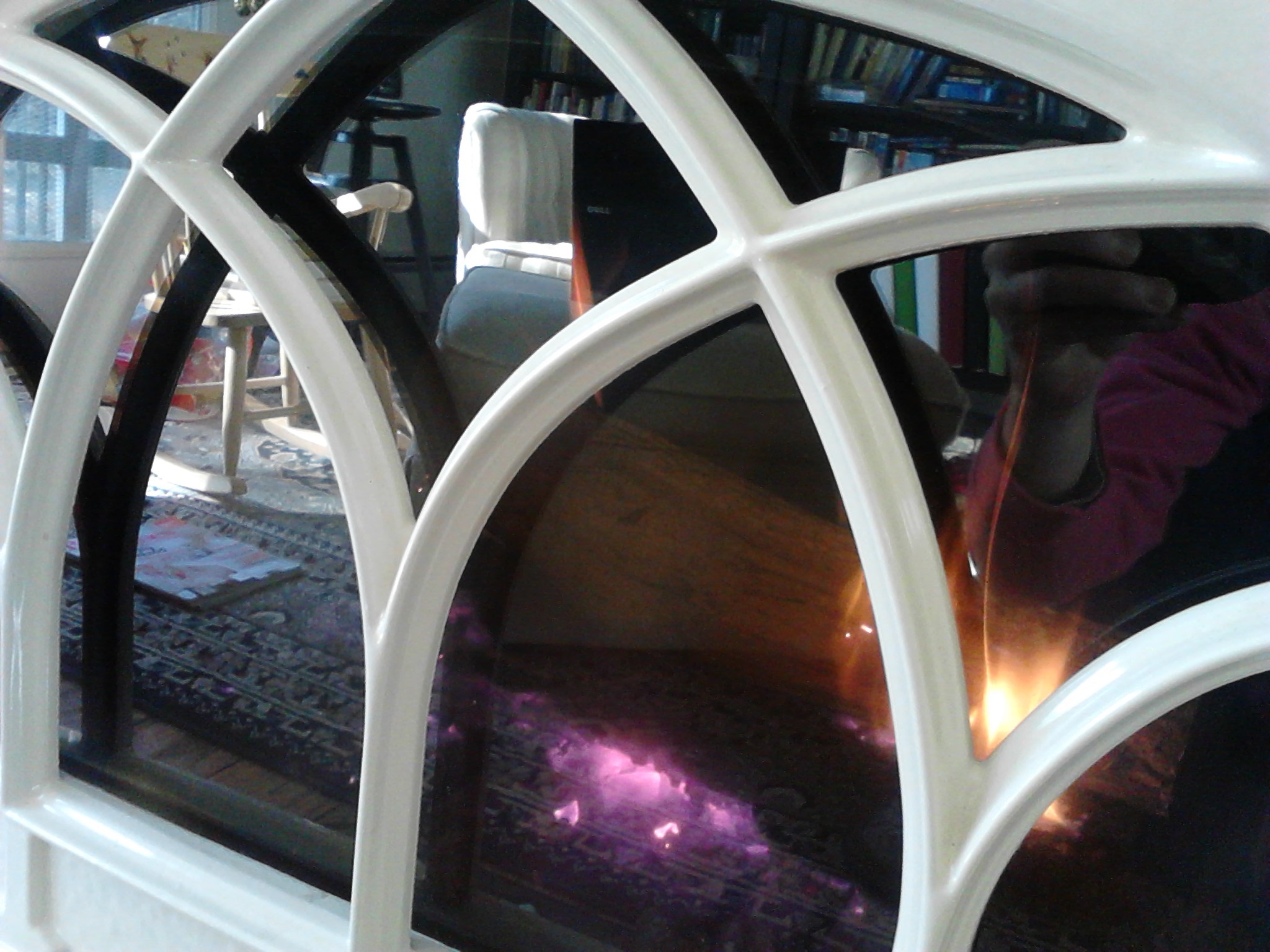
Reflecting on fire

                Reflections of fire (Jennifer Butler Basile)

Standard
anxiety, Living

Weeds

The mosquitoes actually held off long enough the other night for me to do some weeding in our vegetable garden.  In that time shortly before the gloaming, when the heat of the day was finally fading as the sun dipped between the trees and the wind rose up to fill its space, I loosened the earth all around my feet, gently extricating snap pea tendrils from crab grass claws.  There were weeds with plump, red stalks that looked like they would ooze moisture if I snapped them.  There were delicate rounded leaves with lacy white flowers.  They were under and around and throughout – an integral part of my garden – perhaps more numerous than the plants that were supposed to be there.

At times, I had to stand back and survey the leafy patch below me.  Bent over in the worst possible posture for my back, it was hard to distinguish the plants from the weeds.  At eye level, all the leaves blended into one range of green.  It was hard to tell where the clover ended and the pea leaves began.  The heart-shaped leaves of the green beans melded with tall stalks of pointed leaves.  There were even imposter marigolds with tiny yellow buds.

It almost scares me, the uncanny ability of nature to so closely mimic ‘actual’ plants with its weeds and then to germinate them right next to the others so they have the best possible chance at survival by blending.  Think about it, the first weeds a gardener pulls – even if it’s in the five-second walk to her driveway – is the tall spindly one sticking out like a sore thumb.  These others are stealth, imposters of the best kind – or most insidious depending on whose side one takes.

It’s no wonder, then, that I have a hard time distinguishing my bad habits from productive practices; destructive behaviors from healthy ways of being.  The roots of the less desirable plants of my life are invasive, wrapping themselves around my more likeable attributes and behaviors, making themselves almost impossible to extricate – or at least harder to distinguish or even notice.  Without stepping back to take stock, my life is one solid plane of green, weeds and all; the different shades and shapes indistinguishable.

Making the rounds at our local farmers’ market, I stopped to talk with a woman who had woven some beautiful baskets (who also happens to know a thing or two about gardening; she harvests worms for composting).  One skinny, oblong one with a graceful arch of a handle caught my daughter’s eye.  The woman directed my attention to a small ceramic plaque stitched to its front.  ‘Weeds’, it said.  She told me of the Native American tradition of placing their worries in a basket such as this to put them away; make them go away.  I joked how you could also take weeds as a literal worry as a gardener.

But as the day went on, I marveled at how symbolic that little basket and the word etched on its front were.  If I don’t take the time to stuff those weeds into a receptacle of some sort, they will crowd out the good in my life.  The weeds of worry, perfectionism, over-catastrophizing, unrealistic expectations, not prioritizing, not slowing down enough to come to a gentle stop rather than a screeching halt.  I need to cultivate my garden in such a slow, gentle way that I see the weeds as they pop up and handle them one by one, rather than waiting to turn the earth over and start over because they’ve taken over.

I think I need a bigger basket . . .

I think I need a bigger basket . . .

Standard
Living

Have To

Do you have to go away to realize where home is?
Do you have to go where it’s loud to discover quiet?
Do you have to ask questions to realize there are no answers?

Do you have to mentally and verbally vomit to free your mind and start fresh,                                                  to get any sort of meaning,                                                                                                                                      clarity,                                                                                                                                                                               peace?

Do you have to hear the tiny squeak of baby birds or the squall of a newborn to remember that life is fragile and once was new and precious?

You don’t have to do anything.

There’s that thing described so simply as free will, but which so complexly screws up life.

But if you want to –

If you realize you need to –

Life is infinitely better.

Standard
Living, May is Mental Health Month, Mental Health

An Imperfect Porpoise

Balance.

The very word makes me twitch.

It’s supposed to be peaceful, magical, that neutral territory where the heart sings and your psyche lies in savasana.

That is, if you can attain it.

I’m forever striving.  I want to show that boulder who’s boss, shoving it up the mountain for good.  But if it doesn’t roll back over me on its way back down, it’s got so much momentum it just goes over the other side.

I lamented to my therapist that I just want to conquer depression.  I want to beat it into submission and be done with it.  I like closure.

2011-03-25-the-epiphany-of-sisyphus

Depression is not an open-close case.  It is full of decisions and appeals, a juggernaut of self-imposed juries.

For every bright spot, there is a chance of dark days.  For every low point, there is an arc of highs.  And sometimes it’s all over the road like a reading of the Richter scale.

Unfortunately (or not), this same concept applies to life.

Whether I like it or not, I have to take the good with the bad, the ups with the downs, the victories with defeat.

While Sisyphus has been the poster-child of my life as of late, a friend tried to introduce me to someone new. She said,

Here’s to imperfect progress–a gradual improvement of mood and attitude despite life’s natural ups and downs.

I’m trying to frame this in terms of my buddy Sisy and his vertical hangout.  I can’t.  A long, gradual slope comes to mind, maybe strewn with boulders along the way.  Or maybe it’s like that part of the trail where you hit the tree line and think the summit is just over the next hump, but it stretches on and on and up and up.  The view improves, but the trek is still arduous.

Rolling this new idea of imperfect progress around in my head, the words transmuted themselves into ‘an imperfect porpoise’, which not only made me laugh, but kind of fits.  I’m happy, but I don’t chirp like Flipper; can’t.  Some days I flit about the surface, skimming the waves, others I plunge into the depths.  And all the time, I like to turn words and things on their heads and see what comes about.  Porpoises are intelligent; I wonder if they over think things as much as I do.

What IS the porpoise of life, anyway?

What IS the porpoise of life, anyway?

“An Imperfect Porpoise” is my modern-day myth.  It is about the ever-elusive balance.  The disgruntled admission that this is what I need to seek, rather than domination or perfection.  And maybe that a moving target has less chance of being flattened by a boulder ;-).  Hey, old habits die hard.  This new guy and I are just getting acquainted.  Sisy and I go way back.  This whole life is imperfect anyway, right?

Standard
anxiety, Living

All You Can Eat Buffet

Buffets are not the best means of eating for anxious people.

So many choices, so much activity, so many chances for E. Coli and bacteria.

Then the bus loads of people coming in, adding to the tumult.  Kids cranky from traveling.  Everybody wanting food at the same time.  Not unlike the distractions of life, pulling our attentions from our goal: homing in on the buffet line.

The myriad choices are like our choices in life.  So many desirable options.  Mac n’ cheese.  Fried chicken.  Tostadas.  Sweet and sour pork.  Then what we should eat: the salad.  Also a lot like life, no?  We can choose what we know we need and is usually more cost effective (i.e. veggies) vs. what we want or think we should have (bacon-wrapped filet).

In the world of an anxious person, who cannot prioritize, who perseverates over decision-making, who gets overwhelmed easily, the all-you-can-eat buffet is a microcosm for life on a very bad day.

Unfortunately in real life, we do not have a Reina, the queen of bussing, to clear away our messes – or watch us to decide when that’s needed.

Or an all-you-can-eat ice cream bar.  Damn it.

images

Standard