River in the middle of green trees
Survival

To those of us in middle age

Who curse out our parents for ‘giving it to us’

– whatever it may be:

diabetes, depression, attention deficit disorder –

and then turn around to our teens cursing us out for giving it to them.

Who move children into college

and come home to crap they’ve left behind.

Who are exhausted in every sense of the word.

Whose friends are going through it.

Whose parents are ill or actively dying.

Who alternately sweat or shake with chills or shit after drinking wine

It all feels like too much –

but this is life for a lot of us right now.

We are not alone and we will survive.

Standard
Mother vs. Self
Writing

An Ocean State Story of My Own

My grandmother was a connoisseur of the written word.

She devoured it voraciously.

Oftentimes, seeing her car in the library parking lot, I would find her among the stacks or bump into her in the lobby, fist full of the next adventure to be had.

As my own love of writing deepened in high school, she began to share what she deemed stellar examples of its use. A clipping of newspaper, a strong Op Ed, a well-executed essay.

She’d come of age in the glory days of the Providence Journal, her own brother disappearing into its whole block of a building for work each day. It was a stalwart of journalism and professional writing.

Naturally, then, I came to appreciate those writers and articles she’d send. With my parents referencing Ken Weber’s hiking guide nearly every weekend, I became interested in the sparse yet beautifully evocative language of his nature columns. I fancied myself ‘the next Ken Weber’ as I detailed my own rambles. And as an adult, I discovered more of my own writers.

G. Wayne Miller was a name I was accustomed to seeing in the by-lines of the Journal. When he did an ongoing series about mental health in 2014, I followed closely. How encouraging to see a close-up view of the many facets of mental illness and its treatment in our state. When he retired from the Journal in 2022, I was glad for his accomplishment; sad for the loss of such thoughtful coverage.

Through the wonders of LinkedIn, I stayed abreast of his work with Ocean State Stories (housed within Salve Regina University’s Pell Center). Imagine my surprise and delight when he reached out to me recently to be the subject of one of the Q&A features on their site.

When your writing comes of age with a steady diet of talented writers, fed to you by loved ones, part of the literary fabric of Rhode Island – and then one reaches out to you . . . it’s as if fairy dust has burst from the folds of clipped newsprint.

Thank you, Wayne, for taking the time to read my work and offering the space for me to share it. Your care and attention to mental health already impressed me. Your encouragement of fellow writers means perhaps even more.

Standard
motherhood

Telling the Truth about Motherhood

The other evening, as I lay in my seven year-old’s bed waiting for sleep – hers, though my own comatose mini-nap usually comes first – an unexpected thing happened.

No, it wasn’t my questioning whether I should still be or have ever even started lying with her before bed without: a. spoiling her, b. impeding her sleep progress, c. prolonging this nighttime ritual until we’re both old and gray. That’s been a constant since she first balked at sleep as an infant.

As they usually do, an important revelation snuck out in those twilight murmurs.

“When I grow up, I don’t want to have children.”

My heart instantly hurt for so many reasons.

Sadness for her, that she wouldn’t experience the wonder that is mothering. The fierce, warming, all-enveloping love that it is to raise a little human into a big one.

Regret for me, that I somehow portrayed motherhood to my children in a poor light. That I did them a disservice by not loving it enough or not showing them enough love.

But even as I type that, I can’t believe that I don’t show my children enough love. Surely, they know they are loved. Does my fault lie in my sometimes less-than-joyful servitude?

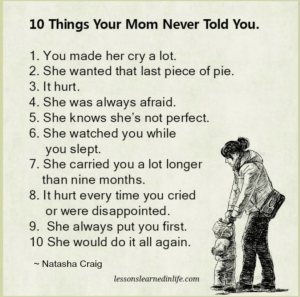
As beautiful a sentiment Mother Teresa of Calcutta shares about washing the dish because you love the person who will use it next, that doesn’t make me more likely to wash dishes or to do so without complaining. Perhaps you’ve seen the list of things your mother never told you.

While many of these ten things are true on some level, I cannot subscribe to this level of subterfuge. Sacrifice and selflessness certainly have their place in parenting, but to sacrifice to the extermination of self is something for which I cannot get on board. Perhaps that means I am not destined for sainthood, but I also believe God created each of us as a special, sacred self to be celebrated – not obliterated.

I also feel it is disingenuous to serve with a smile when anger and resentment broil below. Why can’t we be authentic with our partners and children about how hard this path is? How we serve with love, but also appreciate being appreciated and, even more, equal distribution and support.

By speaking truth about my struggles in motherhood, I hope my daughters will see the inequalities in expectation and systems of modern motherhood. I also hope they will realize the hard-earned worth of fighting for a connected, loved, valued family.

Because while I stand as a symbol of the greater mantle of motherhood for my children, I am also human.

I hope the toil I am totally transparent about will not dissuade my daughters from becoming mothers themselves, but make them realize there is no perfect ideal – except perhaps love.

I also hope that my seven year-old’s proclamation didn’t stem from Cookie World C’s unnecessarily medicalized version of a plastic horse giving birth she viewed earlier that day.

In any event, I have some work to do, but tomorrow’s another day . . .

Standard
Living, motherhood, parenting

A Note to My Children, Aged 43 and 5/12

Disregard my previous missive.

While that advice may have been sound – in a low-level survivalist sort of way – it was ordered toward others rather than centered on you.

Yes, it suggested simple ways to keep the lid on things at home with small children – and you would be the one responsible for completing them – but that’s the only part of YOU that factored into that equation.

It put you at the center of others’ judgment of you – via your home and your housekeeping skills.

Rather than giving you the legacy of neurosis founded on society’s standards of good parenting and homemaking, I challenge you to give yourself the gift of not caring what unexpected guests think of your house; of not deriving your own worth based on how the physical place you share with a slew of other people with their own free wills and sets of hands and collections of things looks.

And if you want to stay in your pajamas all day, please do so without explaining yourself to anyone. You work damn hard and deserve a comfy pair of pants when you want them.

Standard
Weekend Write-Off, Writing

Symbolically Speaking

“Symbols arise from the instant and continuous deterioration of sensation in the memory since first experience.”

 –  in Henry’s notebooks from Perfection by Julie Metz

God, I hope this isn’t true in relation to writing.  In creating symbols and their –isms, does each time I hit that note weaken the power of the initial memory or feeling it elicits?

Writers use symbols to illustrate themes, ideas, emotions.  Illustrate is a key word here.  ‘Show, don’t tell’ is a mantra that haunts us all in our sleep.  We cannot describe said feeling without talking down to or boring our reader.  But if we can hit them where it hurts, draw out that venom from a similar hurt they’ve experienced, yes, that is what makes writing powerful and universal.

Raindrops, an unexpected phone call or delivery, a plump bud about to burst, a family business with one remaining heir.

But where do we cross the line between evocative and cliché?

A repetition, a refrain, an oral tradition, cautionary tales – there are threads that weave us all together in the collective consciousness of all time.  There are reasons for patterns.

But if we bang that drum one too many times, do we risk ‘the instant and continuous deterioration’ Metz mentions above?

Or is it not what we do, but the way that we do it?

The goal is to fine-tune our words, choose them like each brushstroke of a painting.  If we create a unique experience in each scene, regardless of its resemblance to an aura that once surrounded our readers, we will gain connection, a relativity with a resounding freshness.

It’s no small task.  But there’s also pretty good research backing us up.  There’s a reason symbols resonate throughout the millennia.  Through story, there is some thread of our DNA.  Whether it’s deteriorated throughout the years, some small part of it remains and vibrates within us when we read it.

Standard