Children, Literacy, Weekend Write-Off, Writing

Bluebird

I hate books with sad endings.  But I love Bob Staake’s.

The Donut Chef is in heavy rotation in our house.  I cannot eat a donut without proclaiming, “There’s nothing quite like glazed, I think!”

So when I spied a new title, Bluebird, on prominent display in my child’s library at open house, I couldn’t resist removing it from its perch for a peek.  My first grader came home with it a few weeks later much to my delight.

bbsmallcov

Every workshop on children’s writing I’ve attended, particularly those on picture books, says you must have a happy ending or at least end on a positive note of some sort.  Kids need to know they will prevail in some fashion.  Lately, I‘ve been finding many books that are heartbreaking!  After reading Bluebird, I have to say, my excitement in finding a new Staake book was quelled somewhat by the poignant moments at the end of it.

A lonely boy begins a new school year.  Two bullies have him pegged from the moment the class queues up outside.  After school, he heads in one direction, the rest of the children, the other.  He is all alone save the bluebird that has been quietly watching him all day – from tree branches and windowsills.  Immersed in his solitary confinement, he does not notice the bird flit along beside him, until she swoops in low over his head and engages him.  With a fun mixture of tag, hide-and-seek, and follow-the-leader, the two become friends as they move through the city.  These are the only times we see the boy smile.  As he floats a boat in the park, the bird perched upon its mast, drawing the attention and friendship of a nearby boy and girl, readers rejoice with the boy and finally relax.  He will be okay.  He has found happiness, even if one bright spot of it.

And then he passes under the bridge – where three bullies want not friendship, but his beloved toy boat.  At first, the bird hangs back, watching from atop the bridge.  I wanted the bird to rescue him, but the workshops have also taught me that protagonists need to solve problems for themselves.  Still, I was angry that his new friend was seemingly hanging him out to dry.  But when the situation turns dire and the boy truly needs him, she swoops in.  She blocks the blow the boy would’ve received from a stick thrown by the bullies, but sacrifices her own life in the process.  To their possibly redeeming credit, the bullies are appalled by the result of their actions.  A flurry of rainbow-hued birds lifts the boy and the bluebird into the sky for the spiritual denouement.

His friend dies?  He finally has someone that makes him smile and she’s dead?  This is not the gooey goodness of a glazed donut!  But it does adhere to that positive tenet of children’s literature: through the process of nurturing this friendship and finding what makes him happy, the boy can now fly on his own.  The bluebird has taught him how to find happiness on his own.

The plot of this book is riveting and transcendent.  What is astounding is that there is no narrative text whatsoever.  Staake tells this incredibly intricate and rich tale with nary a word.  It is a true testament to his amazing graphic skills.

This book may not have been what I was expecting, but happiness rarely is.  Bluebird joins Bob Staake’s catalog as another superb example of children’s literature.

Standard
Weekend Write-Off, Writing

Symbolically Speaking

“Symbols arise from the instant and continuous deterioration of sensation in the memory since first experience.”

 –  in Henry’s notebooks from Perfection by Julie Metz

God, I hope this isn’t true in relation to writing.  In creating symbols and their –isms, does each time I hit that note weaken the power of the initial memory or feeling it elicits?

Writers use symbols to illustrate themes, ideas, emotions.  Illustrate is a key word here.  ‘Show, don’t tell’ is a mantra that haunts us all in our sleep.  We cannot describe said feeling without talking down to or boring our reader.  But if we can hit them where it hurts, draw out that venom from a similar hurt they’ve experienced, yes, that is what makes writing powerful and universal.

Raindrops, an unexpected phone call or delivery, a plump bud about to burst, a family business with one remaining heir.

But where do we cross the line between evocative and cliché?

A repetition, a refrain, an oral tradition, cautionary tales – there are threads that weave us all together in the collective consciousness of all time.  There are reasons for patterns.

But if we bang that drum one too many times, do we risk ‘the instant and continuous deterioration’ Metz mentions above?

Or is it not what we do, but the way that we do it?

The goal is to fine-tune our words, choose them like each brushstroke of a painting.  If we create a unique experience in each scene, regardless of its resemblance to an aura that once surrounded our readers, we will gain connection, a relativity with a resounding freshness.

It’s no small task.  But there’s also pretty good research backing us up.  There’s a reason symbols resonate throughout the millennia.  Through story, there is some thread of our DNA.  Whether it’s deteriorated throughout the years, some small part of it remains and vibrates within us when we read it.

Standard
Children, Literacy, parenting, Weekend Write-Off, Writing

The Scar

The title drew me in.

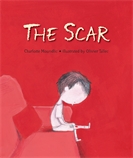
The way the red background swallowed the illustration of the small boy on the cover.

I was in tears by the time I was partway through the book.

0763653411.med

The Scar, by Charlotte Moundlic, is the story of a young boy preparing for, experiencing, and ultimately surviving the death of his mother.

This leaves a metaphorical and literal scar on him.  When he falls and scrapes his knee after his mother’s death, he remembers how she used to soothe him.  When the scrape starts to heal before he does, the boy keeps scraping at it to keep the comfort of his mother alive.

It was around this point that I really started crying.

Death, loss, self-mutilation – what kind of children’s book was this?

For the child who’s lost a parent, exactly the kind that needs to be written.

There’s no shielding those children from the pain, the hurt, the ugly truth.  They live the nightmare.

I was reminded of a man in a writer’s intensive that I took who told the story of student with special needs who found nearly every task throughout his day difficult.  He wanted students like him to read a story about them.  Even though it might be a difficult story to tell, a difficult story to read, there were children who needed a narrative to which they could relate, a way to know they weren’t the only ones to have experienced this.  They were not alone in the universe.  Maybe there were even people who overcame their difficult obstacle.

And while extremely poignant and slightly heartbreaking, The Scar does end on a positive note.  The boy, though always sure to miss his mother, allows the scar to begin to heal.

So what on the surface once seemed revolting, is now something we can look at without cringing – and, for some children, is absolutely essential.

Standard
Children, Literacy, Weekend Write-Off, Writing

An Unexpected Beaver

A dancing dragon and a firefly met on a moonlit night.  They began to talk and play when suddenly out popped a beaver.  They jumped, then laughed and laughed.  Their unexpected visitor added fun and excitement to their meeting.images


The above scene transpired in the puppet theatre at the library yesterday.  My three year-old, in the guise of the beaver, taught me an important lesson about humor in story.

While the dancing dragon and firefly were compelling enough in their budding friendship and moonlight dance, the beaver’s unexpected entrance added another layer of depth that hadn’t been there.

Even the dragon and firefly, as played by her sisters, laughed – not just me in the audience.

It is the unexpected or turning of conventions on their heads that makes the best humor.  It also makes for fresh, unpredictable plots.

Novel, indeed.

Standard
Weekend Write-Off, Writing

Beg, Borrow, or Steal

What is not up for dibs for a writer?


The conversations, the witty remark, the anecdote.


The errant animal who roamed not your village.


The marbles you did not collect.


The talking-to you should have given.


How much is artistic license and how much is misrepresentation?


Anything marked as fiction can be deemed coincidental.


There is also the power of taking something pedestrian and elevating it,

making the commonplace extraordinary, making what should have been become alive.


If it’s all for the sake of art, anything goes.

Isn’t that what Cole Porter would say?


Image from Mary DeMuth

Image from Mary DeMuth


Standard