Depression, Survival, Weekend Write-Off

A Man Called Ove

We all know a man called Ove – or better yet, exactly like Ove.

A crotchety old man. The neighborhood watchdog policing persnickety policies about which no one else cares. A man who never has a nice word to say, who always has something about which to complain.

He exists in every family or neighborhood. In archetypes and novels. Small screen and silver.

He excels in Fredrik Backman’s A Man Called Ove.a-man-called-ove-9781476738024_lg

A third person narrative and clever titles for each chapter continually referring to the main character as ‘a man called Ove . . .’ (backs up with a trailer – as in chapter three) establish a sort of psychic distance between Ove and the reader. We see him as the world does. The archetypal cranky old man.

But just as many of us secretly yearn for the day and chronological age at which we can tell the world around us how we really feel, such outrageously brusque behavior almost endears Ove to the reader. At the very least, it entertains us. His dysfunctional interactions with his neighbors and clerks at the Apple store made me laugh out loud more than once. The fact that Ove is resolutely dedicated to his lifetime car of choice, Saab, brought me – as a Saab driver myself – even more joy.

While the chapter titles are structured the same throughout the book, readers slowly move closer to Ove and his motivation, the reasons for his dysfunction and underlying sadness. He wants to be left alone. He purposely pushes people away because the one person in the world who made him live – his wife – is gone.

“If anyone had asked, he would have told them that he never lived before he met her. And not after either.”

And so now, “Ove just wants to die in peace.” He wants to meet his wife on the other side and will try whatever means it takes to get there.

What I appreciate about this novel is the empathetic way it deals with depression and attempted suicide. Ove, while archetypal in other ways, does not fit the stereotypical profile of a suicidal person. Backman’s portrayal shows that depression can be situational – and elicit feelings of such dire circumstances that the only option left seems to be suicide.

However, Backman’s novel also shows the amazing strength and redemptive powers of love. It may be love that causes Ove to yearn to be reunited with his departed wife, but it is also the long reach of her love that reminds him to be a better man. It is through the initially annoying love and attention of his neighbors that Ove finds a reason to live. It is the hard fought and won love of a feline companion that offers him solace.

There is love in a riotously abstract portrait blasted in color by a three year-old. In a hand to hold. A skill transferred. A deed proffered. A meal shared. There is love in a sense of belonging, community.

A Man Called Ove reminds us all what it means to truly live and love – and I loved every minute of it.


In fact, I loved Ove so much, the next few ‘Weekend Write-Off’ entries will be dedicated to favorite excerpts of the novel, which is just full of gems.  Ove and I will see you next Friday!
Standard
Living, Survival

Everyday Can’t be the Best Day of Your Life

I was driving home from a Girl Scout meeting yesterday, my own three girls crammed into the backseat, when this song came on:

I like this song. It’s catchy. It’s ‘got a funky beat you can dance to’. My girls started bopping all over what limited space they had in the backseat. And it has a positive message. If we don’t treat each day as a gift, we will miss out on the opportunity simply breathing affords us.

However . . .

I can’t help but think that such messages as this, broad sweeping generalizations about life spoken in hyperbole, do us a disservice.

Everyday can’t possibly be the best of your life. Life, the world, doesn’t work like that. There are ebbs and flows, ups and downs.

As someone who’s had a fair share of emotional downs, such attitudes can be caustic.

Today wasn’t the best day of my life. What’s wrong with me? Why can’t I rise above and rejoice?

Much more realistic and empowering would be to see the good in each day, but not expect it all to be good. Chalk up a bad day to just that – a sucky day that’s now done with and can be put away. Looking for the next good day is a good idea, but to expect that every day will be one sets us all up for failure.

I know I’m not waxing optimistic here, but for people whose minds and chemicals work against them, it’s not a matter of the glass and how full it is. All the good vibes in the world can’t spontaneously spout water. We can certainly look for ways to fill the glass, but thinking it will always miraculously be full on its own is a sure way to disappointment.

Standard
Depression, Living, Survival

Let-down. Easily?

The excitement I felt as a child spying Christmas lights through the trees, the twinkling points brightening the darkness, a magical apparition amidst a black backdrop – to say that’s gone away as I’ve gotten older would be a lie. It may have dimmed, but it hasn’t disappeared altogether.

Long drives to relatives’ houses, country roads turned unfamiliar by nightfall, the conical Christmas trees aglow in the windows we pass become the markers, the golden deer high on a hill the waypoints.

Our family traveled to one relative’s house both Christmas Eve and the following Saturday. The same route, the same sparkling spectacles, but somehow, within the space of a few days, the lights had lost their magic.

What once signaled possibility, now was a sad reminder that it was over; the points of light now a poignant prompt of what was. Looking at those lights depressed me in a way I couldn’t name. Not in the way it may have as a child, if Santa hadn’t brought me the one thing I coveted. Or knowing the time of unlimited treats was over. Perhaps because all the preparation leading up to that one day, all the hours reduced to a mere twenty-four, passed by in a flash. There was nothing now to which to look forward.

The lights would soon go out. The joyous strains of Christmas carols would end. The bleak days of winter would set in.

The end of the season is capped with the celebration of New Years’, but that’s always depressed me nearly as much – if not more.

A time to recount what we’ve done wrong during the past year, our mistakes, opportunities missed, amazing moments gone. Waiting in a suspended state, on edge, for – a kiss? A hangover? A mess of confetti to clean up? To wake up the next morning bleary eyed and cranky. What an auspicious way to herald a new beginning. The fact that, for years, New Years’ also signalled the end of vacation for me and the restart of my teaching schedule certainly didn’t help. That was anxiety-inducing and depressing in and of itself.

The whole of the time period between Christmas and New Years’ is a weird dead zone. There no longer is the excuse or mask of Christmas to impel us to at least fake happiness. There is a winding down, a let-down – with the building stress of creating a killer list of resolutions, ways to make our flawed selves better, to overcome our frail ways, to defeat the demons plaguing us for years in this one year. No pressure.

There is a hollow space in my chest during this time. A sadness somewhere behind my eyes and down in my throat. It is a return to normal. A return to a time with no distractions. While stressful with its added expectations and tasks, the time leading up to the holidays gives lots else to think about – rather than our problems. Or at least a good way to avoid them. Now it’s back to ‘ordinary time’.

And while that may not be the designation on the Church calendar at this time, that’s what it feels like to me. No longer extraordinary.

I know if I remove the decorations, the piles of gifts, the social commitments, there is the ultimate fulfillment of my wildest expectation in the birth of Christ. In the silence that follows all the earthly tumult is His quiet peace. I know I’m missing the point if I mistake the silence for sadness, when it should be taking me truly to the heart of the season, the true meaning. Perhaps that’s what the hollow is – the fact that I am missing it. But it is sometimes hard to cross the bridge between knowing and feeling – not because I do not want to, but because my body, or brain chemicals, or something won’t let me.

There is always the problem of unrealistic expectation. If I go from moment to moment, living it for what it is, sucking the marrow out of this minute, rather than anticipating the next, I will enjoy rather than lament. But I’ve always found it hard to balance preparation and mindfulness.

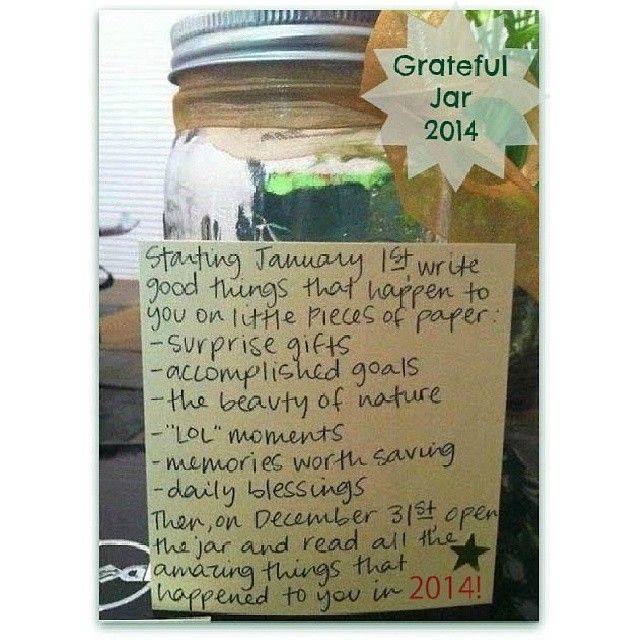
A couple of things I may try:
gratitude jar

Reading these next New Years’ Eve would put a positive focus on the end of the year, what I’ve gained and experienced rather than what will be lost.

Also, viewing the holidays in the terms put forth in this post from Life at the Circus would help keep my perspective from being skewed negatively and keep the absence out of the space after the holiday.  It may even keep me from feeling less in the pressure to make New Years’ resolutions.

May you all continue to see and feel the light of the season – even in the darkness behind your closed eyes. May you find ways to make that light last throughout the year to come.

Standard