Mental Illness

Coming Round the Mountain

After I wrote my last post, I came across notes with the title of this entry.

From years ago.

Ironically, they referenced a book by Emily and Amelia Nagoski entitled, Burnout: The Secret to Unlocking the Stress Cycle.

Seriously.

I’d say you can’t make this shit up – but I literally did.

In fits and starts I have been working my way towards this puzzle – for years.

At the end of my last post, I said “I should go back to the beginning of this latest cycle”.

On some level, my mind, returning to that little coffee shop table repeatedly over the last few years, has known it needed release. That it’s been dragging around all the stress and feelings associated with that deluge of depression and fighting my way back to the surface. And three years ago, when I drafted this ‘mountain’ of notes, I even discovered a big part of why I haven’t been able to let go.

“Magazines tell us that if we just drink ten green smoothies a day, we’ll feel great and look great, our kids will say ‘please’ and ‘thank you’ and our boss will give us that promotion.  And if none of those things happen, it’s because we failed to drink the ten green smoothies; it’s certainly not because of systemic bias.
 
The message is consistent and persistent – whatever is wrong, it’s your fault.  It can’t be true that the whole rest of the world is broken or crazy; you’re the one who’s broken and crazy.  You haven’t tried hard enough.  You haven’t done the right things.  You don’t have what it takes.”

Amelia Nagoski, DMA and Emily Nagoski, PHD

It was in the months/year leading up to January 2020 that I made my first ever attempt at bullet journaling – and it was to track the administration of my natural supplements. Increase to two DHA, take Zen GABA twice daily, add 5-HtP. The fact that I hadn’t ‘cured’ my anxiety and depression just meant that I was adhering to the protocol closely enough. And so I went into logistical overload to ensure I’d given it my best shot.

And I realized two things. That the supplemental schedule was untenable with all that my day already demanded of me – and that it wasn’t enough. While it did improve or ameliorate certain aspects, it did not destroy my depression.

But why couldn’t I trust my body, my own intel?

Obviously what bothered me in 2020 and since then is much bigger than a slender bottle of petite pills.

I still must work on releasing the emotional gak associated with that transition – but it plays into the larger cycle of self-actualization and acceptance I’ve been working through for the larger portion of my life.

Message around the other side of the mountain . . .

Mental illness is not a failure on your part.

Standard
Mental Illness

Harnessing the Seether

“Seether” hits differently as a middle-aged woman.

As a 16 year-old, I was obsessed with the song from Veruca Salt, with its hard-hitting guitar, sick riffs, and angry lyrics – but I was a bit mystified by who exactly the seether was.

I saw it as someone or something outside of her, trying to control her or change her actions – which makes total sense, seeing as how the rage of teenage years is totally self-righteous and almost always directed outside of oneself.

A nasty break-up. Parents trying to tighten the leash. Managers not giving us enough shifts or pay.

Now, as a middle-aged woman with real reasons for rage, I see that the seether is within me.

In January 2020, I had hit the bottom of a very low low. Not as bad as, but the lowest I’d been since, post-partum depression.

Two and a half years earlier, I had weaned myself off the antidepressants I’d been on for nine years. It was a combination of that often false sense of good health that medication management can give you and refill snafus. In the ultimate combination of Yankee can-do attitude/Catholic flagellation, I figured it was time I was healed enough to handle it on my own.

And I was, for a while.

Whether the meds hung around in my system for awhile or my naturopathic/lifestyle aides helped or I got worse in only slight increments, I was doing okay. Until the increments started stacking up the other way and there was such a big pile of mess, I was fucking depressed. Like bad.

I relived the ridiculous feeling of failure/guilt that I felt the first time I went on meds and went to see a psychiatrist nurse practitioner for the first time.

My anxiety for this appointment was beyond. I was all wrapped up in avoidant behaviors, irrational thoughts, nerves, worry. Of course I was running late. Of course there was road construction blocking the entrance to the building I stared at as the clock ticked by. Of course it was raining as I realized I parked in the wrong lot and rushed my then toddler over the adjoining stone wall. Of course I busted into a podiatrist’s office like a crazy woman to get directions to Unit 8.

When I arrived breathless and sweaty at the reception window, the sanctimonious office manager asked me how I was doing. I think he actually thought he was creating a pleasant atmosphere. I was so amped up with anxiety, for once, I answered honestly.

“Horrible.”

I still haven’t figured out whether he had no personality or I set the tone for our relationship with my snarky response.

Late that afternoon, when my husband had returned from work and all the kiddos were settled, I stole away to a quiet coffee shop for a writing session. I still hadn’t processed all the high-energy feelings from the day. I was likely feeling some sort of post-adrenaline slump. I managed a journal entry and this.

I knew it wasn’t enough for the blog that usually helped me think through major mental health journeys. But it was all I could muster. It was all I had.

I was devastated by the complete control my irrational thoughts and fears had over me. And that was coming at the tail end of a harrowing descent into depression.

Periodically, over the last four years (that also included a worldwide pandemic, Holy Mother of God), that little table in its dim corner, complete with coffee cup, has come to mind. The incompleteness of my thoughts that day – and since. How that is a story I have needed to tell. But haven’t been able to. How I should go back to the beginning of this latest cycle – but haven’t been ready to.

I still don’t know if I am.

But “Seether” helped me recognize the strength and sorrow of that rage within.

Perhaps it’s time to process it – and harness it.

Standard
The Partnership in Education
anxiety, Living, Survival

A Day Such as This

On absolutely amazing days like this, when the air moving around you feels like the wind’s caress, the pockets of sun and shade dance across the ground as the leaves move, your very skin feeling lighter and less oppressive.  On a day such as this, which you can’t even imagine in the dark dank days of winter – how can the horrors of the world coexist? 

Thoughts of war, cancer, needless violence, anorexia and body dysmorphia, seizures and convulsions, burns and heartache, loneliness, listlessness. . . how can all these exist on a day such as this? 

When some unnameable something grips your head and heart, a firm and gradual tightening of the vice.  When everything around you says, be well, enjoy – and your brain clamps down. 

It must be for times such as these that the 5-4-3-2-1 grounding technique was created. 

But I’m not in acute stress.  And when I’m done counting and grounding, the things that wound me up will still be there. 

I am living my low-level constant state of anxiety that seems to be this season of life – with friends more like family and family who need support and kids who need parents no matter what age they are.  With health scares and inconsistent schedules and interrupted sleep. 

On a day such as this, I need to sit right down in the center of it and soak it in.  If only I could exist there. 

Standard
Writing

Bonding through Bodkin

I started watching Bodkin because I love a good mystery. 

I sound like the little old ladies who used to check Agatha Christie out of the library, but I’ve been a fan since my Nancy Drew days.  Read my first Agatha in junior high.  Wrote the book report.  Went on a Criminal Minds bender when my youngest was an infant.  Nothing like a sleep deprived foray into psychologically deviant minds. 

Now my cup of tea is usually accompanied by a procedural.  As long as the sun shines, I can deal with initial gore or grit for the sake of a suspenseful solution. 

I needed a new binge and there was my recently added Irish series to fill the bill.

Sure Gilbert was goofy (buffoon actually is how Dove refers to him) and the archetypal turns of phrase were expected, but my ancestral funny bone appreciated the familiar.  Both Dove and Seamus’ stand-offish yet authentically honest wit was a salve to my Celtic soul.  And the series itself has a self-deprecating manner.  When minutes after the trio of protagonists steps foot in the local pub Teddy staggers up from his barstool and sings a lyrical ballad, Dove mutters behind her pint, “That does not usually happen.” 

But the frame of Gilbert’s incessant search for the ‘story’ is what truly makes this series sing. Eventually we learn that the silly American came to Ireland for a story better than the one he was living, but everything starts with the fatal effects of Dove’s insatiable search for spilling the truth. As mysterious details come about, we learn it is the story of Dove’s past that haunts her. Emmy is only just realizing that she has a story.

Stories and folklore are integral to Irish culture.  Within the larger frame of Gilbert’s podcast, there is Samhain.  Nestled within that is the historical tradition and tragedy unique to the town of Bodkin.  From that comes the many layers and intertwined threads of the daily interactions of the townspeople. 

But around episode six, Gaelic becomes global.  It opens with Gilbert describing folktales as not only stories, but warnings, saying that “in Ireland they tell the story of the fetch.  The fetch is your supernatural doppelganger.  And if you happen to see yourself, to see your fetch, it means you’re going to die.”

I’ve been reading Timothy White’s Catch a Fire: The Life of Bob Marley, wherein he goes into great detail of the Rastafarian and Afro-Caribbean traditions that influenced Bob Marley’s life and lyrical philosophies.  Around 1964,

“He [Bob Marley] believed he was possibly under siege by obeah-directed demonic forces and might soon need a ‘shedda-catcher’ (shadow-catcher, a myalman).  Omeriah [Marley’s grandfather] . . . had performed such services for others . . . in the country, when someone believed he had lost his shadow, meaning his temporal soul force.”

Timothy White

And a few years later as Marley learned the tenets of Rastafarianism, Mortimo Planno explained that “before we are born, we have a name, and when we enter this world, we get a new name.  In each man is a separate genesis joined to that name, and most men learn their name only at the hour of their death.  A very few, however, learn it beforehand, along with the knowledge of their own end.”

Ireland and Jamaica are very different places, but the parallel story of knowing or seeing, naming oneself brought these two together like connective threads spun across the sea.  Every culture, every individual yearns to distill its story and yet stretch it in relationship with others.  Story, for every one of us, is crucial to existence.   

In the final scenes of the series, as we hear Gilbert’s closing words and transition into Dove’s epilogue, we hear that it’s not so much what has happened in the past as what story we choose to tell about it. Which is such a powerful reminder.  Not of fabrication, but of which details we choose to focus. 

How frequently do we cause ourselves pain with a negative monologue?  By frontloading our failures?  By refusing to showcase the successes? 

If we can’t change the things that have happened, maybe we can change the story we tell.

Dubheasa Maloney

Just as a narrative shifts with a new point of view so does our outlook with a different lens.  There are times, however, when the lens is a prism reflecting many of us in its image.

Standard
News

Rainy Reckoning

It wasn’t 18th century France. The room was not a gilded salon. I still am not a high society lady.

But last Wednesday in Westerly, we had a grand conversation. Granted, a small one, but it was grand.

In Salon of Self, the groundwork was laid for a recurring gathering of women and mothers, a place to lay out daily travails and how they translate to the overall journey of motherhood. I envision this workshop to grow and change as its participants do, enhancing our caregiving and individual experiences.

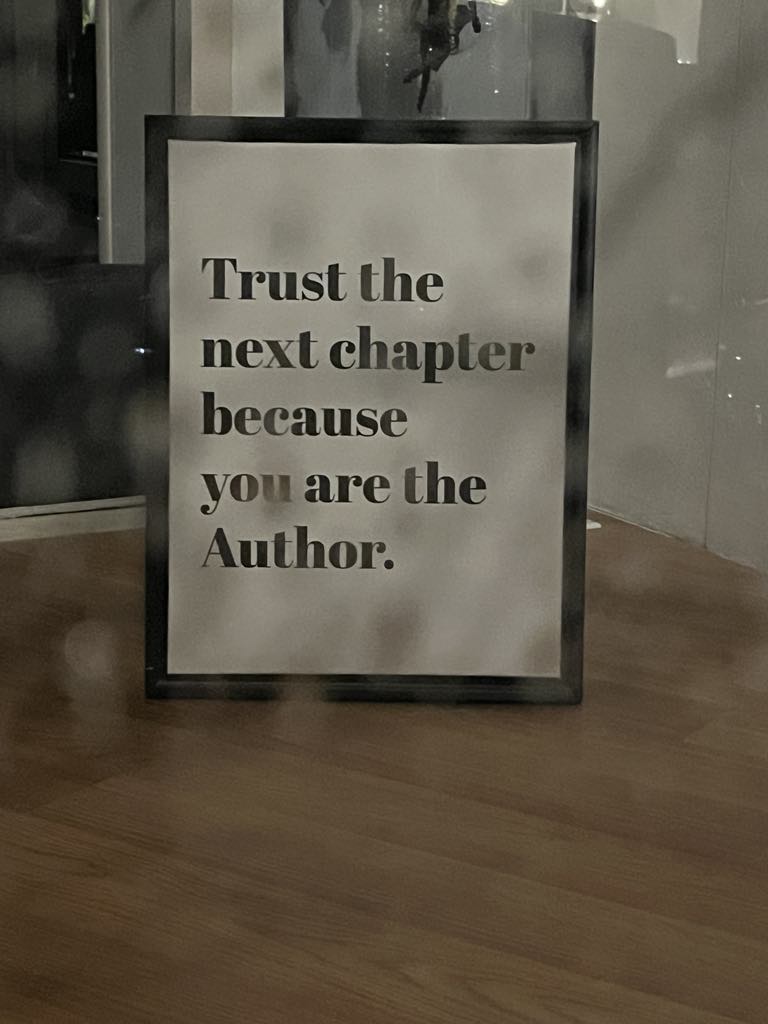
The rain poured down as we shut the lights and closed the door on our session, but a picture my friend sent, seen in a storefront less than a block from where we parted, set a bright tone for the future.

Obviously I see the kismit in this, obsessed as I am with all things writing, but what a potent message for all women and mothers moving forward.

The fact that a dear friend spied this and shared it with me, steps away from sharing such heady things, synthesized everything about female connection and support that I am trying to accomplish.

We all can determine the next step, the next chapter in our lives. We need only take the initiative.

Join us for the next Salon of Self to construct our ideal of not only motherhood, but our personal existence. Be a part of the discussion – if for no one else than your SELF.

Standard
mother vs self, Write to Heal

Sharp Contrast of COVID

In March 2020, the Atlantic proclaimed COVID-19 a ‘disaster for feminism’.

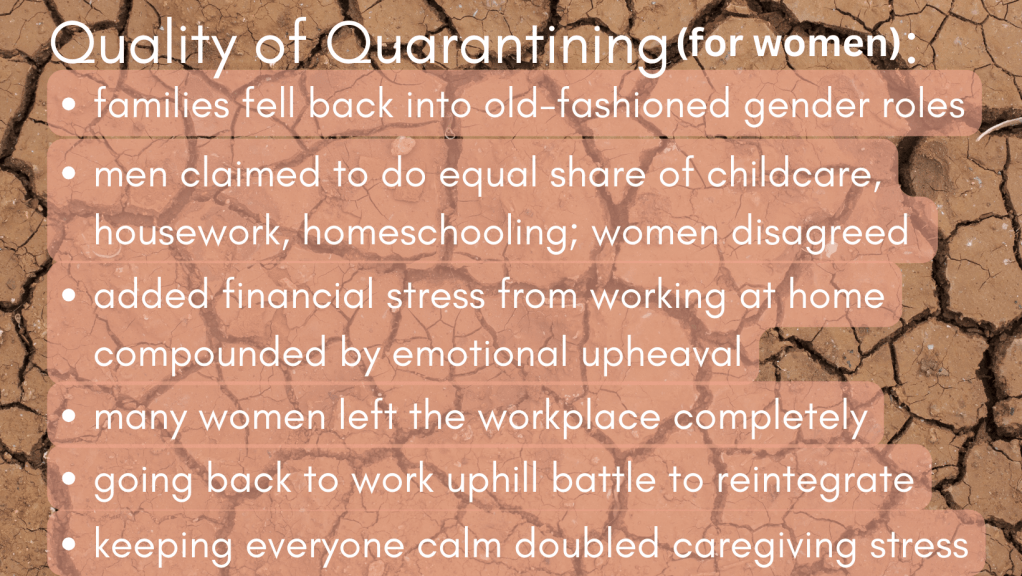
Most of the added labor created by dining rooms turned into classrooms and kitchens into childcare centers fell to women – not because they were the sole caregiver, but due to . . . outdated gender norms? And the added stress of overseeing remote learning brought into stark relief not only the difficulty of teaching, but our nation’s exploitation of school systems as childcare. It emphasized the lack of actual options mothers had. Pandemic conditions also exacerbated the fact that women especially don’t have jobs that support or flex with parenthood.

9 out of 10 working mothers said their mental health had been negatively affected by school closures

2021 TUC survey

A sobering realization, becoming increasingly clear to me, is that . . .

Bridging the gap, between where our support systems are currently and where we women need them to be, will only ever occur when women, likely mothers, force the movement themselves.

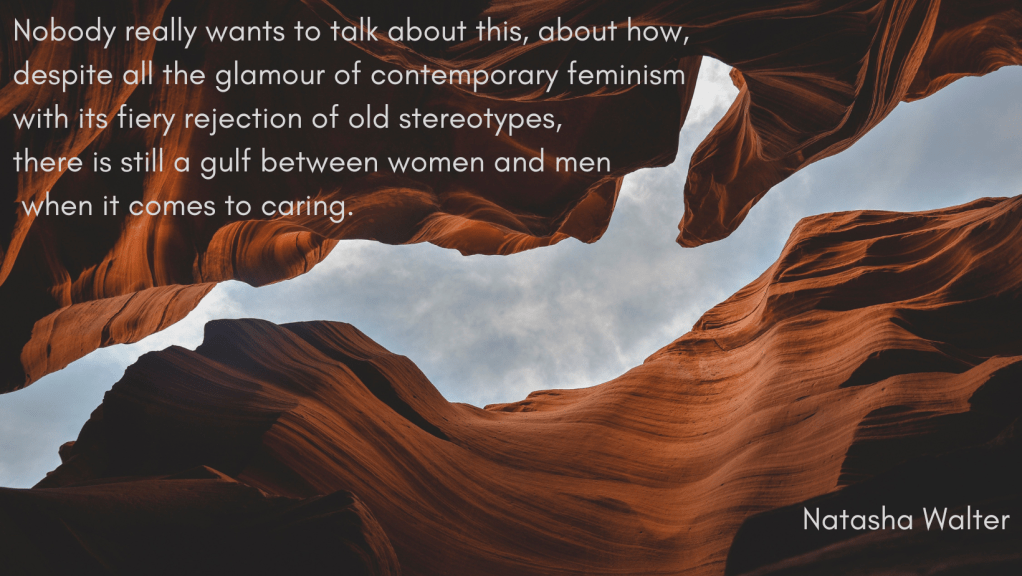
You don’t get any fame or followers these days for banging on about the second shift or the feminine mystique, so who wants to be associated with that kind of feminism today?

Natasha Walker

And why not? It obviously still needs to be talked about. My college freshman’s philosophy final had an essay prompt discussing Simone de Beauvoir and it startled me to see how misguided her interpretation may have been! (I didn’t push the issue because I wasn’t going to reteach an entire semester’s worth in the swiftly closing window she had to complete her essay)

Many young women I have spoken to seem to consider ‘feminism’ as a dirty word. Because they feel its usefulness has been worn out? Because they don’t agree with all tenets of every sub-movement? Because they don’t hate men?

The belief that women deserve equal opportunities and specialized options tailored to their current situations and leveled up as conditions equalize – is not a dirty idea, movement, or revolution at all.

COVID exacerbated a lot of what was already there. Now we all need to recover.


COVID Confidential

What was your COVID experience like?

  • Were you working? Did your employment situation remain the same or change? How?
  • What was home life like?
  • Were your children involved in an educational program? What did that entail for you?
  • What fears did you have?
  • Were there any positives about lockdown/pandemic? For you? For work? Family?
  • What did COVID shine a spotlight on that did NOT work about your life – either something that changed for the better or something that got so bad it really stood out?
  • Did your experience highlight any systems that were failed or broken in your life?
  • Is it possible to brainstorm ideas for how those might be improved if they still affect you?
Standard
may is maternal mental health month, News

May is Maternal Mental Health Month

My first contribution to Rhode Island Moms is live. Check it out!

In a month dedicated to moms, it’s also important to focus on maternal mental health – the most important gift we can give to ourselves.
— Read on rhodeislandmoms.com/health-and-wellness/may-is-maternal-mental-health-month/

Standard
mother vs self, Write to Heal

No Money, Mo Problems

“Comparatively few people realise the long hours of monotonous unrelieved domestic drudgery needed to keep her home and surroundings clean and wholesome, to buy and prepare food, and to attend to the manifold wants of her husband and children in sickness and health.  Fewer still appreciate fully the effects on a woman’s health and mental outlook of the incessant struggle needed to stretch an inadequate income to its utmost limits, and of her restricted environment and the scanty opportunities for recreation or social intercourse during the small amount of leisure she is able to snatch from her daily toil.”

Dame Janet Campbell gave this description of the mother’s experience in 1933 in the Working Class Wives Health Survey in England (cited in Under the Radar). While this isn’t the exact situation of every mother in present-day America, there are alarming similarities

In the 1990s stateside, Leslie Lehr says,

“Since I worked at home, I also wrote for the PTA newsletter, volunteered in the girls’ classrooms, and chauffeured them across the city for playdates and ice-skating, softball and violin. This was all good and fun and worthwhile. I wanted my girls to enjoy everything I had missed when my own mother was working. Yet everything my mother complained about during the second wave of feminism was true. We needed childcare and parental leave to share the burden. I showed Drew financial charts of what my caregiving time would be worth in dollars, but it didn’t make any difference. Without money, I had no power. And none of his respect.”

Not all of us have partners as exacting as the first excerpt or as dismissive as the second, but certain parallels remain.

Even in 1933, women who had been bookkeepers and typists with solvent salaries before marriage and motherhood, whose husbands were suddenly jobless due to the unemployment crisis, faced not only “desperate poverty” but pressures to “make do, tend, and provide” for their family regardless that “their ‘mental and physical well-being’ was being ‘sacrificed.'”

For the last few years of my stay-at-home status, I’ve taken to referring to myself as a financial wizard. Fortunately, I have not been doing so amidst ‘desperate poverty’, but I have become super-creative at stretching a finite amount of money to cover as many infinite financial family needs as possible.

Women don’t get enough credit for the wizardry they perform – both in money-saving gymnastics and in the completion of costly services.

Disparity and dependency are the key words when it comes to finances and woman/motherhood.

And whether it’s the systems society has upheld for us (from capitalistic values of productivity to wage discrimination to gender expectations) or the overflow in our homes (rigid relationship roles or unintentional assignment of/ignorance of duties), women and mothers are significantly impacted by finances. (Beyond the obvious fact that kids are really expensive!)


Money Talks: What does it say to you?

In your notebook, reflect on the following prompts about financial concerns:

  • When you hear the word, money, what thoughts and feelings come to the front?
  • Is it the same with finances or financial?
  • How would you describe your financial status?
  • Does money help you do anything? Does money keep you from doing anything?
  • Does money influence how you mother? If so, how?
  • Have you ever felt you had to be a financial wizard? When? How?
  • Freewrite to explore the connection between money and productivity in your life. You might start by looking at each one individually. Then explore the interplay between the two.
  • Revisit your description of your financial status. Based on your work on the previous prompt, would you change the description now?

Use the calculator in the related resources below to see how much your invisible labor is worth (besides the obvious value of priceless).

Standard
News

Three for Three

First there were Blog updates . . .

Then came next week’s workshop . . .

Now for the trifecta of new developments!

I am excited to announce that I have joined the team at Rhode Island Moms as a contributing writer.

Part of Wicked Good Mom Media, Rhode Island Moms is a blog, news source, calendar, and social support all in one for local moms.

As I stated in my submission to them, being a mother to four children doesn’t make me an expert by any estimation, but it does give me a wealth of varied experiences from which to draw. And I am so excited to draw on my experiences here on this blog to inform what I share with moms there.

This new opportunity won’t change what you see here on Chopping Potatoes.

It gives me a chance to share a slightly different spin with a different audience.

Rhode Island Moms gives you the how-to of mothering; Chopping Potatoes, the what-for.

There simply aren’t enough forums for motherhood and all its complexities.

I am thrilled to be adding my voice to one more.

Standard
News

Have you been to the salon lately?

Last week I shared with you the improved updates to the Chopping Potatoes site and the streamlined subscription process.

Today I have an exciting announcement!

The in-person workshop is back! And we’re taking it to the salon.

Sad to say, I will not be offering mani/pedis – believe me you probably wouldn’t want what I would have to offer.

Before the modern meaning of the word, salons were gatherings of thought, conversation, inventive ideas. And while we are no longer in the Enlightenment, who has more inventive ideas than mothers?

Except what needs attention and creativity more than anything is how to keep our selves from slipping below the surface.

This is why we gather.

To (re)discover what makes our heart sing. To fight our way through the tough parts. To commune with others making the same slog.

Please join me for a combination of reflection, writing, and discussion – all directed toward supporting your SELF.

or scan the code above to register!

Standard