Identity, Perspective

Old School Soul Hole

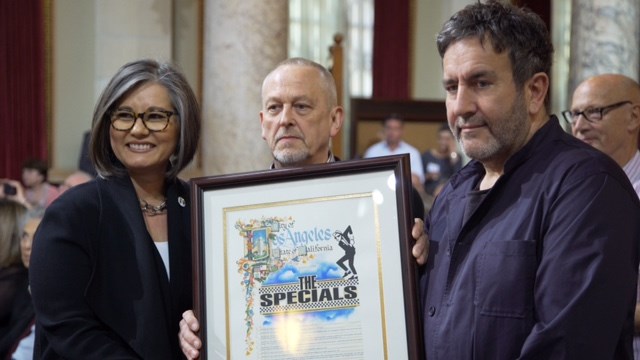
Last week I learned via a post from Reggae Steady Ska that May 29, 2019 was dubbed (see what I did there?) The Specials Day in Los Angeles, California.  Now I was a little confused as to why LA would honor a band who hails from the UK, but then again, I am a white woman in RI who listens to reggae, rock steady, and ska.  The idea that The Specials themselves and the themes of their music exemplify and encourage diversity is what drew a Los Angeles councilwoman to hold them up for the city to see.  It drew me to my CD rack (yes, I still own those) and The Specials album I hadn’t listened to in far too long.

As the bright beats of trumpet danced above the driving guitar, the music swelling from the speakers and spilling into the corners of this room and the next, I realized the deep hole that is left inside me when music doesn’t play.

I have four children.  My house, my life, my mind is very loud.  The last few years I’ve taken to not turning the radio on at all in the car because, there is enough noise in there already.  The power button on the radio is one level of sound on which I can hit the kill switch.  About a year or so ago, on a return drive from ‘the city’, about an hour away from home, I got through more than two thirds of the trip before I realized I hadn’t even turned the radio on then, when I was by myself.  The cacophony in my head was complete if I couldn’t even partake of music when I could listen uninterruptedly to what I chose.

And that’s so sad.

Most of my memory has an overlay of obsession with music.  So many genres and artists.  So many generations and styles.  I’ve imagined the soundtrack of certain parts of my life and relive other parts of my life through song.

wbru3

In August 2017, 95.5 WBRU, the local modern rock radio station I had cut my anti-establishment musical teeth on, closed up shop.  (Well, they were sold to a Christian rock outfit.)  I still had the CDs, I still had internet access, I still had the memories – if I dare be so dramatic – but I mourned the loss of that running record of new and individualistic music as if someone close to me had died.  Still, nearly two years later, I wax nostalgic if I happen to catch the low-power signal they sometimes broadcast on.  I still post from time to time about how much I miss the station when I find a song they used to play on YouTube.  I was getting to the point where even I was wondering what was wrong with me.  Why was I so attached to a freaking radio station?

The obvious answer is because its going off the air was a death of part of my youth.  BRU’s Retro Lunch was the soundtrack to the lunch we all had at my house before Junior Prom.  Their Screamer of the Week was something I talked about with the guy I’d just started dating.  Their Friday Night Countdown was what I recorded onto a cassette and mailed him when he went away to Boot Camp and we were still dating.  So many pivotal moments of my coming of age were backed up by the beats of WBRU.

And research shows that songs elicit the same emotions we experienced when we first heard or listened to them most frequently.  If I loved that part of my life and its soundtrack was now going away, it was almost as if that part of my life was dying.  A leap, yes.  And yes, I can cue up any of those songs on a streaming service or ‘go down the YouTube rabbit hole’ as I say my husband does of an evening every so often (He likes to relive the days I made him all those mixed tapes – yes, we married), but the spontaneity of what would appear next, the destiny of your song coming on at just the right moment, the discovery of something new you’ve never heard before, or hearing it at the moment of its release – that magic of the broadcasting universe is gone.

That radio station represented my teenage self thumbing my nose at the world.  It signified my independence, culling my own style, my own voice, my own philosophy.  I started listening to it when I was first heading out into the world.  Its closing reminds me that I’ve been out here some time now.  Not hearing it makes me suddenly wake up from the melodious trance and notice all the things I wanted to do, but haven’t yet.  I don’t know really any much more than I did then; I am really no happier than I was then.  The teenage angst has been switched out for that of the existential sort.  Only now I can’t blare the radio and rage.

I think the closing of BRU was also the death knell of something bigger in my life.  The joy of music I once had.  The carefree release of a rollicking rhythm.  Now I think too much about heavier things.  I have too much to do.  I don’t have time to pop in the CD or turn on the radio before I rush on to the next thing.  I really feel adrift when the only two stations that play anything remotely my style of music either are out of range or on commercial.  There’s probably a part of me that figures it’s so different, so lesser, then why bother trying to find the music at all.

It’s no secret that I hate change.  I dig my heels in and get drug along unwillingly more often than not.  I’m trying to open my heart to grace, allowing the full potential of situations, my life unfold.  I know reopening my heart and soul to music would only make the journey that much richer.  It’s just sad when you’d found your canon and reveled in it – and now it’s gone.  But I can always use signs from the universe – like FB posts read in RI of UK bands being honored in LA – to signal it’s time to break out those old albums.  And there’s always Pandora.  But if it’s not painfully apparent already – I’ll always be hopelessly old school.
61516000_2405850079435915_649161650837913600_n

LA Councilwoman Monica Rodriguez with Horace Panter and Terry Hall of The Specials

Standard
Weekend Write-Off, Writing

“Where My Books Go”

W.B. Yeats speaks to the greatest wish of all writers – and eloquently so.

All the words I gather,

And all the words that I write,

Must spread out their wings untiring,

And never rest in their flight,

Till they come where your sad, sad heart is,

And sing to you in the night,

Beyond where the waters are moving,

Storm darkened or starry bright

W.B. Yeats
London, January 1892

Standard
Weekend Write-Off, Writing

Behind the Mist

“What’s depression?” I asked my father.

“It’s all about the power of the mind,” he said.  “The only thing that will make it go away is your own determination.”  He ran his hand over the window ledge and frowned at the smudge on his fingers.

When Rosa was happy our house was filled with music.  I could never imagine the silences returning.  The light in her studio burned through the night.  One summer she painted Corry Head.  The gorse blazed like a fireball.  Purple heather covered the rocks.  She painted it with the mist falling down and hiding all of the color.  I wondered if that was what her life was like.  Always trying to escape from behind the mist.

–from “To Dream of White Horses” by June Considine


There is so much about his passage that speaks to me.  The father’s misinterpretation of how it is to live with depression.  The son’s seeming lack of information, yet more complete understanding.  The descriptive pall the illness brings – both literally in the dust that builds up and metaphorically in the mist that envelops the person suffering.

Standard
anxiety, Living, motherhood, Survival

Much Ado About Nothing

I’ve had one full-fledged panic attack.  With all the anxiety over all these years, one full-fledged horrible panic attack.  That’s pretty amazing and pretty lucky.  The lid-about-to-boil-over effect is one of my body’s favorite go-tos.  Lately, it’s switched over to heart palpitations when my mind starts racing.  The other night as I lay in bed thinking of all I wanted to accomplish, my heart ticked up.

See, I was faced with two whole days by myself.

Well, sort of.  The kids, on school vacation, were leaving partway through Wednesday and returning partway through Friday for a sleepover at their grandparents’.  My husband was working, but we’d have the evenings together.

But as I lay in bed the night before this whole evolution started, I felt incredibly disjointed.  I’d be waking with the kids the next day and making sure they had all the underwear and rain jackets and stuffed animals they’d need for Grammie’s.  Starting the day as mom, and then transitioning to . . . what?  A quasi-homemaker washing the laundry of my own that I haven’t had a chance to wash, but would like to wear since I’ll be my own person for a day or so?  Run the errands I didn’t get to yesterday because I can do them in half the time kid-free.  Or switch straight to sloth because I can sit on the couch and watch a movie uninterrupted in the middle of the day?  The pull of doing all the things – and needing to do some of the things – versus the things I wanted to do for my soul’s survival were ramping me up.  Or, more accurately, the fact that I was going to run out of time before I ran out of things to do – and my people came home.

When my baby – at the time – started kindergarten, I found myself floundering as I tried to fit indulgent baths and writing time and house projects in the six hours of each school day.  I actually restarted therapy because I was so lost.  After years of never being alone, I thought I couldn’t wait until I finally was.  And I was right.  But, as any mom of a certain number of years will tell you, whether you mean to or not, so much of yourself becomes the mom-self that when there suddenly is a void – be it from kindergarten or college – you unexpectedly find yourself flailing.  So the switch of me-time flipped from famine to feast – and it still wasn’t enough.  I found myself dreading the return-time of the bus – because I hadn’t done enough, been alone long enough.  And I hadn’t even decided what I was going to do for work now that all my kiddos were in school.  My therapist told me I wasn’t ready to go to work; that I needed to unwind a bit more before I contemplated what was next.

And then I got pregnant.  [Insert bitter ironic laugh here]

Next month that baby will be three.  We’re contemplating sending her to preschool next year so I find myself facing the same quandries of what to do with my ‘free’ time as I did three and a half years ago.  But I’m starting a little early this time.  My eldest is old enough and owns a phone now so for a few hours a week I put her in charge of her sisters and sneak away to write, think.  I can already feel that I have much work to do on myself to prep for the actual work.  Plus, even on those days it’s me and the baby while the others are at school, I still dread the return of the bus.

These two days are a microcosm of that feeling; what elicited that heart-pounding panic in the dim of my room the other night.  I’m not back to square one.  I’m working on such a backlog, such a deficit of self-care in the simplest sense of the word – like silence to think – that the return of my people, the resumption of the needs, demands, to-dos, freaks me the %*$# out.  Not because I don’t love them.  Not because I hate my life.  Not because I could/should keep them away so I can do all my things.  It’s unrealistic for me to think I could possibly catch up on all I’ve been wanting to do in one day to myself.  But I think my ‘fight or flight’ is afraid I’ll never get any time to myself again.

So I lie in bed and run through every possible permutation of what I could do with my time, petrified that I won’t get it right and regret squandering my precious time to myself.

Obsessive, anxiety-inducing behavior.  Not totally rational, though rationalizing every move, of course.

But this day and a half have produced some wins.

I got a haircut.  I hand-washed those long-since buried bits of clothing.  I scheduled two posts.  I drank a latte and ate a muffin bigger than my head.  I drank wine with my husband, enjoyed a new recipe with him without the kids turning their noses up, and watched a movie without turning the volume down.  I reveled in lyrical literature.  And stared into space a bit while my mind wandered.

There’s always the panic – or possibility of.  There’s always something that could be done.  There’s always doubt.  But there are the good things, too.  Here’s to looking in the middle distance enough – neither too closely nor unseeingly – to recognize them.

Standard
Weekend Write-Off, Writing

A Patch of Peat

Beside me a patch of peat was touched with green as though it had gone mouldy, and up from it went a little forest of buds, each on its slender stalk, for spring had come to the moss as well as the curlews.

– from “The End of the Rainbow” by Lord Dunsany

from phys.org

This line jumped out at me because it perfectly describes the little sprigs emanating from the carpets of moss at the edges of the forest right now.  Beauty in nature and word – captured.

Standard
Living, motherhood

On the Treadmill

No, this is not an account of my latest exercise endeavors.  The only personal story I have about treadmills is my daughter’s run-in with one that ended in road-rash (see what I did there?).  That still makes me giggle.  Don’t judge.  It was her own fault.  I’m pretty much in love with OK Go’s endeavors on treadmills, too.

But me, no.

Which is ironic because I’m on one every damn minute of every damn day – the metaphoric treadmill of motherhood.

Maybe it’s unfair to blame all of my mania on motherhood.  There probably is some part of my personality that would still schedule me to my utmost limit – but it’s hard to imagine what life would be like if I ‘only’ had to work without the constraints and constancy of mothering.  And even pre-kid working me would binge watch Trading Spaces in a blob on the couch after a particularly hectic day of work.

Now, when I get the chance to step off the treadmill, I’m like that blob – but without the decision-making capabilities of any grey matter.  Perhaps it’s more accurate to say that the grey matter used for ‘personal’ decision-making is so underused it has atrophied.

When we get off the treadmill so infrequently, our bodies and minds know not what to do without the cycle and incessant motion.  Being at rest is so foreign, that part of ourselves we’ve shoved down for so long is like a salamander with a light shone on it.

That part that cultivates hobbies, interests, passions; rest, rejuvenation, relaxation.  That little corner inside ourselves closest to our souls.  The part that should be getting more play, not the least amount possible.  Not so little that when it can come out to play, we don’t know what to do with ourselves.

By some stroke of luck and generosity, I find myself alone and stuffing my face with donuts.  I’m also sipping on a caramel-sea salt-molasses-coffee concoction.  The caffeine and sugar combination is already thumping in my veins and lining my blood sugar up on the cliff.  BUT what else does one do when you can stuff your face with forbidden foods without little people’s pleading eyes killing your buzz?  Yoga without a little person sitting on your head or smashing into your pelvis while you try to relax into savasana?  A warm bath with the aromatic soaks your friend handcrafted!?  Scrap some of the eight-thousand photos that would bring you into the last decade?  Write that folktale you’ve been ruminating on?  Or the several posts you’ve been marinating?  Or actually get down ideas for the next big jump in your life?

Or you could stand in the middle of your living room floor, holding onto your phone with your atrophied little T-Rex arms and scroll Facebook on your browser – not the app because you took it off your phone for Lent so you wouldn’t go on FB so much – and not sitting down because that would mean it’s not just a temporary distraction to which you’re not totally committed.  You could stand there and fill the void with more vacuous activity instead of plucking one valuable thing out of the myriad you haven’t had a chance for in so long.  You can give in to the confounding paralysis that comes from wishing desperately for more time and then desperately wanting to do all that you’ve missed out on once you get a bit – that you do nothing.  You could also invite your anxiety in so that even watching Trading Spaces or whatever binge-worthy show has replaced it is ruined because you can’t let go of the things you’re not doing.

The answer, I suppose, is to get more free time; take more free time.  Part of that is impossible because – treadmill.  Part of that is more difficult because of my ‘prepping for a sub is more work than a day of teaching’ theory.  And a huge – perhaps the most insurmountable – part of it is breaking ourselves of the mental and emotional habits that have led to this.  Yes, we can be angry at the treadmill, curse the unseen figures that keep turning it on and programming it to higher, faster levels, but we need to learn how to unplug it, unplug ourselves.  So that even when we get some time, we don’t spend the whole time trying to unwind.

Now I face the insurmountable task of unwinding with a gob of caffeine floating throughout my system.  I’ll let you know how savasana goes.  Or maybe I’ll have an energized bout of writing.  I don’t know, I haven’t decided yet.

Standard
Weekend Write-Off, Writing

The Nest

“We’ve come because of the baby,” she said.  “We’ve come to help.”

That’s all I had to read on the book jacket to be hooked.  There’s a problem, a possible trauma, surrounding the birth and/or care of a baby?  I’m in.  Not because I revel in such things, but because I look for solutions, for ways other people dealt with such things, for ways to support others in similar situations.

But The Nest by Kenneth Oppel (illustrated by Jon Klassen) is so much more.  It is rated for ages ten and up, but I found it compelling and psychically scary as an adult.

There is a baby, the main character Steve’s new brother, and he has an unnamed degenerative disease.  There is confusion on Steve’s and his sister, Nicole’s, parts.  There is the overarching sadness that permeates the entire family’s lives.

There is also a recurring vision that Steve has.  A group of luminous wasps that visits him in his dreams and offer to first help, and then ‘fix’, the baby.  This is where the psychological component of the story comes in.  When dealing with trauma and situations far above our intellectual or emotional understanding or ability, it makes sense for the brain to conjure up solutions.  However, Oppel blurs the line between Steve’s inner world and outer reality.

Steve struggles with an unnamed mental illness, one in which he makes bedtime lists and washes his hands so much that they “got all chapped and red, especially around the knuckles”; that makes him feel as if he is “all in pieces . . . like [he] had a hundred shattered thoughts in [his] head, a hundred glimmering bits of stained-glass window, and [his] eyes just kept dancing from one piece to the next without understanding what they meant or where they were supposed to go.”

In his dreams, the wasps – the queen in particular – talk to him about the baby’s condition, about how sad a situation it is and what might be done to remedy it.  Steve senses his parents’ sadness, feels his own.  He feels helpless, both in not knowing exactly what is wrong with his brother and not being able to do anything to improve it.  The queen gives him a solution.


“It’s just not something you can patch up with a bit of string and sticky tape.  No, no, no, we have to do this properly.  Go right back to the beginning of things.  Go deep.  That’s the proper way to do things.  No half measures around here!”

“You mean going right inside the DNA?”

“DNA – aren’t you the clever one!  Yes, good, you’re on the right track.  And we’ll go deeper back still.  That’s where it will make the most amazing difference.”


Steve’s relief at the queen’s assurances of making his baby brother better does not last as she reveals more of her plan, however.  It was never about ‘fixing’ this baby; it was about replacing him with a superior one.  In this special nest just outside the nursery window, they are incubating a baby from the larva state – to replace the ‘broken’ one inside.

Ironically, Steve is petrified of wasps and soon discovers he is allergic to them when one stings him on their back deck.  The fact that he looks to the very thing that terrifies him to solve a problem that terrifies him even more speaks to the psychic line Oppel dances along through the entire book.  Another exterior fear, the man who travels the neighborhood in a van offering to sharpen knives, delves into his interior world as well.

All of this swirls around Steve’s compelling need and desire to keep his brother safe.  It is not about perfection – for either of them – but protecting our true selves.  Whether mentally ill or physically disabled, the dignity of an individual human life is paramount.  And Steve dives into his worst fears to safeguard his brother’s.

the-nest-9781481432337_lg


Standard
Living, Mental Health, Mental Illness, Survival

Incremental Illness

It’s easy to ignore when it creeps up on you,
increasing slowly, by small degrees

Or not even ignore –
just not even notice

the paranoia that maybe you’re not cool enough to hang
the resentment for the life you do not have
the loneliness
the inability to relax
the overwhelm over everyday things:
shopping, showering, getting out the door

Just not feeling
talking, going, doing –
                              it

Until one day it’s suddenly all you can see,
all you can feel

And you have to deal with it all at once

Standard
Identity, Living

Marie Kondo Mind%#@&

It is a hell of a lot easier to make fun of Marie Kondo’s clients when you haven’t tried the KonMari method yourself.

On our New Year’s Netflix binge, my husband and I, along with millions of others across the country, watched Marie Kondo’s Tidying Up.  Yes, there seemed to be a disconnect between the first couple at which the disorganization only hinted.  Yes, I cringed at the way the toddler’s face was seemingly smashed against the mother’s ‘boobies.’  [Not in an anti-public-breastfeeding sort of way, but in an anti-awkward-hold sort of way?]  But those are all criticisms in the category of House Hunters nit-picking.  What got me was the way the second woman still kept what seemed to be an insane amount of clothing she’d bought to ‘hit [her husband] where it hurt.’  The way the mom hoping to have a third child said she was ready to ‘tidy’ but refused to get rid of anything – and then miraculously turned the tide with no clue as to how.  There was and is obviously more of the psychological to tidying than the physical.

I already knew this.  The milkcrates of ephemera in my basement already told that tale.  Knowing and embodying this psychological and emotional truth are two entirely different things, however.

Let it be known that I embarked on our once-nightly KonMari marathon in the midst of helping my mother clean out my grandmother’s house.  My grandmother, thank God, is still with us, but recently required a move to a nursing home.  Knowing that she sat in a facility across town while we rifled through her belongings didn’t necessarily help, though.  There was a weird element of mourning someone you had not yet lost – or at least the existence that you had together, the way of life she’d known.  It also made me mourn my grandfather’s death, which happened when I was five.  I mourned it then, as a five-year-old can in her limited understanding, carrying that childhood sorrow and sense of loss into adulthood, but unearthing his buried belongings brought a fresh wave of poignancy I hadn’t expected.  Then I would come home, with a bag of someone else’s belongings I thought I needed to remember her (and him) by, and watch a show about purging the things of which I already had too many.

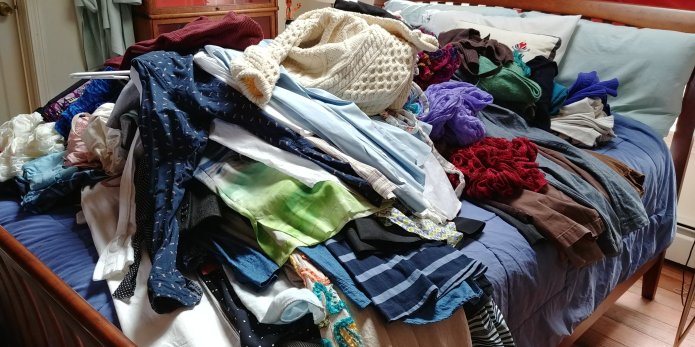
Two whole days went by with me fully intending to make that massive pile of clothing on my bed and start with Kondo’s first step.  I’d look at the clock and wonder whether I’d have enough time to tackle it before bedtime.  I’d gauge whether I had enough energy.  I discussed with my husband the difference between a piece ‘sparking joy’ and practicality.  But in a practical sense, those pieces that spark joy are really the items you actually wear and the others are just taking up space or waiting for the day you run out of clean laundry.

I finally decided this last Saturday to do it.  I went into the basement and grabbed an arm full of plastic dry-cleaning bags encasing one prom and a few bridesmaid’s dresses.  I hauled up my bin of summer clothes, all neatly rolled and stored for the season.  I emptied my drawers and closet.  I patted myself on the back for taking this drastic step, then looking at the huge pile, realized how many more steps I now had to take.

20190112_112931_hdr3950138222842656316.jpg

So much excess in a world of want (Jennifer Butler Basile)

I probably should’ve started by holding one piece I was absolutely positive gave me joy to get that sense of what I was seeking.  Instead, I pulled out the several pieces I’d already had in my head as goners and chucked them into a pile on the floor.  This felt good initially, then left me with no idea of where to go next.  I picked up a sweater I remembered buying on our honeymoon at an Esprit store in San Fran.  Those of you children of the eighties who grew up in New England know what a big deal it was to buy something from an actual Esprit store.  I stared at it, waiting for some sort of answer, then put it down.  The memory of it sparked joy for sure, but did the sweater?  I tried on a bunch of clothes to check for fit and style, but I suppose the fact that I didn’t quite remember the fit meant I didn’t wear those pieces frequently enough to keep them.  One pair of pants in particular kicked my practicality into high gear.  I only wore them when none of my favorite jeans were in the closet, but they fit, were in good condition, and served as a good back-up.  Now, when I wear these, I curse the fact that they aren’t my better jeans, I am annoyed by the waistband and back pockets and poor stitching on some of the seams, but they are a nice neutral color and the length and boot cut of them work.  They are perfectly good pants – why would I throw them out?

Because, apparently, I have an unnatural attachment to things.  My anxiety makes me second guess my decisions.  My desperate grasp for control makes me think if I let something go, I will need it someday and won’t have it.  My tight budget won’t necessarily allow for replacement of missing items.

As I stood staring at the embarrassingly large pile of clothes, so big that I was ashamed to post it on social media that day despite the trending Marie Kondo hashtags, I was paralyzed by so much angst.  Saying thank-you couldn’t absolve me from the guilt and remorse I had in letting these things go.   Not because I was madly in love with pieces, not because I felt compelled to do a penitential cleanse.  Because it was forcing me to make decisions I’d avoided due to lack of brain bandwidth.  Because it meant facing the fact that I no longer needed the beautiful professional wardrobe I’d picked out with such pride when I’d started teaching.  Because it meant accepting that I can no longer wear skirts cut on the bias due to the way childbirth has forever altered my hips and backside.  Because it meant finally owning that any day is special enough to wear my favorite items and look good.  Because it meant not letting laundry reach an untenable level so that I actually have key pieces to wear.

Sorting clothes Marie Kondo style messed with my head because it forced me to face truths about my life, my body, and me: the ways each of them have changed, the ways they need to change.  Perhaps these realizations hit me even harder since I wasn’t expecting pieces of clothing to elicit them.

While I’ve collected these realizations, I’ve yet to process them; they’re my metaphorical basket of clean laundry in the corner yet to be folded and put away.  It took me two days to bag my discards for donation.  I still held certain things up to the light, like my Esprit sweater in the beginning, wondering whether I should part with an item so nice but so infrequently worn.

I’ve obviously learned that physical items carry psychic weight and hope that once the bags are no longer in my peripheral vision, I’ll no longer doubt my culling decisions.  I can already appreciate the way my hangers run freely on their rail; the way I can easily see and access my scarves.  I’m putting much more thought into what I wear, finding new ways to combine pieces I decided to keep.  The prospect of thoughtfully adding new pieces tailored specifically to my style as budget, necessity, and time allow is kind of exciting.  I can’t say the process has brought a whole lot of joy upon my house, as one of the children on the show proclaimed, but then I never was good at dealing with change or letting go.  And clothing is only step one, after all . . .

Standard
Identity, Living, Perspective

Granting Ourselves Permission

In college, a friend and I went out for a night of shopping.  When she was ambivalent about buying a certain item, or deciding between two, I encouraged her to buy it, or both.  Why not?  It looks great, it’s so fun, you like it, go for it.  It was so easy to pull out these positive affirmations.  There was no doubt she deserved a gift to herself.  The approval rolled off my tongue like water.  Plus, it wasn’t my money to spend 😉

This isn’t a case for fiscal irresponsibility, but a small example of how easily we give others permission, yet don’t permit ourselves the same freedom.

I grew up on the back cusp of Generation X, not quite part of it, but as of then, Millenials didn’t exist and there was no Generation Z yet leading to a brief mention of the Ys squeezed in the middle.  In any event, my hands were in technology, my heart firmly rooted in the old school.  I gauged success as being chosen for a job by a superior, validated by an organization, an agency.  By membership, the man, bureaucracy.  Not because I particularly liked it, but because it felt more official, came with a certain amount of cache.  I was used to looking at existing structures and following the chain of command.  I still hold the deep desire to be granted authenticity by a major publishing house.

Then there came under me whole generations of people, who some may say eschew all tradition and decorum to a fault, but who aren’t afraid of creating their own structures.  People who crowd source and crowd fund.  Who wake up one morning with an idea, a dream, and chase it.

In that weird shiftless space between Christmas and New Year’s, my husband and I got our adult time (as surrounded by children) by taking to the couch and Netflix documentaries.  If you watch enough food, travel, and minimalist episodes, their algorithms eventually bring you around to Expedition Happiness, a sparse, reflective film documenting the trek of two young Germans across North America.  Mogli’s music sets an ethereal tone for the film and their attitude does the rest.  They bought an out-of-commission American school bus online, secured a work Visa to retrofit it as a camper, then headed through Canada to Alaska, south along the west coast to Mexico.  Other than an outline of a route, they had no plans.  I still don’t know what they did for money.  I’m having a panic attack just thinking of it all.

And yet, I want that ability, even in small ways in my life, to allow myself such adventures.

Following up on the couple after the documentary, I saw a video wherein Mogli appealed to her fans who wanted her to perform stateside.  She explained that, in typical music industry fashion, she and her band would have to finance a trip to the States first to host a showcase to garner agent interest.  Then, if an agent were interested, he or she would arrange a tour.  A lot of capital up front for something that might never pan out.  But in the next breath, she vehemently exclaimed she wasn’t going to let such a process stop her from connecting with her fans.  She launched a plan to presell a set amount of tickets, which would guarantee her presence in that city.  She circumvented a system that didn’t serve her, cutting the head off an unyielding monster and went straight to the source – her fans.

Personality, not only generational hutzpah, also plays a huge part in such an outlook.  I am much too rooted in my sense of place, home to make a cross-continental trek indefinitely.  I am much too anxious to not plan obsessively.  However, I am also horrible at giving myself permission to follow my inner movings.

It is much too easy to say, oh I can’t do that.

permission-slip1

Kathy McAfee

Who is telling me I can’t?  Is it fear?  Is it adhering too closely to existing, yet increasingly changing, constructs?  Just as there is no one telling me I can’t, there is no one telling me, I can.  But no one ever will when I’m following my own movings – except me.

More people around me, my peers, my contemporaries, are branching out into nontraditional roles in the workforce by following their own desires for what they want in their lives and what they want to see in the world.  Just this week, a friend started her own business.  She got the credentials and experience she needed and went out on her own.  She didn’t look for someone to say her services were needed; she presented her skills to the world and people are seeking her out.

The ease with which I encouraged my friend to buy something special for herself, without guilt, without second-guessing; the passion with which I believe in my friends who have put themselves at the heads of their own destinies – I need to now turn these energies inward.  I must show myself the grace, compassion, and strength I offer to others.  For when I wake up in the morning burning with those dreams, it is only I who put my feet on the floor and follow them.


How do you grant yourself permission?

Standard