

Subscribe to continue reading
Become a paid subscriber to get access to the rest of this post and other exclusive content.

Become a paid subscriber to get access to the rest of this post and other exclusive content.

There are cheerios in various states of being scattered all over the floor.
Ground into the rug, skidded across the tile, tucked underneath the sofa.
No, I’m not describing my own home floors, though we do still find errant Cheerios from time to time.
The mini oat rounds I spy today are surface-decorating the service area of my local car dealership.
A little toddler, whose peals of laughter were as prolific as his breakfast cereal distribution, has covered nearly every square inch of this place. He has brought employees out of their offices, joy to the face of an elderly woman sitting solo, a smile to the gruff service advisor.
He has also brought his mother continual and constant cardio.
She laughingly accused him of throwing the Os as a distraction so he could run the other way while she stooped to collect it. She was laughing, but she wasn’t kidding. He was a cunning little cutie.
There is nothing quite so invigorating to a space and/or group of people as a small child.
Except perhaps a puppy – which we also had at one point when a neighboring businessman brought one in. I’m surprised emoji hearts and stars didn’t start exploding everywhere when the two met.
What is it about young life that inspires camaraderie and conversation?
Is it the lack of pretension? Motive?
Or are we the ones with motive?
Eager to feed off that pure joy and enthusiasm for life. In simple pleasures. Living in the present moment.
To ‘borrow’ that parent’s precious one for just one moment, one brief interaction, since we are so far removed from the sweet innocence they possess.
I’m sure the mom doesn’t feel the innocence every day. She does not soak in the wonder.
And I don’t say this as a criticism. I say this as a lived-in fact.
The relentless running after, keeping out of harm’s way, perpetual picking up after – floods our senses when caring for a young one is our reality.
And I’m not becoming one of those old grocery store ladies who say, ‘savor it, it’ll be gone before you know it’.
As I said, I’m still picking up the occasional Cheerio. But I’m picking my little one up a lot less.
I’m one of the ones who want to soak in the wonder and the up-turned eyes.
And there’s nothing wrong with that.
The service areas of our car dealerships – and our world in general – could use more of that.


As a child, I’d spent hundreds of hours playing The Game of Life. According to Hasbro, you begin life as a phallic pink or blue peg (a fitting introduction to the patriarchy).
Feel the Bern by Andrew Shaffer


Become a paid subscriber to get access to the rest of this post and other exclusive content.

The other evening, as I lay in my seven year-old’s bed waiting for sleep – hers, though my own comatose mini-nap usually comes first – an unexpected thing happened.
No, it wasn’t my questioning whether I should still be or have ever even started lying with her before bed without: a. spoiling her, b. impeding her sleep progress, c. prolonging this nighttime ritual until we’re both old and gray. That’s been a constant since she first balked at sleep as an infant.
As they usually do, an important revelation snuck out in those twilight murmurs.
“When I grow up, I don’t want to have children.”
My heart instantly hurt for so many reasons.
Sadness for her, that she wouldn’t experience the wonder that is mothering. The fierce, warming, all-enveloping love that it is to raise a little human into a big one.
Regret for me, that I somehow portrayed motherhood to my children in a poor light. That I did them a disservice by not loving it enough or not showing them enough love.
But even as I type that, I can’t believe that I don’t show my children enough love. Surely, they know they are loved. Does my fault lie in my sometimes less-than-joyful servitude?
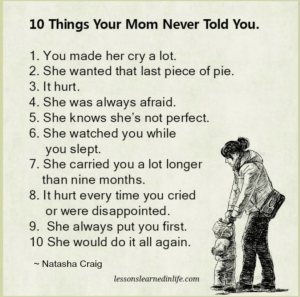
As beautiful a sentiment Mother Teresa of Calcutta shares about washing the dish because you love the person who will use it next, that doesn’t make me more likely to wash dishes or to do so without complaining. Perhaps you’ve seen the list of things your mother never told you.
While many of these ten things are true on some level, I cannot subscribe to this level of subterfuge. Sacrifice and selflessness certainly have their place in parenting, but to sacrifice to the extermination of self is something for which I cannot get on board. Perhaps that means I am not destined for sainthood, but I also believe God created each of us as a special, sacred self to be celebrated – not obliterated.
I also feel it is disingenuous to serve with a smile when anger and resentment broil below. Why can’t we be authentic with our partners and children about how hard this path is? How we serve with love, but also appreciate being appreciated and, even more, equal distribution and support.
By speaking truth about my struggles in motherhood, I hope my daughters will see the inequalities in expectation and systems of modern motherhood. I also hope they will realize the hard-earned worth of fighting for a connected, loved, valued family.
Because while I stand as a symbol of the greater mantle of motherhood for my children, I am also human.
I hope the toil I am totally transparent about will not dissuade my daughters from becoming mothers themselves, but make them realize there is no perfect ideal – except perhaps love.
I also hope that my seven year-old’s proclamation didn’t stem from Cookie World C’s unnecessarily medicalized version of a plastic horse giving birth she viewed earlier that day.
In any event, I have some work to do, but tomorrow’s another day . . .

At some point in my life between the end of high school and becoming a mother, when I had time to ponder and plan such things, I dreamed up the perfect playlists for various moods. I wanted to create mix-tapes (and then burned CDs) ready to roll on appropriate occasions. When getting amped up for an evening out, high energy dance numbers. When nursing a lonesome melancholy, low fi instrumentals and lyrics that reverberated deep in my soul. Either way, a continuous loop of pertinent music that did not necessitate the shuffling of CD cases or channels.
I remember especially wanting the low fi loop. I don’t think it was so much about maintaining that mood, but that only certain sounds were tolerable during it. If no person around me could understand how I felt, the aching melodies with which I resonated could at least reflect it. While I wallowed, I at least had a soundtrack and a companion.
As my own girls approached this age, my two oldest with wildly different tastes in music, the idea of emo came into being. Outside of the scoffing my husband and I made that it had all already been done in the name of goth, there was almost a mocking attitude toward this music and lifestyle. I got the sense that my kids and those their age who didn’t identify as emo feared turning so if they listened to the music.
The Cure fan in me was insulted. Why discount music based purely on the associated stereotype? Now, I was not defending Panic! At the Disco, but I felt it was dangerous to swear off an entire category of music and its fans simply because they were misunderstood.
And while I wore my darkness in the quiet of my teen bedroom ensconced in sound, such mocking obviously struck a chord. What about the kids who needed a musical companion to confront or survive the darkness inside?
That’s when I started wondering what came first: the Cure fan or the depressed teen? Boys (and girls) about to fall out or those who already down?
Was the music a crutch or did it egg the depresso on?
During a summer when my then three children were home on summer vacation, I discovered the book A Man Called Ove by Fredrik Backman. I loved it so much, I wrote extensively about it, but in describing its eponymous main character’s drastic means of dealing with his deep depression to a relative, she asked whether it was a good idea for someone dealing with her own depression to read such a novel. Ah, I scoffed, I’ve already been so freaking low, what else can happen? From then on, I read it with a ‘come at me’ attitude, daring the book to do its best.
Backman’s treatment of depression and the loneliness it breeds was achingly beautiful. He handled Ove’s character with such compassion and dignity – while also being starkly accurate. I appreciated the unflinching reality of the illness from which I also suffered. And yet, the realistic descriptions did bring back my own reality. Even in memory, the feelings were difficult to relive. Come at me, they did.
And so a few weeks ago, like a dolt, I plucked another questionable title for such a highly sensitive survivor as myself off the library shelf. The book jacket description of My Year of Rest and Relaxation by Ottessa Moshfegh –
“A shocking and strangely tender novel about a young woman’s efforts to duck the world by embarking on an extended hibernation with the help of one of the worst psychiatrists in the annals of literature and the battery of medicines she prescribes”
A Year of Rest and Relaxation by Ottessa Moshfegh
– piqued my mental health-abstract fiction-tragic hero-loving, meaning seeking self’s interest. Never mind that ‘ducking the world’ was high on my postpartum mother’s list. It was like Kramer’s portrait in Seinfeld.
I wondered whether reading about a woman who obviously did not deal with her ennui by healthy means was a narrative I should entertain, but I threw it into my bag of books, alongside Clark the Shark and Elephant and Piggie.
By the time I’d powered through the three other books I’d selected – in hopes of inspiring juvenile summer reading, but ended up reading in moments stolen between snack-getting, screeching, and screen time – I’d forgotten what the fourth book at the bottom of the bag was.
Oh, I thought as I pulled it out.
Reading late at night and in a bleary-eyed early morning state may not have aided my digestion of this book. The end of the summer with kids all sick of each other and me with a new school looming over all of us may not have helped my self-esteem either. I mentioned my possibly poor choice of books to my therapist. She said, at the very least, you can reflect on how things could always be worse. Which made me laugh, of course.
Moods do tend to overcome me. Even other people’s. But if I pull myself out of the moment to take stock of my mood, especially in relation to everything else – the big picture as they say – I should be all right. Even with ennui and affective moods and music. I won’t blame my depression on Robert Smith just like I won’t become a psychotropic fiend a la the young woman having a year of rest and relaxation.
Just as flies didn’t issue forth from mud in medieval times, moody music doesn’t cause depression. Do people who suffer from low moods tend to gravitate toward such music? Perhaps. Would I be as compelled to read novels about mental illness if I didn’t suffer from a form of it myself? Probably not.
Everyone needs to be conscious of the media they consume – especially those who are highly sensitive.

Can we talk about executive dysfunction?
I feel like this absence of function is everywhere!
On reels about Adult ADHD to menopause to thyroid conditions, to depression, anxiety – the list goes on.
The proliferation of social media content sharing symptoms with clickbait titles like, “Sure signs you have trauma-informed . . . insert syndrome here”, clarify some things for us, giving us those, oh that’s why I do that moments. But they also can make us (me, we’re talking about me – maybe you, too) paranoid, thinking we have every flipping struggle under the sun.
While the A-ha moments can make our lives easier, especially if we take our new questions and epiphanies to our therapist to work through them and integrate tactics into behaviors and routines, most of these posts offer no solutions – just a new title to add to our tally of neuroses.
I read an interesting article this week positing that while such posts have helped decrease the stigma surrounding mental health via awareness and exposure, mental health practitioners aren’t 100% appreciative. The phenomenon of ‘therapy-speak’, this widespread use of therapy vernacular, has assigned mental health diagnoses to non-clinical behaviors by untrained people.
“Mental health professionals urge, you should embrace nuance and avoid pathologizing normal – albeit annoying or painful – behavior.”
Allie Volpe, “The Limits of Therapy-Speak” in Vox
Enter my paranoia (and my comment about bringing such concerns to a trained therapist).
I’m not walking around diagnosing my friends or strangers on the street, but more than one of those reels has given me pause with my own concerns.
Which brings us back to Executive Dysfunction (and yes, I see the irony in my sidebar).
When a Gen Xer such as myself was raised in a people-pleasing, perfectionistic-inducing atmosphere, it may have been easy to mask symptoms of ADHD. And just like my depression didn’t fully manifest – or become a real f*$%ing problem – until my third postpartum go round, I’ve been able to function and keep all.the.plates.spinning – until now. A friend, helping to manage her own child’s ADHD and discovering her own possible similarities, found in her research that women approaching and going through menopause is the largest group of new diagnoses for the disorder.
Now, my people-pleasing, perfectionist tendencies (see above) doth protest. I’m not having a problem functioning, says the woman with unfinished tasks all over the house. I don’t have a problem managing, says the woman who is running late to every single event she attends.
And those freaking reels do not help, with their peppy, easily digestible, eye-candy way of pointing things out.
But how much is a lack of executive dysfunction and how much is the untenable expectations put on modern mothers? How much is the lingering effects of a global pandemic? How much is my lack of sleep? My wonky thyroid? My anxious tendency to flee from the overwhelming? How much is the reality of four freaking kids and their often inattentive attitude to my pleas for help? The very people-pleasing, perfectionist feeling I have to, promising to, do all. the. things?
The answer likely lies right in the middle.
But that’s not something I can suss out all by myself. And I suppose that’s the point.
Not only would my executive dysfunction likely not let me (insert self-deprecating laugh here), I am not the professional trained for that job.



 Chopping Potatoes