


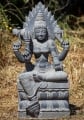
An ancient symbol of Hinduism, Adi Shakti, represents the sacred feminine. Her four symbolic weapons represent primal creative feminine power. The numerous weapons reflect the balance each individual female must make between woman and mother.
Not only is this a potent reminder of the balance women have always had to seek, but the innate and sacred power within us.
In fact, I’m all but convinced that women are so strong that Satan tried to set us up for inferiority for all eternity. When he chose Eve as the recipient of his tempting invitation in the garden, which he knew would enact the chain of events leading to (hu)man’s fall from grace, he did so with the full intent that the full blame would fall on her. She ate the forbidden fruit. She offered it to Adam. She instigated the break from God’s will. Never mind that he set her up. Thousands of years later Eve still bears the blame.
Childbirth was apparently meant to be painful, but the intensity ratcheting up a result of Eve’s transgression. Does this increase in pain (ie bad, negative) also lessen or taint the power of childbirth? At least in the eyes of male biblical scholars who punish the evil woman with it.
[I do find it interesting that Mary, the mother of Jesus, has been referred to as the ‘new Eve’, undoing the advent of sin ushered in by the first woman by bringing the life of her child – God’s child – into the world. Not to get too theological, but it does encourage me that perhaps the patriarchal tide will be spiritually stemmed – which many would find completely surprising coming from the Catholic Church!]
Another indicator of women’s strength is the fact that patriarchy pits us against each other. In our previous module, Propped up by Patriarchy, we started to explore this idea. That, in order to play by patriarchy’s rules, to achieve success in that paradigm, we often must out-play or cast out our female ‘competitors’.
A major reason Sarah McLachlan founded Lilith Fair was to fight the idea of record labels and promoters who often said, “but we already have a girl.”
It is the paradigm of patriarchy that there’s limited room for females in that space. At least a most favored or powerful one.
This idea is present in fairy tales even.
Snow White.
Historically, the Queen is an evil, hated character. But, “in the patriarchal Kingdom of the text these women inhabit the Queen’s life can be literally imperiled by her daughter’s beauty.” (The Madwoman in the Attic, Gilbert and Gubar) Is the Queen simply responding to the threat of her own demise? How devastating that her own power and vitality can’t exist alongside that of her burgeoning daughter.
It is not the men who create the ideal stereotype who endanger these women, mothers – at least not overtly. They’ve set the board for women to knock each other down.
In an article by Angie Hunt cited in the first module (Misguided Archetype), Kelly Oddenweller says “In some cases, [the ideal moms] are mothers who embody what our culture believes is a good mom and yet among mothers, they are treating each other very negatively.”
It is not that we live to tear others down; such attacks or negative attitudes come from insecurity. Fear of ‘looking bad’ or being less than fuels such animosity. And no woman I’ve known longs to be perfect or drive themselves into lunacy achieving insane standards.
No woman created the ideal mother.
Men, society encourage this to keep us from achieving our true power.
If we look back to Adi Shakti . . .

“Many of you will feel you don’t have the space or energy to pick up this sword, to recapture the true meaning of health, peace, and happiness. I argue that you don’t have the space or energy not to.”
Has society made you or your ways of being feel weak? How so?
- Reflect on these instances, either one or one at a time.
- What about these moments actually showed strength? Flip the paradigm and find the authenticity of your personal way of doing in that instance.
Where do you take up your sword?
- Do you feel the upside down quality of the paradigm and try to operate outside of it? How so?
- If you haven’t yet or can’t think of a time you did, find one now that, going forward, you can flip to your advantage. Write on how you’ll do things differently in that instance.
- Do you carve out time and space for you as a woman? Does doing so feel like a fight?
What is your relationship to the shield?
- Do you revel in protecting and caring? Is it an honor? Or a burden? Sit with this in writing for a few minutes.
- Do you find it challenging yet rewarding? Or do you feel it is thrust upon you (at least this version of it) by the misshapen paradigm?
- Reflect on ways you can wield the shield to best protect your version of motherhood.
 Chopping Potatoes
I’m reminded of a recent campaign by Brandi Carlisle to get female country artists more airplay on country radio, which is male dominated. Women’s contributions to music and society in general are undeniable and major(ity), yet these viewpoints are so underrepresented.
LikeLiked by 1 person
Yes, how sad that Carlisle and other female artists are still fighting the same fight! And, as you said, in greater society as well.
LikeLike